
Thinking your neighbor is solely responsible for that ceiling leak could cost you thousands in legal fees and repair bills. Many homeowners feel overwhelmed by the technical jargon and strict HDB rules, especially when worrying about accidentally damaging the waterproofing membrane in a new BTO. It’s frustrating to deal with the confusion of the 50/50 cost-sharing rule or the anxiety of hiring a contractor who might not be HDB-registered. You deserve a clear path to a leak-free home without the stress of hidden costs or regulatory non-compliance.
This guide will help you master the latest hdb toilet waterproofing regulations, technical standards, and permit requirements for 2026. We’ll show you how to ensure your renovation meets the Singapore Standard SS 637:2018 and survives the mandatory 24-hour water ponding test. You’ll get a direct, no-nonsense look at everything from the 3-year restriction on new flats to the exact steps for getting your HDB permit approved, ensuring your masonry and waterproofing works are done right the first time at a fair, transparent price.
Key Takeaways
- Learn why you must wait three years before hacking bathroom tiles in a new BTO flat to keep your HDB waterproofing warranty intact.
- Master the technical requirements of the hdb toilet waterproofing regulations, including mandatory 150mm wall upturns and compliance with SS 637:2018.
- Understand the specific scenarios where an HDB Renovation Permit is required to avoid heavy fines and ensure your contractor is properly registered.
- Get the facts on the 50/50 cost-sharing rule for inter-floor leaks so you know exactly who pays when seepage occurs between units.
- Save on renovation costs by hiring a direct contractor for tiling and masonry, cutting out interior design markups without sacrificing technical quality.
Understanding HDB Toilet Waterproofing: The 3-Year Rule & Warranty
Getting the keys to your new BTO flat is an exciting milestone, but your renovation plans must respect the structural limits of the building. The Housing & Development Board (HDB) manages Public housing in Singapore with strict guidelines to ensure every unit remains functional for decades. One of the most important rules you’ll encounter is the 3-year restriction period for bathroom works. This isn’t just red tape; it’s a technical safeguard for your home’s structural integrity.
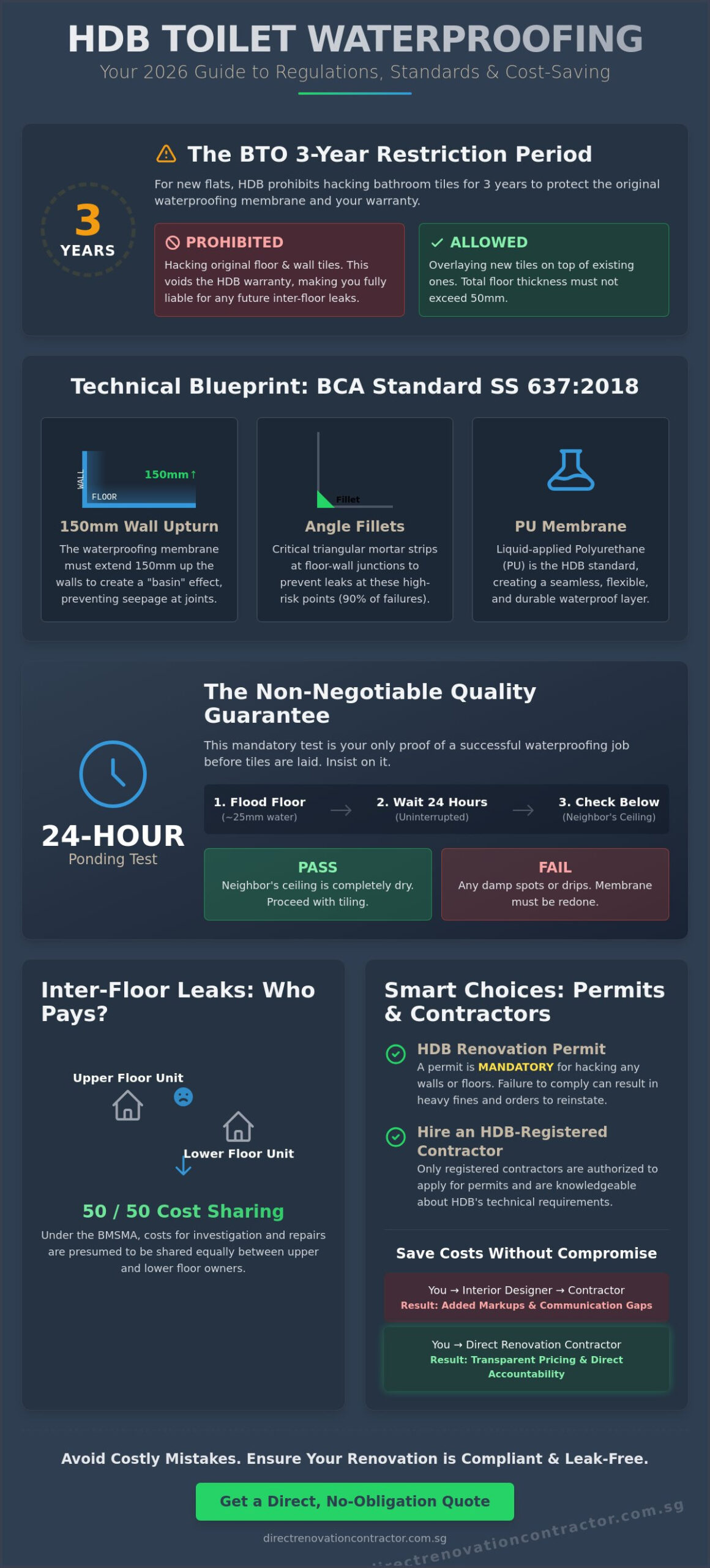
Under current hdb toilet waterproofing regulations, you’re prohibited from removing original floor and wall finishes in bathrooms for three years from the date the block is completed. During construction, HDB applies a specialized waterproofing membrane to prevent water from seeping through the concrete floor slab. Hacking these tiles too early risks puncturing this membrane. If you perform unauthorized hacking before the 3-year mark, you’ll be legally liable for any leaks that occur. You also void the HDB warranty, meaning you’ll have to pay for expensive repairs out of your own pocket if your neighbor downstairs reports a wet ceiling.
What the 3-Year Rule Prohibits vs. Allows
The 3-year rule is the mandatory cooling period for BTO structural works. While you can’t hack away the existing masonry, you aren’t completely stuck with the default look. HDB allows homeowners to overlay new tiles using approved adhesives. However, you must ensure the added weight doesn’t exceed safety limits and that the total thickness of the floor finishes stays within the 50mm cap. As a direct contractor, we often help owners choose lightweight tiles that refresh the space without violating these hdb toilet waterproofing regulations.
Claiming Under the HDB Defects Liability Period (DLP)
If you notice signs of seepage in your new toilet, don’t panic. For the first year, your flat is covered by the Defects Liability Period (DLP). You should report any leaks to your HDB Branch Office immediately so the original building contractor can fix the issue. After the first year, the Building Maintenance and Strata Management Act (BMSMA) typically governs how leaks are handled between neighbors. If a leak happens after the DLP but before the 3-year mark, HDB may still step in to investigate if the original membrane was faulty, provided you haven’t done any unauthorized hacking that would void your coverage.
Technical Standards for Waterproofing: BCA SS637 Compliance
You can’t rely on luck to keep your bathroom dry. In Singapore, the Building and Construction Authority (BCA) sets the mandatory bar with SS 637:2018. This is the Code of Practice for waterproofing reinforced concrete buildings, and it’s the standard every HDB-registered contractor must follow. If your contractor isn’t familiar with SS 637, you’re taking a massive risk with your property. This standard ensures that the waterproofing system is durable enough to handle daily water exposure for its expected 10 to 15 year lifespan.
Most HDB projects today use liquid-applied Polyurethane (PU) membranes. It’s a seamless layer that’s brushed or rolled on, making it perfect for the tight corners and pipe penetrations found in a typical bathroom. While torch-on membranes exist, they’re often too bulky for small HDB toilets. A vital part of these hdb toilet waterproofing regulations is the “upturn.” The membrane must climb at least 150mm up the wall and kerbs. This creates a “basin” effect, ensuring water doesn’t seep into the wall joints where the floor meets the masonry.
The 24-Hour Ponding Test: Your Quality Guarantee
Don’t let any tiles be laid until you’ve seen a successful ponding test. This is your only real proof that the membrane works before it’s covered up. Your contractor will seal the floor traps and flood the area with about 25mm of water. After 24 hours, you should ideally visit the neighbor living directly below you. Check their toilet ceiling for any dark spots, dampness, or dripping. If it’s bone dry, the test has passed. If there’s even a hint of moisture, the membrane has failed and must be reapplied from scratch. We always recommend engaging professional tiling and masonry works that include a documented ponding test for your legal protection.
Critical Junctions and Floor Trap Details
Water always finds the easiest path down, and about 90% of leaks happen at the joints where the floor meets the wall. To prevent this, we install “angle fillets.” These are small triangular strips of mortar placed in the corners to create a smooth, sloped transition for the waterproofing membrane. Without them, the membrane can easily crack if it’s forced into a sharp 90-degree angle. We also pay close attention to the area around the floor trap. Following hdb toilet waterproofing regulations means the membrane must be tucked properly into the pipe opening to prevent water from bypassing the drainage system entirely.
HDB Renovation Permits: Hacking vs. Tiling Regulations
Don’t risk a heavy fine or a legal headache by skipping the paperwork. Any work involving the replacement of toilet floor or wall finishes requires a valid HDB Renovation Permit. This is a non-negotiable part of hdb toilet waterproofing regulations. You must engage a contractor from the HDB Directory of Renovation Contractors (DRC). These HDB-registered firms are the only ones authorized to carry out these works because they understand the structural limits of your block and are held accountable for any damage to the building’s common property.
If you’re living in a resale flat older than three years, you have the green light to hack and replace your tiles, but the permit is still mandatory. HDB tracks these renovations to ensure that the structural reinforced concrete (RC) slab isn’t damaged during the process. We always advise homeowners to check their contractor’s credentials on the HDB website before signing any contract. Working with an unregistered “fly-by-night” worker might save you a few dollars upfront, but it leaves you with zero legal recourse if your waterproofing fails or if HDB discovers unauthorized works during a flat inspection.
The Permit Application Process for Homeowners
First, select your HDB-registered contractor. We usually handle the technical submission for our clients, but you must acknowledge the application through the HDB portal or the LifeSG app using your Singpass. Once HDB grants the permit, you’ll receive a digital copy that must be displayed at your unit’s entrance. For projects involving hacking, HDB enforces a strict 21-day completion window for all noisy works. You must also adhere to specific hours: noisy activities like drilling and hacking are only allowed between 9:00 a.m. and 5:00 p.m. on weekdays. You can’t perform these works on weekends or public holidays, and you must finish the heavy hacking within three consecutive days to minimize disturbance to your neighbors.
Hacking vs. Overlaying: A Regulatory Comparison
Choosing between hacking and overlaying is a major decision for any bathroom renovation. If you choose to hack, you’re legally required to replace the entire waterproofing membrane and conduct a new 24-hour ponding test. This is the “clean slate” approach that we recommend for long-term peace of mind. Overlaying, or tile-on-tile, is a faster option that doesn’t require a hacking permit, but it comes with strict hdb toilet waterproofing regulations regarding thickness. The total thickness of the new floor finishes and screed cannot exceed 50mm, and wall finishes must stay under 25mm. From a direct contractor’s perspective, hacking is the better investment. It allows us to inspect the concrete slab for hidden cracks and ensures a fresh 10 to 15 year lifespan for your waterproofing, which is a huge selling point for future buyers.
Inter-Floor Leaks: Legal Responsibility and Cost Sharing
Ceiling leaks are the most common source of friction between neighbors in HDB flats. When water starts dripping from above, it’s rarely a matter of “if” it will cause a dispute, but “how much” it will cost to fix. Understanding the legal framework is essential for every homeowner. Under HDB’s current guidelines, the responsibility for maintaining the inter-floor slab is shared between the upper and lower floor owners. This is the foundation of the 50/50 cost-sharing rule, which applies when a leak is caused by general wear and tear of the structure.
The first step in any dispute is identifying the root cause. Is it the floor slab’s waterproofing membrane or a leaking sanitary pipe? If the leak is from a pipe, the owner of that specific pipe bears the full cost of the repair. If it’s the slab, HDB’s Goodwill Repair Assistance (GRA) scheme often provides a solution. Under the GRA, HDB co-pays 50% of the repair cost. The remaining 50% is shared equally between the two flat owners, meaning each owner pays 25% of the total bill. This financial structure is a key part of hdb toilet waterproofing regulations designed to settle disputes without long legal battles.
Who Pays for the Repair? A Breakdown of Scenarios
The financial burden depends entirely on the timing and cause of the leak. In Scenario A, if you’re within the initial BTO warranty period, HDB typically handles the repair at no cost to either party. Scenario B covers older flats where the membrane has naturally degraded over its 10 to 15 year lifespan; here, the 50/50 split applies. Scenario C is the most contentious: if the leak is proven to be caused by recent renovation works in the upper unit, that owner is 100% responsible for all repairs. This is why adhering to technical hdb toilet waterproofing regulations during your renovation is so critical for your financial protection.
Steps to Take When You Spot a Ceiling Leak
Don’t wait for the damage to spread. Start by documenting everything immediately. Take clear photos and videos with timestamps to show the progression of the dampness. Next, contact your Town Council or HDB Branch Office to request an investigation. They will often send a technical officer to assess the situation and determine the source of the seepage. You should also engage a qualified HDB registered contractor to perform a joint inspection with your neighbor. Having a professional technical report makes it much harder for a neighbor to ignore the problem.
If communication breaks down, our “Direct Contractor” approach is to stay focused on the technical facts. Show your neighbor the inspection report and the official HDB guidelines. If they still won’t cooperate, your final legal recourse is the Community Disputes Resolution Tribunals (CDRT). The CDRT can issue a mandatory court order for the repair to proceed, but it’s always faster and cheaper to settle things through technical transparency. For a clear assessment of your bathroom’s condition and a fair price on repairs, get a direct quote for plumbing and waterproofing works from our team today.
Why Work with a Direct Contractor for HDB Waterproofing?
Hiring an interior design firm for a bathroom overhaul often means paying a 20% to 30% premium just for coordination. When it comes to structural integrity, you don’t need a middleman; you need a builder. By working with a direct contractor, you eliminate these unnecessary markups on masonry and plumbing work. You’re paying for the actual labor and raw materials like cement screed and PU membranes at factory-direct prices. This transparency ensures that every dollar of your budget goes into the floor, not into a designer’s commission.
Quality control is significantly higher when you can speak directly to the tiler and waterproofer. In a typical ID setup, technical instructions can get lost in translation. Following hdb toilet waterproofing regulations requires precision, especially with wall upturns and pipe sealing. A direct contractor manages these details on-site every day. We aren’t just coordinators; we’re builders who understand the ‘ins and outs’ of the local renovation landscape. This hands-on involvement is why we can guarantee compliance with hdb toilet waterproofing regulations without the confusion of a middleman.
The Value of Direct Masonry and Plumbing Expertise
Technical works like waterproofing require a contractor’s eye, not just a designer’s. A designer might focus on the tile pattern, but we focus on the angle fillets and the structural slab. We manage your HDB permit submissions directly, ensuring all hacking and tiling works comply with the latest standards from the start. This technical focus is a core part of successful Home Renovation in Singapore, where structural compliance is just as important as the final look. We take the guesswork out of the application process so you don’t have to worry about rejected permits or failed ponding tests.
Getting a Fair Quote for Your Toilet Renovation
A transparent masonry quote should always be broken down into specific stages. You should see clear costs for hacking, hauling of debris, floor screeding, and the waterproofing system itself. Be wary of “all-in” lump sums that hide the quality of materials used. While a “cheap” quote might save you money today, poor waterproofing often leads to rectification costs exceeding $5,000 once you factor in hacking the new tiles and legal disputes with neighbors. Don’t cut corners on the membrane or the skill of the person applying it. If you’re ready for a straightforward, no-nonsense renovation, Request a direct quote for your HDB toilet renovation today and get the technical quality your home deserves.
Protect Your Property with Expert Waterproofing and Masonry
As an HDB Registered Contractor, we offer factory-direct pricing and technical transparency that interior design firms simply can’t match. Our team manages your permit applications and technical compliance from start to finish, so you can focus on enjoying your new space. Don’t wait for a damp patch to appear on the ceiling before you take action. Get a Direct, Transparent Quote for Your HDB Waterproofing Works today. Your home deserves the protection of professional workmanship and honest, straightforward pricing.
Frequently Asked Questions
Do I need an HDB permit to change my toilet floor tiles?
Yes, you must obtain an HDB Renovation Permit before changing your toilet floor tiles. Any work involving the replacement of floor finishes or hacking of existing tiles is strictly regulated. This ensures that the structural integrity of the flat is maintained and that the works are carried out by a contractor from the HDB Directory of Renovation Contractors (DRC).
What is the HDB 3-year rule for toilet waterproofing?
The 3-year rule is a mandatory restriction that prohibits homeowners of new BTO flats from removing original bathroom floor and wall finishes for the first 36 months after the block’s completion. This rule exists to protect the waterproofing membrane installed by HDB. If you hack your tiles within this period, you’ll void your warranty and become fully liable for any inter-floor leaks that occur.
Who is responsible for a ceiling leak in an HDB flat after 5 years?
Responsibility for a ceiling leak after the warranty period is typically shared between the upper and lower floor owners. Under the Goodwill Repair Assistance (GRA) scheme, HDB often co-pays 50% of the repair cost, with the remaining 50% split equally (25% each) between the two neighbors. However, if the leak was caused by recent renovations in the upper unit, that owner is 100% responsible for the bill.
Can I use DIY waterproofing kits for my HDB toilet?
You shouldn’t use DIY kits for structural repairs as they don’t comply with the hdb toilet waterproofing regulations or the SS 637:2018 technical standards. While surface sealants might offer a temporary fix for minor dampness, they aren’t a substitute for professional membrane application. Any work involving hacking must be done by a registered contractor to ensure it passes the mandatory 24-hour ponding test.
How long does a professional HDB toilet waterproofing job take?
A standard hacking and re-waterproofing project usually takes between 4 to 7 working days to complete properly. This timeline includes one day for hacking and debris removal, one day for masonry screeding and membrane application, and a full 24 hours for the mandatory ponding test. Tiling and the installation of plumbing fixtures typically take another 2 to 3 days depending on the complexity of the layout.
What happens if my neighbor refuses to fix a leak coming from their toilet?
If a neighbor refuses to cooperate, you should contact your HDB Branch Office or Town Council to initiate a joint inspection. They will serve as a mediator to help both parties reach an agreement under the 50/50 cost-sharing framework. If the neighbor still refuses, your final legal option is to file a claim with the Community Disputes Resolution Tribunals (CDRT) to obtain a court order for the repairs.
Is a ponding test mandatory for HDB renovations?
Yes, a 24-hour water ponding test is mandatory whenever you replace the waterproofing membrane in an HDB toilet. Your contractor must flood the floor with roughly 25mm of water after the membrane has cured but before the new tiles are laid. This is the only technical way to ensure the hdb toilet waterproofing regulations have been met and that the unit below won’t suffer from seepage.
How much does HDB toilet waterproofing cost in 2026?
In 2026, costs vary based on the extent of the work required. Non-invasive repairs like Polyurethane (PU) injection grouting generally cost between $800 and $1,200. For a full hacking and re-waterproofing job, which involves removing all tiles and applying a new membrane, prices typically range from $1,500 to $3,000 per bathroom. These prices depend on the bathroom size and the specific materials chosen for the masonry works.