
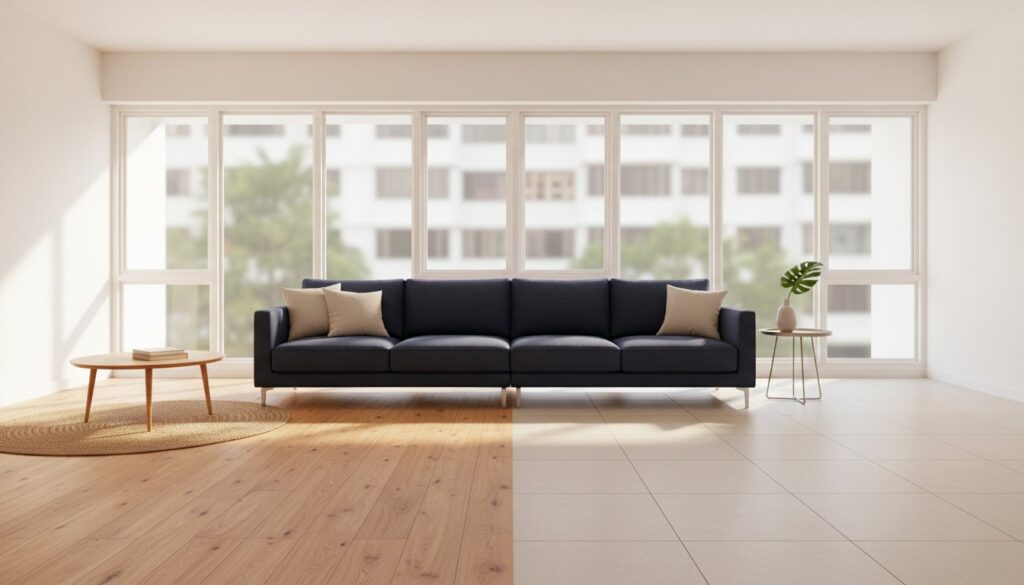
Choosing between vinyl flooring vs tiles for hdb isn’t just about picking a color; it’s a financial decision that can swing your renovation budget by over $5,000 depending on your unit type. You’ve likely heard conflicting horror stories about SPC warping or tiles popping, and the technical jargon like LVT or homogenous masonry only adds to the confusion. It’s frustrating to face hidden costs like cement screeding or hacking fees that weren’t in the initial quote. You want results, not jargon. You need a floor that lasts 15 years without paying a middleman markup.
I’m providing this pragmatic guide to help you choose the right material based on technical facts rather than sales pitches. We’ll break down the 2026 market rates for materials and labor, explain the strict HDB 50mm thickness rule, and reveal why your BTO’s 3-year wet area restriction might dictate your choice. This guide will give you the transparent pricing and technical clarity needed to secure a durable floor without the typical renovation anxieties.
Key Takeaways
- Understand the technical differences between SPC vinyl and porcelain tiles to select the right material for your unit’s specific floor conditions.
- Calculate the total project cost of vinyl flooring vs tiles for hdb by including essential wet works like cement screeding and debris disposal.
- Avoid costly compliance issues by following HDB regulations on floor thickness and the mandatory three-year restriction for BTO wet area renovations.
- Compare the long-term durability of each material against Singapore’s humidity to prevent common issues like tile popping or vinyl warping.
- Save on your renovation budget by engaging a direct contractor to handle hacking and installation without paying for unnecessary middleman markups.
Understanding Your Options: Vinyl Planks vs. Ceramic Tiles for HDB Flats
Deciding on vinyl flooring vs tiles for hdb starts with understanding that materials have evolved significantly by 2026. You aren’t just choosing between plastic and stone; you’re choosing between different engineering standards. Vinyl has moved beyond the thin, sticky sheets of the past. Modern options like SPC (Stone Plastic Composite) offer a rigid core that handles Singapore’s humidity much better than older Vinyl composition tile or LVT (Luxury Vinyl Tile). While LVT is flexible and soft underfoot, it’s more prone to expansion. SPC is the direct contractor’s choice for stability in a tropical climate.
Tiles remain the traditional heavyweight for local homes. Ceramic tiles are cost-effective but porous, which can lead to issues if they aren’t sealed correctly. Porcelain tiles are denser and more durable, making them ideal for high foot traffic. Homogenous tiles are the top tier because the color and material are consistent through the entire body. If you chip a homogenous tile, the damage is almost invisible. Tiles provide a cooling effect that many Singaporeans appreciate, whereas vinyl feels warmer and softer. In 2026, we see more homeowners choosing a hybrid approach: tiles for the kitchen and toilets, and vinyl for the living room and bedrooms to balance comfort and utility.
The Anatomy of Modern Vinyl Flooring
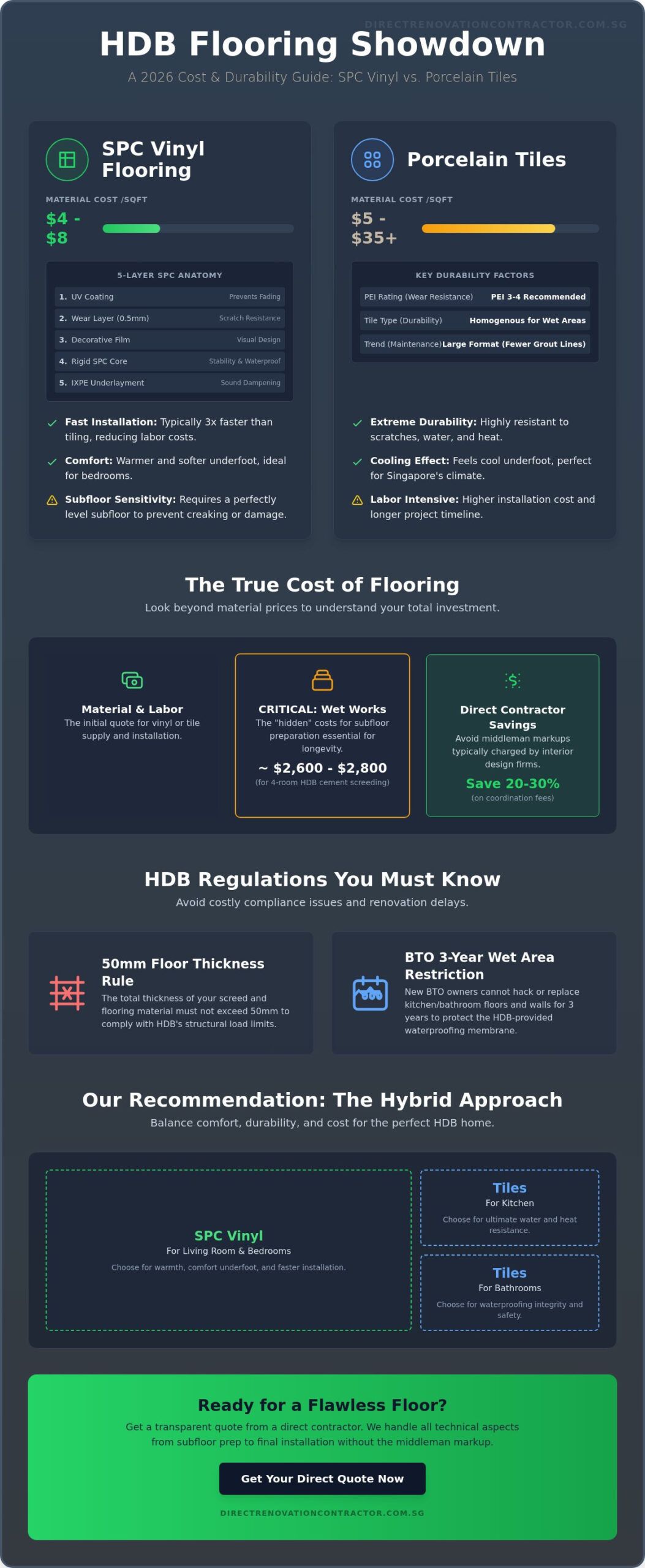
High-quality SPC vinyl isn’t a single slab of plastic. It’s a 5-layer system. It starts with a UV coating to prevent fading, followed by a transparent wear layer. This wear layer is critical. For HDB flats with heavy foot traffic, we recommend a thickness of at least 0.5mm. Below that is the decorative print film and the rigid SPC core. The final layer is usually a built-in IXPE underlayment for sound dampening. We use click-lock systems exclusively. This creates a floating floor that handles minor subfloor imperfections without needing messy adhesives that can fail over time.
The Durability of Masonry and Tiling
The True Cost of Flooring: Installation, Screeding, and Hacking Fees
Comparing vinyl flooring vs tiles for hdb requires looking past the price tag on the sample board. In 2026, standard vinyl material costs range from $4 to $8 per square foot, while tiles can swing wildly from $5 to $35. However, tiles are labor-intensive. Tiling requires a skilled mason to mix mortar, lay each piece with precision, and apply grout; a process that takes three times longer than a vinyl installation. When you work with a direct renovation contractor, you eliminate the 20% to 30% coordination fee typically charged by interior design firms. You pay for the actual man-hours and raw materials, keeping your budget transparent and focused on quality workmanship.
Vinyl installation is faster, but it’s rarely just about the planks. While global discussions on vinyl flooring durability highlight its cost-effectiveness, Singaporean homeowners must factor in local masonry requirements. If your subfloor isn’t perfectly level, your expensive SPC vinyl will eventually click, creak, or even snap at the joints. We prioritize technical integrity over quick fixes. This means we often recommend a self-levelling compound or a proper cement screed base to ensure your floor remains flat for the next decade. Skipping this step is the primary cause of vinyl failure in HDB flats.
Screeding and Subfloor Preparation
New BTO owners often face a surprise cost: the subfloor. HDB provides the structural slab, but it’s rarely smooth enough for direct vinyl application. You must budget for cement screeding, which currently costs approximately $2,600 to $2,800 for a standard 4-room flat. HDB regulations mandate the use of pre-packed screed for dry areas. If your floor has significant dips, we use self-levelling compounds. These are more expensive than standard screed but essential for a professional vinyl finish. Without a level base, the “hollow” sound under vinyl becomes a permanent annoyance.
Labour and Masonry Charges
For resale units, hacking is the biggest hurdle. Removing existing tiles costs between $400 and $700 per area. This doesn’t include the cost of hauling away debris and the mandatory HDB permits. Once the floor is bare, masonry charges for tiling include the application of grout. We recommend epoxy grout for kitchens and toilets; it’s stain-resistant and won’t turn black like standard cement grout. Finally, don’t forget the skirting. While PVC skirting is a budget-friendly match for vinyl, matching tile skirting requires more masonry hours but offers a much more durable, premium finish that resists vacuum cleaner impacts.
Durability and Maintenance: Which Material Survives the Singaporean Climate?
Singapore’s relentless humidity and high temperatures put immense stress on your floors. When comparing vinyl flooring vs tiles for hdb, you must consider how these materials react to thermal expansion. Tiles are naturally inert and handle heat exceptionally well. They won’t warp even if your living room receives direct afternoon sun. Vinyl has improved with the introduction of Stone Plastic Composite (SPC) cores, which are much more stable than older LVT options. However, even high-quality SPC can expand slightly. We always leave a 3mm to 5mm expansion gap along the perimeter of the room, hidden by skirting, to prevent the floor from buckling. This is a technical requirement that direct contractors never skip.
Waterproofing remains the primary reason tiles dominate kitchens and toilets. While SPC vinyl is marketed as 100% waterproof, the weak point is the click-lock joint. If water seeps through these joints and stays trapped on the subfloor, it can cause mold or damage the underlying cement screed. In contrast, properly laid porcelain tiles with a waterproofing membrane are impenetrable. This is why HDB enforces a 3-year restriction on hacking bathroom tiles in new BTOs. They want to ensure the original waterproofing remains intact. If you’re renovating a kitchen, we strongly advise tiles over vinyl for better long-term structural integrity.
Pet owners often ask about scratch resistance. Glazed porcelain tiles are nearly impossible for a dog to scratch. SPC vinyl is also highly durable, but a very heavy or sharp object can eventually gouge the wear layer. If you have large pets, we recommend tiles for the main living areas. We also address the “popping tile” phenomenon, which often scares resale buyers. This usually happens because of poor masonry workmanship or insufficient joint spacing. We prevent this by using high-quality C2 grade tile adhesive and ensuring every tile has a consistent 2mm to 3mm grout joint to allow for natural movement during temperature swings.
Long-term Maintenance Requirements
Maintenance routines differ significantly between the two materials. You should never use a steam mop on vinyl. The high heat can delaminate the layers and weaken the click-lock system over time. A simple damp microfiber mop is enough. For tiles, the main headache is the grout. Over time, cement-based grout absorbs dirt and turns black. We suggest using a grout sealer or upgrading to epoxy grout during installation. If a tile cracks, replacing it is a messy job involving a hammer and chisel. Replacing a vinyl plank is faster, provided you have leftover stock from the original installation batch.
Health and Safety: VOCs and Slip Resistance
Safety is a priority for multi-generational HDB households. We only supply vinyl that meets low VOC (Volatile Organic Compound) standards, ensuring your indoor air quality is safe for children. For elderly-friendly homes, we look at slip resistance ratings. An R9 rating is standard for living rooms, but we recommend R10 or R11 for kitchens and R12 for toilets. Tiles are also the hypoallergenic choice. They don’t trap dust or pet dander, making them the better option for family members with asthma or allergies. We provide specific tile recommendations based on these ratings during our site measurements.
HDB Regulations and Installation: BTO vs. Resale Considerations
HDB regulations are strict for a reason. They protect the structural integrity of the block and your neighbors’ units. When you’re deciding between vinyl flooring vs tiles for hdb, your flat type dictates your legal boundaries. New BTO owners face a mandatory three-year restriction on hacking bathroom tiles to protect the original waterproofing membrane. If you ignore this, you risk heavy fines and liability for any leaks into the unit below. Engaging an HDB registered contractor ensures all permits are filed correctly and that your renovation stays within the mandatory 50mm floor thickness limit. This 50mm rule includes both your screed and the final floor finish.
Permit approval typically takes three to seven working days. We handle the documentation for you, including the submission of floor plans and the specific hacking permit. For resale units, hacking is often necessary to reach the raw slab, especially if the previous owner already overlaid a floor. HDB rules state you can only have one layer of flooring on top of the original tiles. Stacking multiple layers adds excessive weight to the building structure and is a direct violation of housing standards. We always verify the existing floor layers during our initial site visit to avoid mid-project legal complications.
Overlaying Vinyl on Existing Tiles
Overlaying is the most efficient way to save money on a resale renovation. You skip hacking costs and debris disposal fees entirely. However, we only recommend this if the base tiles are structurally sound. We check for “hollow” sounds by tapping the existing tiles across the entire flat. If more than 10% of the area sounds hollow, an overlay will eventually fail as the base shifts. One common oversight is door trimming. Adding 5mm of vinyl on top of tiles means your bedroom doors might scrape the floor. We include professional door trimming in our technical assessment to ensure a smooth finish.
Hacking and New Masonry Works
If you’re gutting a resale flat, hacking is unavoidable. This process costs between $400 and $700 per area, depending on the floor size and material. Once the old tiles are removed, we must apply a new waterproofing membrane in wet areas. HDB guidelines are very specific here; the waterproofing must extend up the wall by at least 150mm. Debris disposal is another technicality we manage. We haul all hacked materials to approved disposal sites, ensuring you don’t face penalties for illegal dumping in common HDB areas. For a clear breakdown of these technical costs, you can view our HDB resale renovation packages.
Making the Right Choice: Room-by-Room Flooring Recommendations
Selecting the winner in the battle of vinyl flooring vs tiles for hdb depends on the specific demands of each room. We don’t believe in a one-size-fits-all solution. A pragmatic homeowner often chooses a hybrid approach to balance comfort, cost, and long-term durability. For living rooms and bedrooms, vinyl is the preferred choice. It’s softer underfoot and provides a warmer feel when you step out of bed. Since these are dry areas, the risk of water seepage is minimal, allowing you to enjoy the aesthetic of wood grains without the high cost of real timber.
Kitchens and bathrooms require a different technical standard. We always recommend heavy-duty porcelain tiles for these zones. Kitchens face heavy appliance weight, dropped pots, and frequent grease spills. Porcelain is dense enough to resist impact damage that might gouge the wear layer of a vinyl plank. In bathrooms, tiling is non-negotiable. HDB waterproofing standards are designed around masonry works. Installing vinyl in a shower area is a recipe for subfloor mold and adhesive failure within 24 months. Stick to tiles for any area that sees standing water.
Balconies are another area where tiles outperform vinyl. Even with the improved stability of 2026 SPC vinyl, constant exposure to direct UV rays and tropical rain can lead to fading or joint expansion. UV-resistant outdoor tiles or homogenous masonry handle the elements much better. This ensures your balcony floor lasts the full 15 years without needing a mid-life replacement. By matching the right material to the right environment, you maximize the lifespan of your renovation budget.
The Hybrid Approach to HDB Flooring
You can transition between different materials seamlessly if you plan the subfloor heights early. We use two main methods for transitions:
- Transition Strips: These T-mouldings are the most cost-effective and allow for the necessary expansion gaps between vinyl and tile.
- Flush Joints: This requires precise screeding. We calculate the height difference between a 5mm vinyl plank and a 10mm tile during the masonry phase to ensure a perfectly level walk-through.
We suggest coordinating colors by matching the undertones of your vinyl wood grain with the grout or base color of your stone-look tiles. This creates a cohesive flow throughout the flat.
Final Decision Checklist for 2026
Before you commit to a material, run through this technical checklist to ensure your choice fits your 15-year plan:
- Budget vs. Lifespan: Are you looking for the lowest upfront cost (Vinyl) or the lowest cost over 20 years (Tiles)?
- Lifestyle Check: Do you have large pets that might scratch a wear layer, or children who need a softer surface for play?
- Cooking Habits: Do you engage in heavy “wok hei” cooking? If so, tiles are significantly easier to degrease.
Once you’ve decided on your room-by-room layout, get a direct carpentry and flooring quote to see your actual savings. Eliminating middleman markups allows you to invest more in high-quality materials that stand the test of time.
Securing Your HDB Investment for the Next Decade
Your HDB flooring is a 15-year commitment that requires technical foresight. Choosing between vinyl flooring vs tiles for hdb isn’t just a design choice; it’s a structural decision. You’ve learned that while SPC vinyl offers comfort for bedrooms, porcelain tiles are non-negotiable for wet areas like kitchens and toilets. Success depends on proper subfloor preparation and following HDB’s 50mm thickness regulations to avoid future legal or structural issues. Focus on the integrity of the installation to prevent common problems like popping tiles or warping planks.
We operate as an HDB Registered Contractor to give you peace of mind and factory-direct material pricing. Our expert masonry and carpentry teams work directly with you, ensuring there are no hidden costs or middleman markups. We prioritize functional results and financial transparency in every project we handle across Singapore. Skip the ID markups and get a direct quote for your HDB flooring today. We look forward to helping you create a durable, high-quality home that fits your budget perfectly.
Frequently Asked Questions
Is vinyl flooring better than tiles for a 4-room HDB flat?
The better choice depends on your budget and how long you plan to stay. Vinyl is faster and more cost-effective for living areas, with a standard 4-room flat installation costing between $3,000 and $7,000. Tiles offer superior long-term durability and are better for wet zones. We often recommend a hybrid approach to balance comfort in the bedrooms with the heavy-duty resilience of tiles in the kitchen.
Can I install vinyl flooring over my existing HDB tiles?
You can overlay vinyl on existing tiles without an HDB permit, provided the base layer is sound. The total thickness of the new floor and adhesive must not exceed 13mm. We only proceed with an overlay if your current tiles aren’t hollow or cracked. If the base layer is unstable, the vinyl joints will eventually snap. We always conduct a tap test during site measurement to verify integrity.
How much does it cost to hack HDB floor tiles in 2026?
Hacking existing floor tiles currently costs between $400 and $700 per area. For a complete 4-room flat overhaul, total hacking and disposal fees can reach up to $6,100. These prices include the labor for demolition and the hauling of debris to approved disposal sites. We manage the HDB permit applications to ensure your renovation complies with all noise and safety standards without hidden coordination fees.
Does vinyl flooring emit toxic gases (VOCs)?
Modern vinyl flooring meets strict low-VOC standards to ensure indoor air quality is safe for residential use. We only supply materials that have been certified for low emissions. While older products had higher chemical levels, current SPC options are much safer for families and pets. We provide technical data sheets for all our flooring products so you can verify the safety ratings before the installation begins.
Why are my HDB floor tiles popping or cracking?
Tiles usually pop due to thermal expansion or poor masonry workmanship during the original installation. If the contractor didn’t leave enough room for natural movement, the tiles press against each other and lift. Insufficient adhesive or uneven cement screeding also contributes to this problem. We prevent this by using high-quality C2 grade adhesive and ensuring consistent 2mm to 3mm grout lines across the entire floor area.
How long does a vinyl floor last compared to tiles in Singapore?
Vinyl flooring has a typical life expectancy of 10 to 20 years in a Singaporean environment. Tiles are significantly more durable and can easily last over 20 years with basic maintenance. When comparing vinyl flooring vs tiles for hdb, consider that vinyl is easier to replace if you want a fresh look, but tiles offer the best lifetime value for homeowners who want a permanent flooring solution.
Do I need an HDB permit to change my flooring?
You need an HDB permit for any works that involve hacking and replacing existing floor tiles. A permit is not required if you are laying vinyl flooring as an overlay or directly on the subfloor. As a direct contractor, we handle the submission of all necessary documentation for hacking works. This ensures your project follows the mandatory 50mm thickness rule and avoids any legal complications during the renovation.
Is SPC vinyl really 100% waterproof for HDB kitchens?
The SPC material itself is 100% waterproof, but the click-lock joints are not completely airtight. If water sits on the floor for extended periods, it can seep through the seams and cause mold on the subfloor. For heavy-duty kitchens, porcelain tiles remain the superior choice. If you choose vinyl flooring vs tiles for hdb in your kitchen, you must wipe up spills immediately to protect the structural integrity of the installation.