
Engaging an interior designer can cost you 30% to 50% more than working directly with a registered contractor for the exact same renovation outcome. It’s a significant financial gap that many Singaporean homeowners don’t realize exists until the final invoice arrives. You’re likely feeling the pressure of balancing a strict budget against the fear of heavy HDB penalties for unauthorized hacking or structural errors. It’s a common anxiety; nobody wants their dream home renovation stalled because they lacked a valid hdb renovation permit or hired an unregistered firm.
This 2026 guide is designed to remove that uncertainty. You’ll learn exactly how to identify and verify a legitimate HDB registered contractor who can handle your project safely and legally. We’ll cut through the confusion between BCA and HDB requirements to ensure your renovation stays compliant from day one. By the end of this article, you’ll know how to secure direct-to-factory pricing and professional workmanship without the hidden markups of an intermediary. This approach gives you total control over your home’s structural integrity and your renovation budget.
Key Takeaways
- Understand the legal necessity of the Directory of Renovation Contractors (DRC) and how it protects your home’s structural integrity.
- Learn the process for obtaining an hdb renovation permit to ensure all hacking and masonry works are fully compliant with 2026 regulations.
- Compare the financial models of interior designers versus direct contractors to eliminate unnecessary middleman coordination fees.
- Use our 2-step verification checklist to check a contractor’s demerit points and training history on the official HDB portal.
- Discover the benefits of a direct-to-factory renovation model for achieving high-quality carpentry and masonry at transparent prices.
What is an HDB Registered Contractor and Why is it Mandatory?
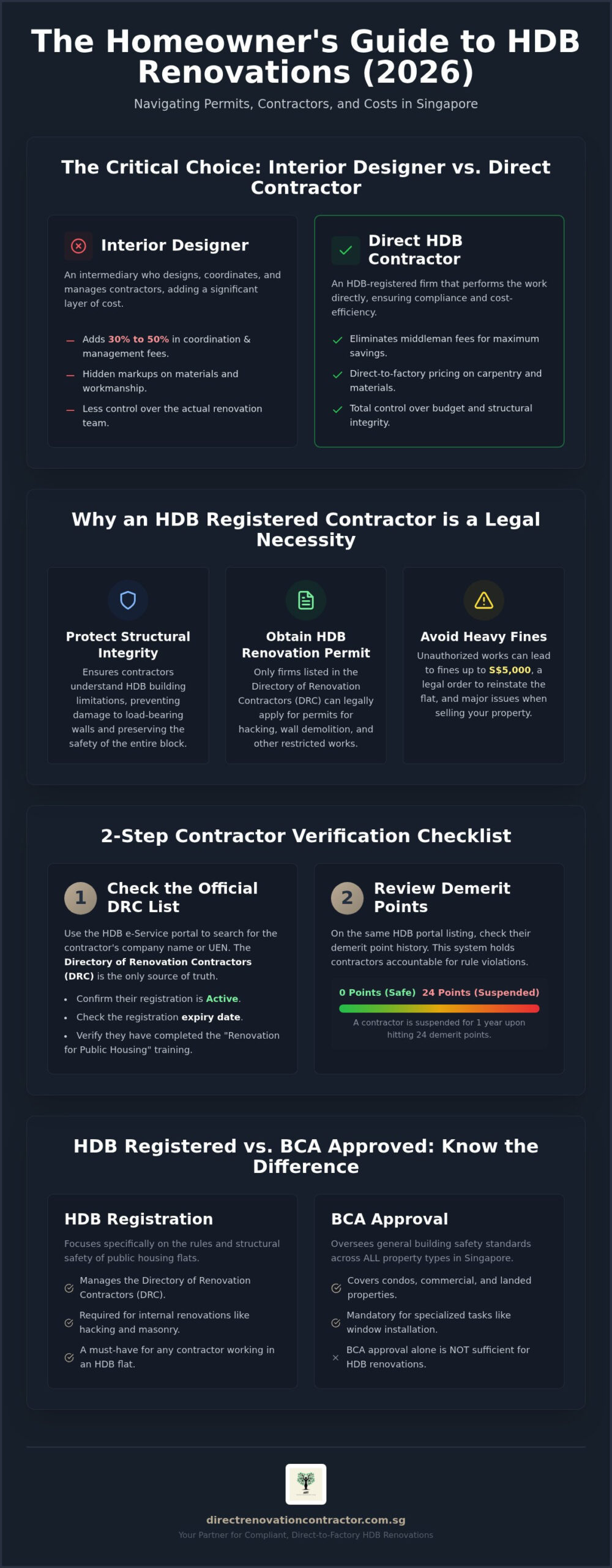
An HDB Registered Contractor is a firm trained to follow HDB’s strict renovation guidelines to prevent structural damage. This isn’t just a professional label; it’s a mandatory legal requirement managed by the Housing & Development Board (HDB) through their Directory of Renovation Contractors (DRC). The DRC acts as a critical safeguard for Singapore’s public housing ecosystem. It ensures that every company performing work inside your flat understands the technical limitations and architectural requirements of the building.
You cannot simply hire any general handyman to hack walls or change your floor finishes. These specific activities require a valid hdb renovation permit, and HDB regulations state that only a registered contractor can apply for this permit on your behalf. HDB blocks are designed with load-bearing structures and sensitive waterproofing membranes. If an untrained worker hacks a wall that provides structural support or damages communal piping, the integrity of the entire block is at risk. Using a registered firm ensures your home remains safe for your family and your neighbors.
The Legal Consequences of Using Non-Registered Contractors
Ignoring these regulations carries heavy risks that go beyond a simple warning. If HDB discovers unauthorized works or the use of an unregistered contractor, you can face fines of up to S$5,000 or more. Beyond the financial penalty, HDB has the authority to demand that you reinstate the flat to its original condition at your own expense. This means you’ll pay twice; once for the illegal renovation and once more to tear it all down. These records stay with the property. When you decide to sell, any illegal renovations found during the pre-sale inspection will stall the transaction and likely slash your resale value.
BCA Approved vs. HDB Registered: Knowing the Difference
Homeowners often confuse the Building and Construction Authority (BCA) with HDB. The BCA oversees general building safety and standards across all property types in Singapore, including condos and commercial spaces. HDB focuses specifically on the rules governing public housing flats. While a firm might be BCA-registered, they must still be on the DRC list to work on HDB units. These two agencies collaborate to regulate the industry, ensuring that your hdb renovation permit covers internal changes while specialized safety standards are met.
Window works are a unique area where these regulations overlap. All window installations or replacements must be carried out by a BCA-approved window contractor. This is because falling windows pose a severe public safety risk. Hiring a direct contractor who understands these nuances simplifies the process and keeps your project entirely above board. It’s about technical competence and following the law to avoid future headaches.
The Directory of Renovation Contractors (DRC) Explained
A flashy showroom in a high-end mall doesn’t guarantee a safe renovation. The real proof of a firm’s legitimacy is found in the Directory of Renovation Contractors (DRC). This database is the official registry for firms that have completed the mandatory “Renovation for Public Housing” training. This isn’t a design course. It’s a technical program that teaches contractors how to protect the structural integrity of HDB blocks while managing noise and debris. If a firm isn’t on this list, they cannot legally apply for your hdb renovation permit.
HDB uses a demerit point system to police these contractors. Points are issued for various infractions, such as failing to protect common property or performing hacking works without approval. If a contractor hits 24 demerit points within a 24-month window, they’re suspended from the directory for a full year. This system ensures that only those who respect the rules stay in business. You should also look for CaseTrust accreditation; these firms are vetted for fair trading and enjoy a five-year listing period compared to the standard four-year cycle for other registered contractors.
How to Use the HDB e-Service to Verify a Contractor
Verifying a firm’s status takes less than five minutes. Use the HDB e-Service portal to search by the company’s name or Unique Entity Number (UEN). Once you find the listing, look closely at the expiry date. If their registration is set to expire next month and they haven’t renewed, you’re taking a risk. More importantly, check the demerit point tally. A firm with a clean record is always a safer bet than one with multiple active penalties. Checking these details before you pay a deposit is the best way to avoid renovation scams.
The Criteria for a Firm to Join the DRC
The entry requirements for the DRC are strict to protect homeowners. A business must have at least three years of proven experience in the construction industry and a clean track record with no major legal disputes. Additionally, the firm’s directors and site supervisors must pass a specific HDB training course. This ensures they can navigate the complexities of modern HDB blocks, including the 3-year restriction on hacking BTO bathroom tiles. Choosing a qualified direct renovation contractor means you’re hiring experts who already know these rules inside out, saving you from potential fines and structural errors.
HDB Registered ID vs. Direct Contractor: The Cost Gap
Choosing between an interior designer (ID) and a direct contractor is a financial decision as much as a creative one. Most ID firms in Singapore operate primarily as project managers. While they might be the ones submitting your hdb renovation permit, they rarely employ the tilers or carpenters who actually step into your flat. Instead, they outsource the physical work to direct contractors and add a management fee to every line item in your quote. This intermediary layer can increase your total renovation cost by 30% or more without necessarily improving the final quality of the workmanship.
Direct contractors like Direct Renovation Contractor Singapore offer factory-direct pricing by eliminating the ID middleman. We handle the technical site assessments and the manual labor in-house. This streamlined model allows us to pass the savings directly to you. You aren’t paying for a designer’s expensive marketing budget or a fancy showroom lease in the city; you’re paying for the raw materials and the technical skill required to transform your space. It’s a pragmatic approach that prioritizes your budget and the structural integrity of your home.
Hidden Markups in Interior Design Quotes
Transparency is often lacking in traditional ID quotes. Markups are frequently buried in high-volume trades like carpentry, tiling, and electrical works. A designer might charge S$150 per foot for a cabinet that actually costs S$100 to build, pocketing the difference as a coordination fee. There is also a persistent referral fee culture where tile, lighting, and bathroom fixture suppliers pay IDs a commission for every customer they bring in. To see how these undisclosed fees impact your bottom line, read the Direct Renovation Contractor Singapore: The 2026 Comparison Guide.
When to Choose a Direct Contractor Over an ID
This path is best for homeowners who have a clear vision and want to maximize their budget. If you’ve already spent hours researching styles and know exactly what you want, you don’t need to pay someone else to curate your choices. It’s especially effective for targeted works like hiring a carpenter singapore homeowners rely on for custom wardrobes or kitchen cabinets. Our DIY Renovation Support Package is designed for this specific group. It bridges the gap by providing professional 3D drawings for your hdb renovation permit application while allowing you to enjoy direct contractor rates for the actual construction.
Checklist: How to Hire an HDB Registered Contractor in 2026
Hiring a contractor is a technical partnership, not just a financial transaction. In 2026, the Singapore renovation market is crowded with intermediaries and marketing firms. You need a structured vetting process to ensure your money buys actual labor and materials, not just coordination fees. Following a logical checklist helps you filter out fly-by-night operators and identify professionals who respect HDB’s structural guidelines.
- Verify DRC status and demerit points: Use the official HDB portal to confirm the firm is active. A clean record indicates they follow safety protocols and manage noise levels correctly.
- Request a detailed quote breakdown: Never accept a “lump sum” price. A professional quote should specify linear footage for carpentry and area measurements for tiling. This prevents hidden markups and ensures you pay for exactly what is installed.
- Visit their physical workshop: Legitimate direct contractors often operate out of dedicated industrial facilities. Seeing a physical workshop proves they have the machinery and staff to handle your project in-house.
- Confirm the site supervisor: Ask for the name of the person who will actually be on-site. You need a single point of contact who is accountable for daily progress and safety.
- Verify permit applications: Ensure that every hdb renovation permit is applied for under the firm’s registered name. This links the contractor legally to the work performed in your flat.
Essential Questions to Ask During the First Meeting
Red Flags to Watch Out For
Avoid contractors who demand a 50% deposit before any work begins. A standard, fair payment schedule is typically 10% to 20% upon signing, with subsequent payments tied to completed milestones. Be wary of firms that claim a permit isn’t necessary for hacking works. This is a major liability that could lead to structural damage and heavy fines. If you receive a generic quote that lacks material specifications or measurements, it’s likely a sign of future “hidden costs.” To avoid these traps, work with a direct renovation contractor who prioritizes transparent, line-item billing.
Why Direct Renovation Contractor is the Right HDB Partner
Direct Renovation Contractor Singapore operates with a clear mission: providing high-quality, legally compliant renovations without the unnecessary overhead of a design firm. We are fully registered with HDB and strictly adhere to all 2026 renovation guidelines. This ensures your home isn’t just aesthetically pleasing but structurally sound and fully authorized. We take the technical burden off your shoulders by managing the entire hdb renovation permit application process from start to finish. Our team understands the specific requirements for different flat types, ensuring that your project moves from approval to execution without legal delays.
Our direct-to-consumer model is built on transparency. Because we own our production facilities in Paya Ubi Industrial Park, we control both the quality and the cost of your custom carpentry. You aren’t paying for a middleman’s commission or a salesperson’s referral fee. Whether you’re looking for specific hdb renovation in singapore for a new BTO or a complex overhaul of an older resale flat, our packages are designed to provide maximum value. We focus on functional results and technical competence rather than high-concept artistic visions that often inflate budgets unnecessarily.
Our Expertise in HDB-Specific Works
We specialize in the heavy lifting of renovation. This includes professional masonry, plumbing, and electrical installations that meet current safety standards. Our in-house team handles the hacking and demolition works, ensuring no load-bearing walls are compromised. By keeping these core trades in-house, we maintain a steady project rhythm and a predictable completion timeline. You get the peace of mind that comes from working with a seasoned professional who understands the nuances of Singapore’s public housing infrastructure. We don’t just build; we ensure the structural integrity of your block is respected at every stage.
Transparent Pricing and Technical Competence
Our quotes are declarative and final. We reject the practice of undisclosed coordination fees and intermediary commissions. When you receive a quote from us, it includes a clear, line-item breakdown of labor and material costs. This financial clarity is a cornerstone of our business model and a verbal seal of our quality. We believe a successful renovation is one that’s finished on time, within budget, and in full compliance with local laws. This pragmatic approach appeals to savvy homeowners who value hard work and straightforward communication over flashy presentations. Get a transparent quote from an HDB Registered Contractor today to see the difference a direct model makes for your hdb renovation permit and your overall project budget.
Secure Your Direct Renovation Today
Building a home in Singapore shouldn’t involve navigating hidden fees or worrying about structural integrity. You’ve seen how verifying a contractor’s record in the DRC protects your investment and why the direct-to-factory model is the most cost-effective path for savvy homeowners. By choosing a firm that handles its own carpentry and site supervision, you ensure that every dollar spent goes directly into the quality of your flat rather than an intermediary’s pocket. This transparency is the cornerstone of a stress-free renovation.
We take the technical complexity out of your hands by managing the entire hdb renovation permit application and ensuring all works meet BCA standards. Our Paya Ubi workshop is ready to fabricate custom solutions for your space without the standard ID markups. It’s about getting professional workmanship at a fair, transparent price from a homegrown expert who knows the local landscape inside out.
To complement your new home’s design and security, you can learn more about the high-quality digital locks and gates offered by AN Digital Lock.
Browse our HDB BTO & Resale Renovation Packages to start your project with a partner who values technical competence as much as you do. Your dream home is well within reach when you choose a direct, registered expert.
Frequently Asked Questions
Do I really need an HDB registered contractor for minor works like painting?
Yes, you must engage a contractor from the Directory of Renovation Contractors (DRC) for all works, even minor ones like painting or basic carpentry. While these simple tasks don’t require a specific hdb renovation permit, HDB regulations mandate that any person hired to perform work in your flat must be registered. This ensures that all workers on the premises are aware of and follow the required safety and noise protocols.
How long does it take for HDB to approve a renovation permit?
HDB typically approves a renovation permit within three working days for standard requests that don’t involve complex structural changes. If your project includes extensive hacking or masonry, the review process can take up to three weeks. Your contractor submits the application through the HDB e-Service portal, and you’ll receive an SMS notification once the approval is granted.
What happens if my contractor loses their HDB registration mid-project?
If a contractor is suspended or removed from the DRC during your renovation, they are legally prohibited from continuing any work on your flat. You’ll need to terminate your agreement and engage a new registered firm to complete the remaining tasks. This is why we recommend checking a contractor’s demerit points and registration expiry date before you commit to any down payment.
Can I hire an ID who is not HDB registered if they hire a registered sub-contractor?
You shouldn’t sign a contract with an unregistered interior designer for the actual construction work. The firm that applies for your hdb renovation permit must be the same one you have a direct contract with. Hiring an unregistered ID who then outsources to a registered firm creates a messy legal grey area and often results in higher middleman markups without adding technical value.
How much does an HDB renovation permit cost in 2026?
The administrative fee for an HDB renovation permit application typically ranges from S$20 to S$75 in 2026. This fee is paid directly to HDB during the electronic submission process. While the fee itself is small, the permit is your most important document, as it proves your renovation is legal and that your hacking works won’t compromise the building’s structural integrity.
Is CaseTrust accreditation mandatory for HDB registered contractors?
CaseTrust accreditation isn’t mandatory, but it’s a helpful indicator of a firm’s reliability and fair trading practices. Contractors with this accreditation are listed in the DRC for a longer period of five years compared to the standard four years for non-accredited firms. It’s a useful benchmark for homeowners who want extra assurance regarding a contractor’s financial transparency.
What is the standard payment schedule for HDB renovations?
A pragmatic payment schedule usually starts with a 10% to 20% deposit upon signing. You then make progressive payments as milestones are reached, such as 30% after hacking and masonry works are finished. You should always retain the final 5% to 10% of the contract value until all defects are rectified and the site is cleared to your satisfaction.
Can I do my own DIY renovation without any HDB registered contractor?
You cannot perform your own renovation if the works involve hacking, masonry, or specialized electrical and plumbing installations. HDB rules require these tasks to be carried out by DRC-listed professionals to maintain the safety standards of the block. While you can handle simple decor or assembly of loose furniture, any structural or utility changes must be handled by a registered partner.