
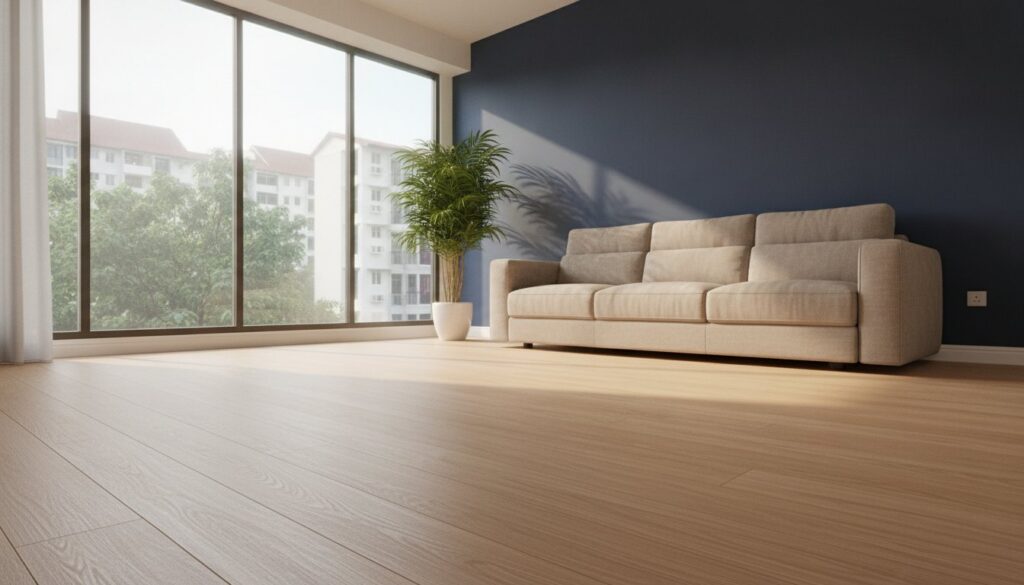
The most expensive brand of vinyl flooring singapore won’t save your renovation if the sub-floor preparation is handled poorly. Many homeowners pay a premium for high-end labels only to end up with “hollow” sounds or buckling planks because the technical installation was overlooked. It’s frustrating to realize that a large portion of your renovation budget often goes toward middleman commissions rather than the actual material or craftsmanship on your site.
You deserve a floor that is genuinely waterproof, scratch-resistant, and safe for your family regarding formaldehyde levels. This 2026 guide simplifies the technical jargon surrounding SPC and LVT thickness so you can make an informed decision for your HDB or condo. We’ll show you how to achieve a seamless overlay installation that avoids expensive hacking costs while maintaining structural integrity. By the end of this article, you’ll understand how to source quality materials directly from a renovation contractor, ensuring transparent pricing and professional workmanship without the unnecessary design firm markups.
Key Takeaways
- Understand the technical differences between SPC and LVT to choose a floor that balances rigid durability with underfoot comfort.
- Learn how the direct contractor model eliminates middleman markups, providing transparent pricing for your vinyl flooring singapore installation.
- Discover why professional sub-floor preparation and moisture testing are essential to preventing “hollow” sounds and long-term buckling.
- Identify how to save on renovation expenses by using seamless overlay techniques that remove the need for costly and messy tile hacking.
- Ensure your home’s air quality by learning how to check for low formaldehyde levels and high-grade wear layers in your chosen materials.
Understanding Vinyl Flooring in the Singapore Context
Modern vinyl flooring has evolved significantly from the thin, rubbery linoleum found in older flats decades ago. Today, Understanding Vinyl Flooring involves looking at high-tech, multilayered planks designed for both durability and aesthetics. In 2026, vinyl flooring singapore remains the top choice for residential projects because it balances cost-effectiveness with high performance. It’s a technical flooring solution that handles our local environment without the maintenance headaches of natural timber.
Most homeowners choose this material during an HDB renovation in Singapore because of its extreme versatility. Unlike real wood which requires periodic sanding or tiles that involve messy, expensive hacking, vinyl offers a streamlined installation process. The wear layer is the most critical technical component. It’s a transparent top coating that protects the decorative design from scratches, scuffs, and stains. For a high-traffic household, we recommend a wear layer of at least 0.5mm. This ensures the floor reaches its full potential lifespan of 15 to 25 years in a residential setting.
Transparency regarding health standards is also a priority for our team. Cheap, uncertified materials often emit high levels of formaldehyde, which is a major concern in enclosed, air-conditioned rooms typical of local apartments. We focus on sourcing low-VOC (Volatile Organic Compounds) products. Always look for industry certifications like FloorScore. These labels guarantee that your indoor air quality isn’t compromised by your renovation choices.
The Anatomy of a Vinyl Plank
A standard plank consists of several specialized layers. The UV coating is essential because Singapore’s tropical sun is harsh. Without this layer, planks near balconies or large windows will eventually discolour or fade. The decorative layer uses advanced printing technology to mimic real wood grains or stone textures with incredible accuracy. Finally, the core material defines the board’s stability. The core determines how the floor handles heavy furniture and how much “give” it has when you walk on it.
Why Vinyl Suits the Singapore Climate
Our local relative humidity often exceeds 80%, which is a nightmare for organic materials. Vinyl is 100% waterproof and dimensionally stable. It won’t warp, swell, or rot like solid wood parquet when exposed to moisture. It’s also naturally termite-proof. Since the core contains no organic wood fibers, it’s an unattractive target for pests that often plague older properties. For maintenance, you don’t need specialized oils or expensive cleaners. A simple damp mop is sufficient to keep the surface pristine for years.
SPC vs. LVT: Choosing the Right Type for Your Home
Choosing between Stone Plastic Composite (SPC) and Luxury Vinyl Tiles (LVT) isn’t about finding a “premium” label. It’s about matching material properties to your specific lifestyle. SPC features a rigid core made from limestone and stabilizers, making it incredibly dense and resistant to impact. LVT is more flexible and offers a softer, slightly cushioned feel underfoot. While LVT was the original standard for vinyl flooring singapore, SPC has gained massive popularity because it handles our local humidity and heat with better dimensional stability.
Thickness is a technical detail that homeowners often overlook. For most HDB flats, 5mm is the industry sweet spot. A 4mm plank might feel thin if your sub-floor isn’t perfectly level, while 6mm options offer the best sound dampening and durability. When we source materials, we ensure manufacturers follow strict safety regulations for vinyl chloride to guarantee the planks are safe for your family. This technical oversight is why we avoid unbranded, “cheap” stock that lacks proper certification.
The installation method you choose will define your home renovation timeline and budget. Click-lock systems are the modern residential standard. They create a “floating” floor that doesn’t require messy adhesives, making them perfect for overlaying existing tiles. This method is faster and allows the floor to be used immediately after the last plank is clicked into place.
The SPC Advantage for BTOs
SPC is the most logical choice for BTO owners. Its limestone core prevents the planks from expanding or contracting when you switch your air-conditioning on and off. It’s also highly resistant to dents from heavy furniture like refrigerators or wardrobes. Most of our SPC planks come with an integrated IXPE underlayment. This built-in layer provides a quieter walking experience and helps mask minor sub-floor imperfections that could otherwise cause “hollow” sounds.
Glue-Down Vinyl for Commercial Spaces
Glue-down vinyl remains a cost-effective solution for large-scale office projects. It’s easy to replace a single damaged tile in a high-traffic hallway without ripping up the entire floor. However, professional sub-floor preparation is non-negotiable for this method. Any moisture or bumps in the concrete slab will cause the adhesive to fail or the tile to “telegraph” the imperfection through the surface. If you’re planning a commercial space, you can speak with our site supervisors to assess if your current floor condition is suitable for glue-down application.
Vinyl vs. Tiles vs. Parquet: A Practical Comparison
The financial logic of choosing vinyl flooring singapore usually centers on the total project cost rather than just the material price per square foot. While ceramic tiles might cost similar to high-end vinyl, the labor for hacking and masonry work significantly inflates the bill for a renovation Singapore project. For a standard 4-room HDB flat, the supply and installation of vinyl typically ranges from S$3,000 to S$7,000. This is a substantial saving compared to the five-figure sums often required for complete retiling or solid timber installation.
Overlaying is the primary advantage of modern vinyl systems. You avoid the dust, noise, and the S$1,000 to S$2,000 expense associated with hacking old tiles. Because vinyl planks are thin, usually between 4mm and 6mm, they can sit directly on top of your existing floor without creating significant height issues. This speed of installation means a whole flat can be floored in just two days, whereas tiling could take over a week including curing time.
Acoustics and comfort are where vinyl truly outperforms traditional materials. Ceramic tiles are cold underfoot and reflect sound, creating echoes in large rooms. High-quality vinyl feels warmer and absorbs impact. This makes it a quieter choice for families with children or pets. It doesn’t have that sharp “clack” sound when you walk in heels or drop a heavy object. From a resale perspective, a well-installed SPC floor mimics the look of premium parquet so closely that it often maintains or even boosts property valuation for pragmatic buyers who value low-maintenance finishes.
HDB and Condo Flooring Regulations
HDB strictly regulates floor thickness and material usage. If you’re doing a full floor replacement in a resale flat, you must use HDB-approved pre-packed screed. The total thickness of the screed and finish should not exceed the original slab height too much to avoid excessive weight. In 2026, many HDB owners prefer overlaying to bypass these structural complexities entirely.
Condo owners face MCST rules that are often stricter than HDB guidelines. Many management committees demand a specific Sound Transmission Class (STC) rating for flooring to prevent noise complaints from neighbors below. We solve this by using 5mm or 6mm vinyl with high-density underlayment that meets these acoustic standards. Another practical hurdle is the “door gap.” Since overlaying adds height, we typically need to trim the bottom of your timber doors so they swing freely over the new surface.
Maintenance Realities: Long-term Care
Cleaning protocols for vinyl are straightforward but specific. You should avoid steam mops, as the intense heat can weaken the click-lock joints or cause the material to expand. A simple damp microfiber mop with a pH-neutral cleaner is all you need. Unlike parquet, you’ll never need to varnish or sand the surface to keep it looking new.
The Technical Installation Process: Why Sub-Floor Prep is Key
Successful vinyl flooring singapore projects depend entirely on what happens before the first plank is laid. We treat every installation as a technical masonry project rather than a simple cosmetic upgrade. Skipping the site assessment is a common mistake that leads to “bubbling” or joint failure within the first year. Our team uses professional hygrometers to test moisture levels in the concrete slab. Trapped water vapor can compromise the floor’s integrity and lead to mold growth, even if the material itself is waterproof.
Our installation team follows a strict five-step protocol to ensure structural stability and long-term durability:
- Step 1: Site assessment and moisture testing of the sub-floor to ensure a dry foundation.
- Step 2: Sub-floor preparation, including grinding down high spots and filling cracks with patching compound.
- Step 3: Laying high-density IXPE or EVA underlayment for sound dampening and thermal insulation.
- Step 4: Precision cutting and click-lock assembly with carefully calculated expansion gaps at every wall.
- Step 5: Skirting and transition strip installation for a clean, professional finish that hides the raw edges.
The Importance of Floor Leveling
Level floors are non-negotiable for a high-quality finish. If your sub-floor has a deviation of more than 3mm over a 2-meter radius, you’ll experience “clicking” noises when walking. This happens because the planks flex into the hollow spaces below, eventually causing the click-lock joints to snap under the pressure. As a direct contractor, we handle the cement screeding and leveling ourselves. We prefer self-leveling compounds for high-precision finishes. These polymer-modified mixtures flow into the lowest points of the room, creating a mirror-flat surface that traditional hand-screeding can’t match. If you’re unsure about your current floor’s condition, you can get a site assessment from our technical team to avoid future repair costs.
Skirting and Finishing Touches
Skirting is more than just a decorative border; it hides the essential expansion gaps required at the wall perimeter. In Singapore’s humid climate, we recommend PVC skirting over traditional wood. PVC is 100% termite-proof and won’t rot or swell if you mop the floors frequently. We finish every edge with professional silicon sealing to prevent water seepage under the planks. Transition strips are also used at doorways to manage slight height differences between rooms. This is especially important when overlaying vinyl in the living room while keeping original tiles in the kitchen. We ensure these strips are color-matched to your planks for a cohesive aesthetic throughout the home.
Maximising Savings: The Direct Contractor Advantage
Dealing directly with the technical team also prevents “translation errors” that occur when requirements pass through several layers of management. In a typical ID setup, your specific requests pass through a designer before reaching the site supervisor, which often leads to miscommunications regarding floor patterns or skirting heights. When you work with us, you speak directly to the experts responsible for the structural integrity of your floor. This direct line of communication is vital when integrating flooring with custom carpentry. We coordinate the installation of your wardrobes and kitchen cabinets to ensure the vinyl is laid correctly around built-in units, preventing future shifting or unsightly gaps.
Accountability is the final piece of the savings puzzle. If a plank starts to lift or a joint separates, you don’t want to be bounced between a designer and a third-party subcontractor. We provide a single point of responsibility. If there’s a technical issue, our dedicated team across Singapore handles the rectification immediately without the need for middleman approval.
The True Cost of a Flooring Quote
Reading a quote requires looking beyond the headline Price Per Square Foot (PSF). Many firms offer “free skirting” or low entry rates only to pad the final bill with hidden fees. Common undisclosed costs include delivery charges, floor protection using corrugated sheets, and a 10% wastage buffer. We provide a consolidated quote that includes supply, installation, and all necessary site preparation. Don’t be swayed by “freebies” that often hide lower-grade materials or poor wear layers. Always compare the total bottom-line figure against the technical specifications of the plank to ensure you’re getting genuine value.
Project Management for Savvy Homeowners
You don’t need a high-concept design firm to visualize your home. We provide 3D architectural drawings to help you plan your layout and color schemes without the expensive ID consultancy fees. Timing is also critical for a smooth project. Vinyl should be installed after all wet works and major painting are complete, but before the final carpentry installation. This sequence protects your new floor from heavy machinery and falling debris. If you’re ready for a straightforward, technical approach to your renovation, you can request a direct, unmarked-up quote from our technical team today.
Secure a Durable Floor with Direct Contractor Savings
Choosing the right vinyl flooring singapore involves more than picking a color; it requires a technical understanding of core materials and a commitment to professional sub-floor preparation. You now know that SPC offers the rigid stability needed for local residential conditions and that avoiding middleman markups can save you thousands on your total renovation bill. By focusing on technical workmanship rather than flashy marketing, you ensure a floor that’s both aesthetically pleasing and structurally sound for decades.
Prioritizing HDB-compliant materials and expert leveling prevents common long-term issues like “hollow” sounds or buckling planks. Our local team, based in Paya Ubi Industrial Park, manages every stage of the process from moisture testing to final skirting installation. This direct-to-consumer model ensures you receive professional technical support and high-quality results without undisclosed fees or intermediary commissions. Your home deserves a foundation that’s built with honesty and technical competence.
Ready to upgrade your space? Get a Direct Contractor Quote for Vinyl Flooring and work with a partner who values straightforward communication and fair pricing. We’re here to help you build a home that’s as functional as it is beautiful.
Frequently Asked Questions
Can I install vinyl flooring over my existing HDB tiles?
You can install vinyl directly over existing HDB tiles provided the sub-floor is structurally sound and level. This overlay method is a standard practice for vinyl flooring singapore projects because it bypasses the need for expensive and messy hacking works. We conduct a site assessment first to check for hollow tiles or significant height deviations that might compromise the click-lock joints over time.
Is vinyl flooring waterproof enough for kitchens and bathrooms in Singapore?
Vinyl is 100% waterproof and highly suitable for kitchens where spills and humidity are common. However, we don’t recommend it for the “wet” areas of bathrooms, such as shower zones, where constant standing water and high temperatures can eventually affect the joints. For kitchen installations, our team applies professional silicon sealing at the edges to prevent moisture from seeping under the planks.
What is the difference between 4mm and 5mm SPC vinyl?
The primary difference lies in dimensional stability and the quality of the underfoot feel. A 5mm SPC plank is more rigid and better at masking minor sub-floor imperfections than a 4mm version. Most 5mm options also come with a thicker integrated IXPE underlayment. This provides superior sound insulation and reduces the “hollow” noise often associated with thinner, entry-level materials.
How long does it take to install vinyl flooring for a 4-room HDB flat?
A standard 4-room HDB flat usually takes about 2 days to complete. The first day involves site preparation, moisture testing, and laying the main floor areas. The second day is dedicated to finishing the remaining rooms, installing skirting, and applying final silicon seals. This timeline assumes the sub-floor is already level and doesn’t require extensive cement screeding or self-leveling compounds.
Does vinyl flooring emit toxic fumes or formaldehyde?
High-quality vinyl flooring singapore does not emit harmful levels of formaldehyde. We source materials that meet strict international safety standards, such as FloorScore certifications for indoor air quality. It’s essential to avoid unbranded, “cheap” products that lack these technical verifications. Inferior resins can release Volatile Organic Compounds (VOCs) into your home, which is a health concern in enclosed, air-conditioned spaces.
Do I need to hack my existing floor before installing vinyl?
You don’t need to hack your existing floor if the tiles are in good condition. Overlaying is the most cost-effective way to refresh your home’s look without the dust and noise of demolition. Hacking is only necessary if the existing tiles are badly cracked, “popping” up, or if the additional height of the vinyl would prevent doors from opening even after professional trimming.
How do I maintain my vinyl floor to make it last 20+ years?
Longevity depends on simple but specific cleaning habits. Use a damp microfiber mop with a pH-neutral cleaner and avoid using steam mops, as intense heat can damage the internal core or click-lock joints. To ensure the floor lasts over 20 years, use felt pads under heavy furniture to prevent deep gouges and keep the surface free of abrasive grit or sand from outside.
Is vinyl flooring scratch-proof if I have pets or children?
Vinyl is highly scratch-resistant but not entirely scratch-proof. Its durability against pets and children depends on the thickness of the wear layer. We recommend a wear layer of at least 0.5mm for residential high-traffic areas. While it handles claws and toys much better than solid wood parquet, dragging heavy appliances or sharp metal objects across the floor can still cause permanent surface damage.