
Most homeowners in Singapore pay significantly more for ceiling fan installation simply because they let an interior designer handle the coordination. It’s a common trap; you’re already busy with a renovation, so you accept opaque pricing and “management fees” without a second thought. You want the job done right to avoid the nightmare of a falling fan, but you shouldn’t have to pay a premium for a middleman who doesn’t actually touch the wiring. Understanding How To Save On Ceiling Fan Installation Costs In Singapore? starts with recognizing that technical competence and fair pricing can coexist when you cut out the intermediaries.
We agree that safety is non-negotiable. This article provides a clear roadmap to reducing your expenses by using a direct contractor model and bundling your electrical services to stop paying multiple transport fees. You’ll discover a transparent breakdown of what you should actually be paying for concrete versus false ceiling setups. We’ll also explain how to ensure your installation remains EMA-compliant without the inflated price tag of a design-heavy firm. By the end of this guide, you’ll have the practical knowledge to manage your fan upgrades safely and cost-effectively.
Key Takeaways
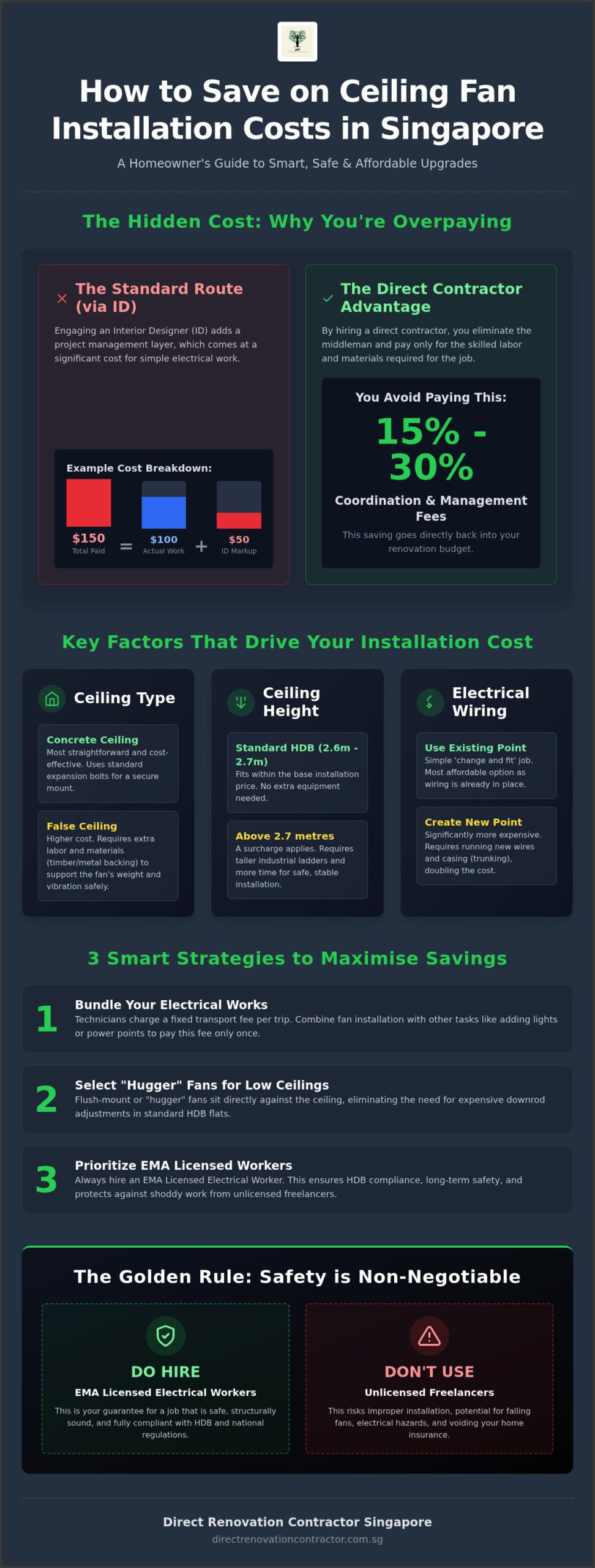
- Bypass the standard 15-30% coordination markups by engaging a direct renovation contractor instead of an interior designer for your electrical works.
- Minimize transport surcharges by bundling your ceiling fan installation with other necessary tasks like lighting or power point additions in a single session.
- Discover How To Save On Ceiling Fan Installation Costs In Singapore? by selecting “hugger” or flush-mount fans that eliminate the need for expensive downrod adjustments on low ceilings.
- Ensure long-term safety and HDB compliance by prioritizing EMA Licensed Electrical Workers over unlicensed freelancers who may compromise the structural integrity of your installation.
Understanding the Variables: What Drives Ceiling Fan Installation Costs in Singapore?
Every homeowner wants to know How To Save On Ceiling Fan Installation Costs In Singapore? without compromising on safety. To do that, you first need to understand that a quote isn’t just a random number; it’s a calculation based on three primary components: labour, mounting hardware, and transport fees. Transport fees are a fixed cost per trip. This means a technician charges the same amount to travel to your HDB flat whether they install one fan or five. Labour costs cover the actual assembly and mounting of the Ceiling fan, while hardware costs include specialized brackets or heavy-duty bolts required for a secure fit.
Ceiling height is a significant variable that many people overlook. In standard HDB BTO flats, ceilings usually sit at 2.6 to 2.7 metres. If your ceiling exceeds 2.7 metres, expect a surcharge. Working at height requires taller industrial ladders and more time for the technician to stabilize the equipment. It’s a matter of workplace safety and physical effort. The higher the ceiling, the more complex the balancing process becomes to ensure the fan doesn’t wobble at high speeds. When you’re looking at How To Save On Ceiling Fan Installation Costs In Singapore?, knowing your exact ceiling height helps you avoid unexpected “on-site” price adjustments.
Concrete vs. False Ceilings: The Structural Cost Factor
The type of ceiling you have dictates the mounting method and the final price. If you’re mounting directly onto a concrete slab, the process is straightforward and uses standard expansion bolts. A concrete slab mount serves as the most cost-effective baseline for any fan installation. However, false ceilings are a different story. Because gypsum boards cannot support the weight and vibration of a moving fan, we must install timber backing or metal brackets behind the board. This reinforcement prevents the fan from eventually tearing through the ceiling. In some HDB resale flats, we might even need to hack a small portion of the false ceiling to secure a support bracket to the original concrete above, which naturally increases the labour intensity.
Electrical Wiring and Point Creation
Your existing electrical infrastructure is the final major cost driver. If there’s already a lighting point or a dedicated fan point in the centre of the room, the job is a simple “change and fit.” If you need to move that point just one metre away, the cost can double. This is because the electrician must run new wiring and install surface casing, also known as trunking, to reach the new location. While most residential fans operate safely on a standard 13A lighting circuit, creating a brand-new point from the distribution board (DB) involves significantly more material and time than simply tapping into an existing line. Choosing to use existing points is one of the easiest ways to keep your renovation budget under control.
The “Direct” Advantage: Avoiding Middleman Markups and ID Coordination Fees
When you engage an Interior Designer (ID) for a full flat renovation, they typically act as a project manager. This service isn’t free. Most IDs add a coordination fee of 15% to 30% on top of the actual electrical subcontractor’s quote. For a single fan, this might seem minor. However, across a whole house, these markups represent a significant portion of your budget. If you are looking for How To Save On Ceiling Fan Installation Costs In Singapore?, the most effective strategy is to hire a direct renovation contractor singapore. This model allows you to communicate directly with the team performing the work, ensuring you pay for labour and materials rather than coordination overhead.
Consider the math behind a standard installation. An ID might quote you $150 for a fan installation that actually costs $100 from the electrician. The extra $50 covers the ID’s time to call the electrician and schedule the slot. By managing that one phone call yourself, you’ve already reduced your costs by a third. In 2026, savvy HDB owners are increasingly moving toward this direct-to-contractor approach to maximize their renovation mileage. You aren’t just saving money; you’re gaining direct access to the technical experts who understand the structural requirements of your home.
Transparency in Quotations
Direct contractors provide itemized breakdowns that clearly separate labour from material costs. You won’t find “hidden markups” disguised as general administrative fees. We provide the raw cost for heavy-duty brackets or specialized regulators without adding a percentage on top. This level of clarity is essential for anyone researching How To Save On Ceiling Fan Installation Costs In Singapore? because it allows you to compare quotes accurately. You should always insist on seeing the credentials of the Licensed Electrical Workers who will handle your wiring to ensure the work meets national safety standards and insurance requirements.
Managing Your Own Project
Taking the lead on your project doesn’t mean doing it blindly. We offer a DIY support package that provides professional guidance while you retain control of the timeline. A common mistake in fan placement is often ignored by design-heavy firms: light strobing. This happens when fan blades rotate under a light source, creating a flickering effect. We use 3D drawings to verify precise placement before the first drill hits the ceiling. By acting as your own project lead, you eliminate the need for a middleman while still receiving technical expertise. If you’re ready to start your project without the extra markups, you can explore our direct electrical services today to see the difference in transparency.
Strategic Planning: Bundling Electrical Works to Maximise Savings
Calling a technician to install a single ceiling fan is the most expensive way to handle your home improvements. Every professional visit involves a base fee that covers travel time, fuel, and equipment setup. If you’re looking for How To Save On Ceiling Fan Installation Costs In Singapore?, the most effective strategy is to group your tasks. Scheduling one fan installation today and a lighting fixture next week means you pay two separate transport fees for work that could have been completed in one afternoon. By consolidating your electrical needs, you force the fixed costs to be spread across multiple items, lowering the price per unit.
Strategic bundling is particularly effective during a home renovation. Instead of treating the fan as an afterthought, coordinate with your main contractor to include the mounting during the masonry or false ceiling phase. This allows the electrician to run the necessary wiring and secure the internal support brackets before the ceiling is sealed or painted. It’s much cheaper to install a bracket while the structure is exposed than to cut into a finished ceiling later.
The “Whole-House” Electrical Strategy
Data from local projects shows that installing five fans in a single session is approximately 40% cheaper per unit than five separate call-outs. This bulk rate applies because the technician only needs to set up their ladders and tools once. For those undergoing a full hdb renovation in singapore, the best time to plan your fan points is during the hacking phase. This is when we can easily run concealed wiring through the walls and ceiling slabs without the need for unsightly surface trunking. Planning early ensures your home looks cleaner and your wallet stays heavier.
Minimising Site Visits
Contractors charge for their time and expertise. If we arrive at your site and the fans haven’t been delivered yet, or if the power hasn’t been turned on by the utility provider, you’ll likely face an “abortive trip” fee. These unnecessary charges can quickly erase any savings you’ve made elsewhere. To avoid this, use a simple readiness checklist before your contractor arrives:
- Ensure all fan units are physically on-site and unboxed to check for transport damage.
- Verify that the electrical supply is active and the distribution board is accessible.
- Clear the floor area directly under the installation points to provide safe ladder access.
- Confirm the required installation height with the technician before they start drilling.
A direct contractor streamlines this workflow because there’s no middleman to miscommunicate the schedule. When you’re managing the project yourself, clear communication about site readiness is your best tool for How To Save On Ceiling Fan Installation Costs In Singapore?. Efficient scheduling doesn’t just save us man-hours; it directly reduces the final quote we provide to you.
Selecting the Right Fan for Your Ceiling Type to Minimise Labour Costs
Your choice of fan hardware determines the complexity of the physical labour required on-site. Many homeowners buy a fan based on aesthetics alone, only to find that the installation requires custom brackets or downrod modifications that drive up the final bill. Understanding the technical specifications of your unit is a vital step in How To Save On Ceiling Fan Installation Costs In Singapore?. By matching the fan’s mounting system to your ceiling’s structural reality, you eliminate the need for specialized troubleshooting during the install.
For standard HDB flats with low ceilings, “hugger” or flush-mount fans are the most pragmatic choice. These units sit directly against the ceiling slab without a long downrod. This design saves you money because the technician doesn’t need to spend time measuring, cutting, or adjusting a rod to meet the 2.1-metre safety clearance required by local regulations. In contrast, heavy fans with solid wooden blades often require heavy-duty steel expansion anchors rather than standard plastic plugs. This increased weight adds to the labour intensity and requires a more robust mounting setup to prevent vibration and noise over time.
Integrated LED lights are another cost-saving feature to consider. If you choose a fan with a built-in light kit, you only need to pay for one electrical point. Installing a separate ceiling light and a fan in the same room usually requires two separate wiring runs and two sets of labour charges. While a DC motor fan might have a higher upfront purchase price, it often simplifies the setup process. These fans are generally lighter and more efficient, though you should verify that the internal transformer fits comfortably within your existing ceiling rose to avoid extra modification fees.
Fan Design and Installation Complexity
The physical footprint of your fan matters if you have custom furniture or bulkheads. If you are working with a carpenter singapore to build full-height wardrobes or kitchen cabinets, a flush-mount fan is much easier to integrate. It provides more clearance for cabinet doors to swing open without hitting the blades. Choosing fans that come with universal mounting brackets also reduces the need for the contractor to fabricate custom plates on-site, which keeps your labour costs predictable and low.
Smart Fans and Remote Control Savings
Remote-controlled fans offer a hidden financial advantage during the wiring phase. Because the speed and light are controlled via a wireless handset, the electrician doesn’t need to install a physical wall-mounted regulator. This eliminates the need for additional wall hacking and the running of extra wires from the switch to the fan. The trade-off is a higher upfront fan cost, but the lower labour and material costs for wiring often make it a cheaper overall solution. If you already have a smart home ecosystem, selecting a compatible fan can further reduce the need for specialized rewiring. If you need professional advice on matching a fan to your specific ceiling structure, you can consult our electrical specialists to avoid costly mismatch errors.
Executing Your DIY Renovation: Professional Installation with Direct Renovation Contractor
Our team consists of EMA Licensed Electrical Workers who understand the nuances of local residential wiring. We ensure every fan is grounded correctly and meets HDB’s strict safety standards. Once the fan is up, we don’t just walk away. We perform a full balancing check to eliminate wobbling. A wobbling fan doesn’t just sound annoying; it puts unnecessary stress on the mounting bracket and the motor. Balancing the blades on day one extends the life of your appliance and prevents future service calls. This is the most practical way to manage How To Save On Ceiling Fan Installation Costs In Singapore? while protecting your home.
Quality Assurance Without the ID Price Tag
We prioritize structural integrity over stylistic flair. Our business model is built on transparency, which means we explicitly reject undisclosed fees and intermediary commissions. You receive a clear, itemized quote that reflects the actual work performed. This straightforward approach is why we’re the preferred partner for pragmatic homeowners who value quality workmanship. We don’t hide costs in “coordination fees” or “management packages.” You get direct access to the people doing the drilling and wiring, ensuring your project stays on budget and on schedule.
Ensuring Long-Term Safety
Long-term safety depends on the hardware hidden behind the canopy. We use high-quality RC anchors and always secure the mandatory safety wire to the ceiling slab. This secondary support system is your final line of defence against mechanical failure. To keep your costs low over the next decade, we recommend a simple maintenance routine:
- Check the blade screws for tightness every six months.
- Wipe away dust buildup to prevent blade imbalance.
- Listen for unusual clicking sounds that may indicate a loose bracket.
- Ensure the safety wire remains taut and uncorroded.
These small steps prevent the motor from overworking and avoid expensive repairs. If you’re ready to proceed with a safe, compliant installation, you can Get a direct quote for your ceiling fan installation to see our transparent pricing in action. We bridge the gap between your DIY management and professional-grade results.
Taking Control of Your Home Upgrade Costs
Achieving a cooler, more comfortable home doesn’t require a premium price tag. By now, you understand that How To Save On Ceiling Fan Installation Costs In Singapore? depends on your ability to cut out the middleman and plan your electrical works strategically. Whether it’s choosing a flush-mount fan for your HDB flat or bundling multiple installations into a single session to waive transport fees, every decision you make directly impacts your final bill. Bypassing interior designer markups and working directly with a technical expert ensures your budget goes toward quality hardware rather than coordination fees.
Our team provides direct-to-owner pricing with zero ID markups, backed by an expert electrical team that prioritizes HDB and EMA compliance. We believe in total financial clarity, which is why we provide transparent, itemised quotations for every job we undertake. You don’t have to sacrifice safety for savings when you work with a partner who values technical competence over flashy presentations. Save on your renovation by hiring a Direct Renovation Contractor today and get your ceiling fans installed correctly the first time. We’re ready to help you build a more efficient home with straightforward, honest service.
Frequently Asked Questions
Do I need an HDB permit to install a ceiling fan in Singapore?
You don’t need a specific HDB permit to install a standard ceiling fan in your flat. However, the Housing & Development Board requires that any changes to your home’s electrical wiring be performed by a licensed electrician. Structural alterations to the ceiling slab are strictly prohibited; you must use existing points or surface trunking for new installations to stay compliant.
What is the average cost to install a ceiling fan on a false ceiling in 2026?
Installation on a false ceiling is more expensive than on a concrete slab because it requires additional structural reinforcement. Technicians must install timber backing or specialized metal brackets to support the fan’s weight and vibration. While specific rates vary based on the complexity of the reinforcement, this is a key factor when researching How To Save On Ceiling Fan Installation Costs In Singapore? as it involves more man-hours.
Can I install a ceiling fan myself to save on costs?
You should never attempt a DIY ceiling fan installation in Singapore. Local regulations mandate that all electrical works, including new fan points and wiring, must be carried out by an EMA Licensed Electrical Worker. DIY attempts are not only illegal but also risk structural failure or electrical fires, which can void your home insurance policy and lead to costly repairs later.
Why do electricians charge more for high ceilings in Singapore?
High ceilings, typically those above 2.7 metres, require more time and specialized equipment to manage safely. Electricians must use taller industrial ladders and take extra precautions to stabilize the unit at height. This increase in labour intensity and workplace safety risk is why you’ll see a surcharge for condos or landed properties with double-volume ceilings compared to standard HDB flats.
How much does it cost to add a new electrical point for a fan?
The cost of a new electrical point depends on whether you choose surface trunking or concealed wiring. Running new wires from the distribution board involves significant material costs and labour. To understand How To Save On Ceiling Fan Installation Costs In Singapore?, consider that using an existing lighting point is always the most economical choice, as it avoids the extensive hacking or casing required for a brand-new line.
What is the difference between an LEW and a general handyman for fan installation?
A Licensed Electrical Worker (LEW) is certified by the Energy Market Authority to perform and sign off on electrical installations safely. A general handyman lacks these legal credentials and may not follow HDB-compliant safety standards. Hiring an LEW ensures your fan is structurally sound and your wiring meets national safety codes, providing a level of liability protection a handyman cannot offer.
How can I avoid strobing effects when placing a fan near downlights?
Strobing occurs when fan blades pass directly under a light source, creating a persistent flickering effect. To avoid this, ensure there is a minimum clearance of 50cm between the tip of the fan blades and any downlights. Proper planning during the site assessment phase is the only way to prevent this visual irritation without having to pay for expensive repositioning of lights or fans.
Does the weight of the ceiling fan affect the installation price?
Yes, the weight of your fan directly impacts the type of mounting hardware required. Heavier fans, such as those with solid wood blades or large DC motors, often need high-tensile expansion bolts and reinforced brackets. These materials cost more than standard plastic plugs, and the added weight makes the physical mounting process more labour-intensive for the technician, which usually increases the final quote.