

Comparing bottom-line totals across three different bids is the fastest way to blow your renovation budget. When you start getting multiple renovation quotes for your home, you quickly discover that a cheaper bottom line usually points to omitted trades rather than genuine value.
You probably already sense that opaque lump-sum packages and vague line items hide true material costs, setting you up for expensive variation orders halfway through construction. Between interior designers pushing steep concept markups and firms submitting mismatched estimates, determining who delivers honest build quality can feel overwhelming.
This practical guide cuts through the confusion. You will learn how to solicit, normalize, and evaluate multiple renovation quotes to avoid hidden contractor markups and secure fair trade pricing. We break down an actionable framework to standardise your scope of work, catch omitted carpentry and wet works, and select a reliable direct contractor with transparent payment milestones.
Key Takeaways
- The true value of getting multiple renovation quotes lies in line-item normalization across three to five builders, rather than scanning for the lowest bottom line.
- Standardising your project brief with official floor plans and trade-categorised tasks ensures every contractor prices an identical scope of work.
- Auditing trade specifications, including carpentry carcass materials and masonry screeding details, immediately exposes inflated intermediary margins.
- Low initial bids frequently omit essential operational items like debris haulage, chemical washing, or realistic material allowances to force later variation orders.
- Safeguard your renovation funds by locking in progressive payment schedules strictly tied to verified physical completion milestones on-site.
Why Getting Multiple Renovation Quotes Protects Your Budget
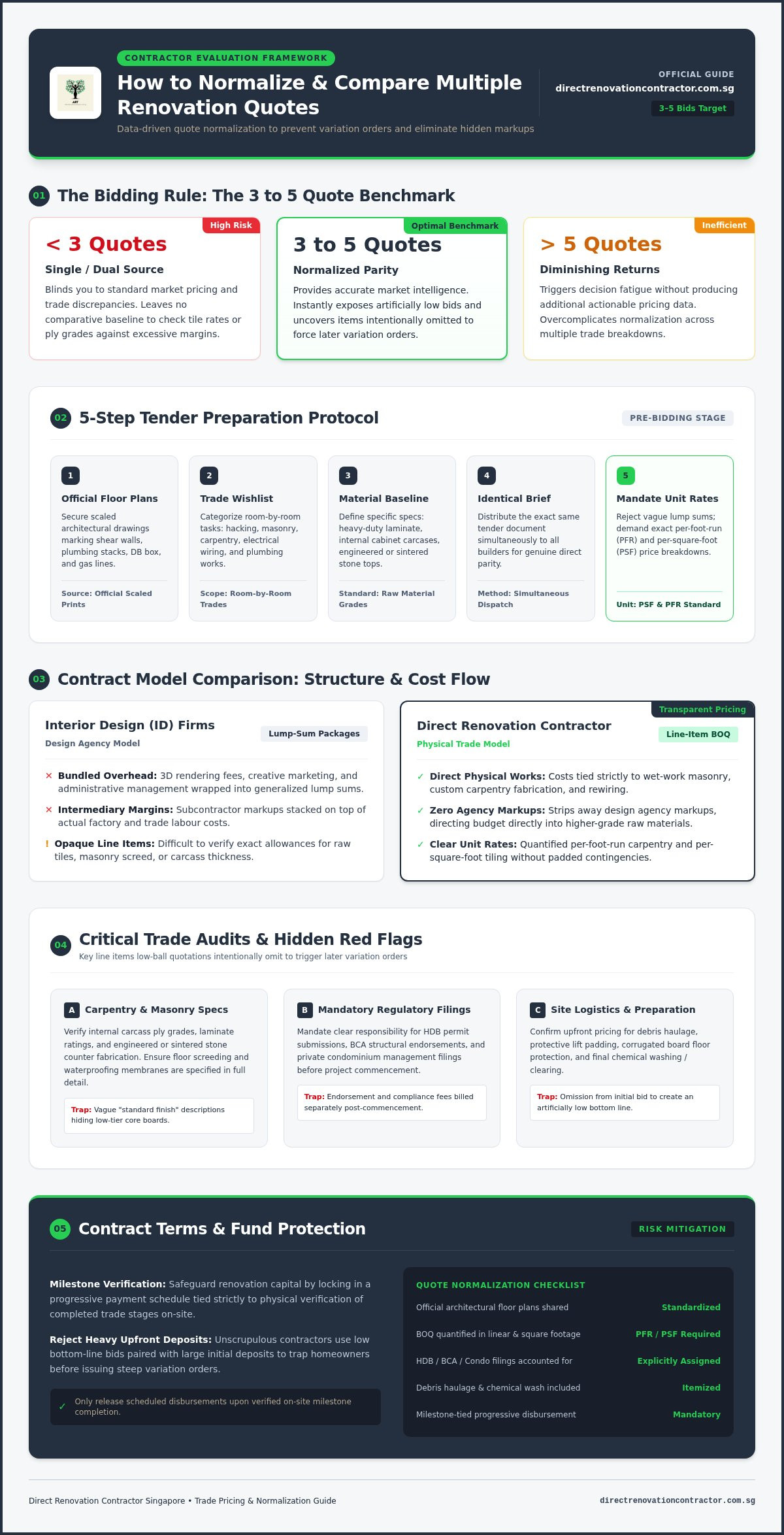
Evaluating raw proposals side by side often creates more confusion than clarity. The real objective of getting multiple renovation quotes is quote normalization: standardising scope specifications across builders so you can compare genuine material and labour costs directly. Soliciting three to five quotes provides an accurate market benchmark. Fewer than three leaves you blind to market variations; more than five triggers decision fatigue without yielding extra pricing intelligence.
A rigorous bidding assessment mirrors the formal construction bidding process used in commercial contracting. When you align line items across multiple proposals, artificially low bids immediately stick out. Unscrupulous firms often submit bare-minimum estimates to secure an initial deposit, fully intending to charge premium rates for omitted essentials through variation orders later on.
The Problem with Single-Source Contracting
Relying on a single quotation removes your pricing leverage and blinds you to trade discrepancies. A sole-source estimate conceals whether specific material allowances, such as basic tile rates or structural ply grades, match standard market quality. Without comparative data, you cannot determine whether you are paying for sound structural workmanship or simply absorbing an inflated business margin. Multiple bids establish an objective baseline for fair trade pricing.
Interior Designer Quotations vs. Direct Contractor Quotes
A critical flaw in residential comparisons is treating design agency proposals and builder estimates as identical documents. Interior design firms routinely bundle management overhead, marketing costs, 3D drafting expenses, and sub-contractor markups into generalized lump sums. In contrast, engaging a direct renovation contractor Singapore homeowners trust provides transparent line items tied strictly to physical works like wet-work masonry, custom carpentry fabrication, and rewiring. By separating creative presentation fees from actual site trade costs, you can strip away unnecessary intermediary charges and fund higher-grade raw materials instead.
How to Prepare a Standardized Scope Before Requesting Bids
Precision at the inquiry stage prevents expensive misunderstandings later. Before contacting renovation firms, establish an identical technical baseline so every builder prices the exact same scope of work. Sending a vague description results in widely divergent bids that are impossible to compare.
Follow these five sequential steps to assemble your tender brief:
- Step 1: Obtain official floor plans. Secure scaled architectural drawings showing structural shear walls, plumbing stacks, gas pipes, and distribution board locations.
- Step 2: Draft a trade-categorised wishlist. Organise your requirements room by room, dividing tasks into hacking, masonry, carpentry, electrical wiring, and plumbing.
- Step 3: Establish clear material baselines. Define exact specifications, such as heavy-duty laminate grades, internal cabinet carcases, and engineered stone or sintered stone counter surfaces.
- Step 4: Distribute an identical document. Send the same brief to all prospective builders simultaneously to ensure parity.
- Step 5: Mandate detailed unit rates. Insist that all quotes use per-foot-run or per-square-foot breakdowns rather than opaque lump-sum figures.
Creating a Clear Bill of Quantities (BOQ)
A functional BOQ quantifies physical dimensions before any site meeting occurs. Record exact linear footage for kitchen cabinets and wardrobe carpentry, and quantify square footage for floor hacking, waterproofing screed, and tile laying. For a comprehensive scope template, consult our home renovation planning guide. When getting multiple renovation quotes against precise trade quantities, contractors cannot pad hidden contingencies into undefined work areas.
Clarifying Mandatory Regulatory Filings
Statutory submissions represent a frequent source of hidden charges. Require every quoting party to explicitly state who handles Housing & Development Board (HDB) permit applications, Building and Construction Authority (BCA) structural endorsements, or private condominium management approvals. Standardising these compliance items, along with protective lift padding, haulage fees, and debris clearing, protects you from surprise line items on your first invoice. Enforcing this level of documentation helps homeowners avoid a home improvement scam or dealing with contractors who obscure operational costs.
If you want to review your itemised quantities directly with an experienced builder, submit your floor plan to Direct Renovation Contractor Singapore for an unbundled trade breakdown.
Evaluating Quotes Line by Line: Key Trade Breakdowns
Lump-sum totals hide structural deficiencies. True normalization requires examining the distinct trades that make up your build: masonry, carpentry, electrical infrastructure, plumbing, and surface preparation. Consumer protection guidelines consistently advocate getting multiple estimates to verify that specifications match across bids rather than simply hunting for the lowest price tag.
Auditing Carpentry Specifications and Hardware
Carpentry rates vary wildly based on internal build quality. When getting multiple renovation quotes, check whether the pricing covers basic particleboard or solid plywood carcasses finished with internal colour polyester (PVC). Verify if the builder includes branded soft-close hinges and heavy-duty drawer runners as a standard baseline or charges them as add-ons. You can assess baseline structural joinery using our carpenter Singapore resource to ensure quotes reflect fair fabrication costs without middlemen markups.
Unpacking Masonry, Screeding, and Waterproofing Rates
Masonry items represent a common trap for surprise expenses. Pay close attention to these critical details:
- Tile supply allowances: Check whether the included rate per square foot covers practical showroom selections or leaves you facing immediate top-ups.
- Waterproofing membrane: Ensure the quote specifies an approved two-part elastomeric chemical membrane for wet areas rather than a substandard single-coat liquid seal.
- Pre-packed screed: Verify that floor and wall preparation includes compliant pre-packed screed rather than unapproved manual sand-cement mixes.
Electrical Points vs. Lump-Sum Allowances
Vague electrical allocations are guaranteed budget busters. Never accept a quotation that lists electrical works as a single lump-sum allowance. Insist on explicit per-point unit rates for 13A single sockets, 13A double sockets, lighting points, data cables, and two-way switches. Check whether the proposal covers necessary distribution board (DB) replacements and consumer unit isolator switches. For regulatory requirements and wiring safety compliance, refer to our comprehensive guide on HDB renovation in Singapore before locking in your electrical layout.
Red Flags and Hidden Clauses in Low Renovation Quotations
An unusually cheap estimate rarely signals efficient construction. When getting multiple renovation quotes, a bid that sits significantly below the market average typically conceals omitted trades or aggressive variation order (VO) structures. Unscrupulous builders strip out essential preparatory works to make the total figure look attractive, knowing they can bill you for the missing tasks once demolition starts.
Watch out for loose phrases like “carpentry as discussed” or “electrical as required”. These vague terms provide zero legal scope protection if the builder fails to install what you envisioned. Ensure the contract explicitly states that any future variation orders must adhere to the original unit rates established in your signed agreement.
The Danger of Underquoted Provisional Sums
Provisional sums are estimated allowances for items not yet finalized. Dishonest quotes intentionally depress these line items for floor tiles, sanitary fittings, and light fixtures. Once you visit the supplier showroom, you quickly realize the allowance only covers obsolete stock. You are then forced to pay substantial out-of-pocket top-ups. Insist that all provisional allowances match realistic retail trade rates before signing.
Dissecting Debris Disposal and Protection Charges
Low bids frequently exclude necessary site operational fees that every residential renovation requires. Always check whether your proposal itemises these crucial site-servicing tasks:
- Communal and unit floor protection: Heavy corrugated board laying from the lift lobby right through internal unit walkways to prevent common property damage.
- Haulage and handling fees: The manual labour required for moving sand, pre-packed screed, and raw materials up from unloading bays.
- Debris clearing and cleaning: Scheduled disposal bin haulage, followed by multi-stage chemical washing and window cleaning prior to handover.
If a proposal omits these trade essentials, you will inevitably pay for them later at inflated emergency rates. Protect your budget by having experienced builders inspect your scope. Send your project scope to Direct Renovation Contractor Singapore for an honest, line-item audit without hidden markups.
Selecting Your Contractor and Finalising the Contract Terms
After evaluating line items and stripping away hidden markups, your final decision comes down to contract accountability. The process of getting multiple renovation quotes does more than reveal competitive trade rates; it highlights which builders operate with honest business practices. A reliable firm will willingly tie payments to verifiable site progress rather than demanding heavy cash commitments upfront.
Never sign an agreement that demands a massive initial deposit before works begin. Builders who request substantial capital upfront often use new client money to fund ongoing operational deficits from previous jobs. Protect your cash flow by anchoring every disbursement to verified physical progress on-site.
Structuring Fair Progressive Payment Milestones
A fair contract distributes financial risk evenly between you and the builder. Structure your payment schedule strictly around clear construction milestones rather than arbitrary calendar dates:
- Initial commitment deposit: Limit this payment to a modest percentage that covers permit documentation and corridor surface protection.
- Demolition and masonry completion: Release the next tranche only after hacking is cleared and wet-work screeding passes inspection.
- Carpentry fabrication and delivery: Disburse funds once custom carcasses arrive on-site and electrical rough-ins are verified.
- Final retention sum: Hold back the remaining project balance until every item on your handover defect list is resolved.
Workmanship Warranties and On-Site Trade Accountability
Ensure your agreement incorporates an enforceable defect liability period (DLP) in writing. This warranty must explicitly cover joint leakage, electrical faults, and carpentry delamination. Many homeowners hire design intermediaries only to discover their site coordinator has zero trade background and subcontracts every task without quality control.
Choosing a direct builder eliminates that friction. You deal directly with the trade supervisors responsible for your fabrication and site execution. Once you finish getting multiple renovation quotes and want straightforward, trade-level accountability, book a consultation for transparent trade-priced works with Direct Renovation Contractor Singapore.
Take Control of Your Renovation Investment
A successful home transformation starts with clarity, not guesswork. The process of getting multiple renovation quotes isn’t about finding numbers that fit your budget; it is about holding builders accountable to identical trade specifications. By auditing carpentry joinery, demanding transparent unit rates for wet works, and tying progressive payments strictly to verified site milestones, you protect your hard-earned funds against opportunistic variation orders.
You don’t need to absorb premium design commissions to secure exceptional build quality. Direct Renovation Contractor Singapore delivers direct-to-consumer pricing with zero interior designer markups, supported by in-house carpentry fabrication and specialized trade teams. Whether you are refurbishing an HDB flat, private condominium, or landed property, protect your investment with a transparent, fully itemized Bill of Quantities. Request a Transparent Trade Quote from Direct Renovation Contractor Singapore and begin your build with complete financial confidence.
Frequently Asked Questions
How many renovation quotes should I get for a home project in Singapore?
You should aim to collect between three and five detailed quotations. Two quotes don’t give you sufficient market context to spot inflated rates, while collecting more than five often results in decision fatigue without adding useful pricing intelligence. When getting multiple renovation quotes within this range, you establish a dependable trade benchmark across masonry, carpentry, and electrical works without overwhelming your schedule.
Why do renovation quotes for the exact same floor plan vary so widely?
Quotations vary widely because different builders price drastically different material grades, internal joinery builds, and operational scopes. One builder might quote heavy-duty plywood carcasses and pre-packed screed, while another quotes cheap chipboard and omits required floor protection or haulage fees. Creative agencies also add hefty project management overheads, whereas direct trade contractors price work based strictly on raw material and labour unit rates.
Is the cheapest renovation quote usually a bad choice?
Yes, an unusually low bid almost always signals omitted trades, substandard materials, or unrealistic provisional allowances. Builders often submit low estimates to lock in an initial deposit, only to recover their profit margins through aggressive variation orders once demolition begins. A legitimate quote should align closely with the median trade pricing discovered during your normalization process rather than undercut the market by a wide margin.
What is the difference between an interior designer quote and a direct contractor quote?
An interior designer quote bundles trade costs together with creative concept fees, 3D drafting charges, and sub-contractor coordination markups. In contrast, a direct contractor quotation separates physical trade activities into distinct, itemized unit rates. You pay exclusively for actual site masonry, in-house carpentry fabrication, and licensed electrical installations, eliminating the intermediary commissions typically charged by retail design agencies.
Can I negotiate the price once a renovation contractor submits a quote?
Yes, you can negotiate effectively by adjusting the physical scope rather than squeezing trade margins. When getting multiple renovation quotes, you gain the data needed to identify specific line items where rates exceed the market baseline. Ask for adjustments in laminate selections, reduce custom carpentry linear footage, or purchase your own sanitary fixtures to trim overall expenditure without sacrificing structural build quality.
What is a variation order and how do I prevent it from inflating my bill?
A variation order (VO) is a contractual amendment billing you for work that falls outside your original signed contract scope. You can prevent VO bill shock by securing an itemized Bill of Quantities before construction starts. Ensure essential tasks like haulage, debris disposal, and chemical cleaning appear in the primary agreement, and stipulate that any unexpected works must use the unit rates established in your contract.
What progressive payment schedule is considered safe for residential renovations?
A safe schedule keeps cash disbursements strictly tied to verifiable site completion milestones rather than calendar timelines. Avoid any firm demanding substantial deposits before works commence. A standard framework allocates a modest commitment deposit for initial permits, followed by progressive tranches after hacking, wet masonry, carpentry fabrication delivery, and final defect rectification. Never release your final retention balance until every defect is resolved.