
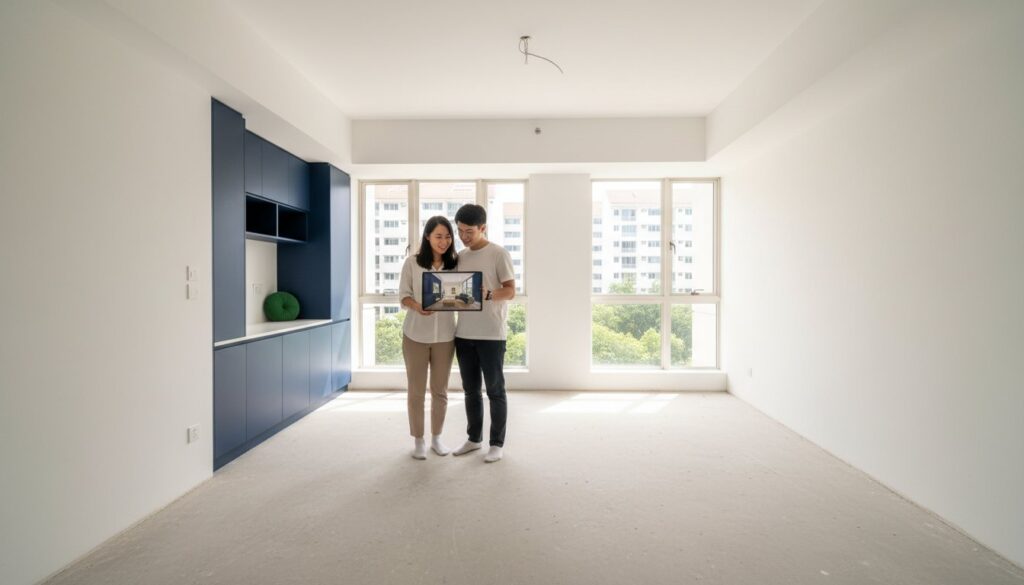
Why do some 4-room flats take six months to finish when the actual manual labor only requires 60 working days? Most delays happen because homeowners don’t have a clear bto renovation timeline after key collection to hold their contractors accountable. It’s frustrating to stand in your empty unit, staring at a floor plan and wondering why the hacking hasn’t started. You want a home that’s built well and finished on time, not a series of excuses about permit delays or missing sub-contractors.
This guide gives you a professional, week-by-week breakdown designed to get you moved in within 8 to 12 weeks. By working directly with a contractor, you’ll cut out the 20% to 30% markup typically charged by interior design firms for project management. We’ll outline the precise technical sequence, from the day you submit your HDB renovation permit to the final chemical wash, ensuring you avoid costly mistakes in masonry and carpentry. Here is the exact roadmap to a faster, more affordable 2026 renovation.
Key Takeaways
- Navigate the critical first 14 days by prioritizing joint defect inspections and HDB permit approvals to ensure your site is technically ready for work.
- Master the 8-12 week bto renovation timeline after key collection to streamline the transition from site protection to final masonry and carpentry.
- Understand the “Wet Works” rule to prevent project delays and material damage by ensuring all masonry is cured before wood enters the site.
- Eliminate the 20-30% middleman coordination fee by communicating directly with the craftsmen handling your hacking, tiling, and electrical works.
- Utilize a professional final walkthrough checklist to verify technical workmanship and manage post-renovation logistics before making your final payment.
The First 14 Days: Post-Key Collection Essentials & HDB Permits
The first 14 days after you get your keys are about logistics and legalities rather than aesthetics. While the tradition of rolling a pineapple is a common sight in public housing in Singapore, your technical priority starts the moment you step inside. You need to pivot quickly from the excitement of ownership to the reality of site management. This initial fortnight sets the pace for your entire bto renovation timeline after key collection. If you miss a defect reporting window or delay a permit application, you’ll face bottlenecks before the first hammer swings.
Opening your SP Services account is your day-one priority. You can’t perform a proper site measurement or test for pipe leaks in the dark. Most savvy owners use the SP Utilities app to activate water and electricity at least three days before their key appointment. Having active utilities allows your contractor to check every electrical point and ensures there’s water pressure to test the drainage in your kitchen and bathrooms. It’s a small, pragmatic step that prevents a three-day delay at the very start of your project.
Defect Inspection & Rectification
Don’t rush into hacking. You have a 7-day window to report cosmetic flaws to the Building Service Centre (BSC) located on-site. We recommend a joint inspection to identify hollow tiles, uneven wall plaster, and window misalignments. In 2024, BSC rectification takes 14 to 21 days on average. If major structural issues appear, your bto renovation timeline after key collection will push back by at least 30 days. Fixing these now prevents HDB from blaming your contractor for pre-existing damage later. We check for “hollow” sounds in floor tiles using a tapping rod; this is a common issue that must be resolved before any masonry work begins.
HDB Permits and Management Office Liaison
Standard painting doesn’t need a permit, but structural changes do. For 2026 projects, expect HDB permit approvals to take up to 14 working days for complex works like hacking or bathroom floor slab replacement. You’ll also need to place a renovation deposit, typically S$500 to S$1,000, with your Town Council or MCST. This deposit covers potential damage to common areas like lift lobbies during the move-in process. As a direct contractor, we handle these technical submissions to ensure every wall you remove is legally cleared. You must also serve “Noisy Work” notices to your neighbors at least 3 days before drilling starts to comply with HDB’s 9:00 AM to 5:00 PM work schedule.
Managing these administrative tasks in week one ensures your site is legally ready for the heavy labor in week three. We’ve seen projects stall because owners forgot to notify the Town Council or failed to account for the BSC rectification period. By staying process-oriented, you avoid the “middleman markups” often associated with firms that outsource this paperwork. You’re paying for quality workmanship, so don’t let avoidable paperwork delays inflate your timeline or your budget.
The 8-12 Week BTO Renovation Master Timeline
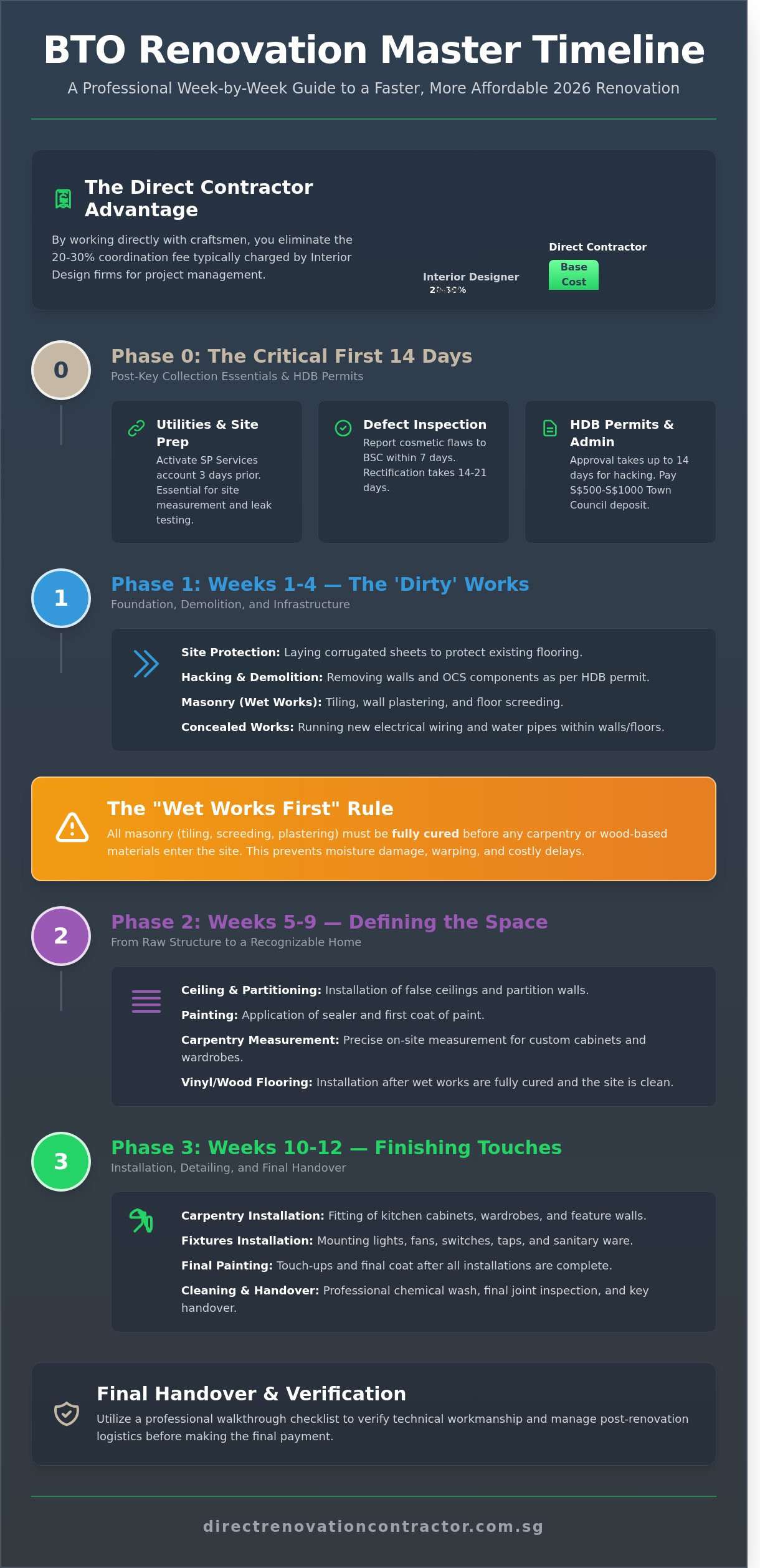
A standard 4-room BTO flat usually requires a 3-month window for a complete transformation. This timeframe isn’t a rough estimate; it’s a calculated sequence of trade dependencies. Your bto renovation timeline after key collection starts the moment the site is cleared and permits are secured. We don’t rely on guesswork or vague promises. Instead, we follow a rigorous 5-phase schedule that ensures every dollar of your budget is reflected in the structural integrity and finish of your home. Delays often happen when homeowners skip steps or hire multiple uncoordinated sub-contractors. By working with a direct contractor, you eliminate these communication gaps.
Weeks 1 to 4: The ‘Dirty’ Works
The first month focuses on heavy labor and infrastructure. We begin by laying corrugated plastic sheets or thick cardboard to protect HDB-provided floor tiles. This is a non-negotiable step to prevent damage from heavy machinery. Once protection is set, hacking begins. Whether you’re removing a non-load bearing wall or stripping down OCS components, we ensure all work aligns with HDB renovation permits which must be clearly displayed at your unit entrance. By week 3, we move into concealed works. Our plumbers and electricians run new pipes and wires inside walls or floor screed. Getting this right now prevents expensive hacking later; we double-check every power point and water outlet against your floor plan before sealing them up.
Weeks 5 to 9: Defining the Space
During this middle stretch, the unit stops looking like a construction site and starts looking like a home. Masonry is the priority here. We construct 50mm high kitchen cabinet bases and shower kerbs using high-quality cement and waterproofing agents. Proper waterproofing is essential; a leak into your neighbor’s unit below can cost you thousands in liquidated damages. Week 7 usually involves the installation of false ceilings and L-boxes. These are necessary if you want cove lighting or need to hide air-con trunking. The most vital milestone in your bto renovation timeline after key collection occurs in week 8: the final carpentry measurement. We wait until masonry and plastering are 100% level before taking measurements. Even a 3mm discrepancy in floor height can cause cabinet doors to misalign, so we never rush this step for the sake of the schedule.
Weeks 10 to 12: The Finishing Stretch
The final three weeks are about precision and assembly. Because we operate our own direct factory, your custom wardrobes and kitchen cabinets arrive on-site pre-fabricated and ready for installation. This direct model typically saves homeowners 15% to 20% compared to firms that outsource their woodworking. Once the heavy cabinets are mounted, we move to “second-fix” electrical and plumbing. This involves installing your actual light fixtures, ceiling fans, and toilet bowls. Week 11 is dedicated to the final coat of Nippon or ICI paint and the installation of vinyl flooring overlays if you’ve chosen that option. We conclude week 12 with a professional chemical wash and a joint site inspection. We don’t consider the job done until every hinge is oiled and every surface is dust-free. If you’re ready to see how these phases fit your specific floor plan, you can get a transparent breakdown of our direct-to-owner pricing.
Technical Sequence: Why the Order of Works Cannot Be Rushed
Managing a bto renovation timeline after key collection isn’t just about booking the right people; it’s about respecting the physical properties of construction materials. A common mistake homeowners make is trying to overlap trades that conflict. For example, masonry is a “wet trade” that introduces significant humidity into the flat. If you rush to install carpentry while the cement screed or wall tiles are still curing, your expensive custom cabinets will absorb that moisture and warp within six months. We enforce a strict “wet works first” rule to prevent this structural failure.
Precision is the second reason the sequence is fixed. Your electrical and plumbing works must be 100% finalized before the first cabinet carcass is mounted. Electricians need to pull cables and position socket points based on the final kitchen layout. If a socket is off by even 20mm, it won’t align with the cabinet cut-out, leading to messy visible wiring or the need to re-drill finished wood. Similarly, we conduct mandatory 24-hour waterproofing ponding tests in all HDB toilets before a single tile is laid. Following the Official HDB Renovation Guidelines ensures that your renovation is both legal and leak-proof for years to come.
Painting also follows a split schedule. We apply the base sealer and the first two coats of emulsion after the electrical trunking is up but before the carpentry arrives. This allows us to cover large wall areas quickly without masking off cabinets. The final “move-in” coat happens only after the carpentry is installed and the flooring is down. This covers the inevitable scuffs and handprints that occur during the heavy lifting phase of the bto renovation timeline after key collection.
The Carpentry Lead-Time Trap
Custom carpentry is the longest lead-time item in any Singapore renovation. It typically requires a 21 to 28-day fabrication period. To avoid a month of dead time, we take final site measurements the moment masonry is completed. Because we operate our own carpentry factory in Paya Ubi, we start cutting panels immediately while the electricians are still on-site. This parallel processing saves you exactly 14 days of downtime compared to firms that outsource their woodworks to third-party workshops or across the border.
Flooring and Protection Logistics
Vinyl flooring is the very last major component to be installed. Since most modern vinyl is only 5mm thick, it’s vulnerable to scratches from heavy toolboxes or falling debris. We keep the sub-floor bare until the cabinets are fixed. Once the flooring is down, we immediately transition into the final site walkthrough. During this 60-minute session, we check for 1mm gaps in silicon, test every drawer slide, and identify minor paint touch-ups. This ensures all sub-contractors finish their “snag list” before we officially hand over the keys for your move-in.
Direct Contractor vs. Interior Designer: Timeline & Cost Impact
Choosing between an Interior Designer (ID) and a direct contractor is the most significant factor affecting your bto renovation timeline after key collection. Most ID firms in Singapore operate on a business model that includes a 20% to 30% coordination fee. This fee doesn’t go toward premium tiles or high-grade plywood. It pays for the ID’s office overheads, showroom rentals, and marketing. When you work with us, you eliminate this middleman markup. You speak directly to the person managing the hacking, masonry, and carpentry teams on-site.
Direct communication leads to faster problem-solving. In a traditional ID setup, a site issue must be reported to the ID, who then calls the contractor, who then talks to the worker. This cycle often wastes 48 to 72 hours. With a direct contractor, the person you talk to is the one holding the floor plan and managing the sub-con teams. This streamlined approach often shaves 14 days off the total project duration because decisions happen in real-time on the ground.
A 4-Room BTO Case Study: ID vs. Direct
Consider a standard 4-room BTO unit requiring basic flooring, kitchen cabinets, and two bedroom wardrobes. Based on 2024 market rates in Singapore, the comparison is clear:
- Interior Designer: Average Cost: S$45,000 to S$55,000; Timeline: 12 to 14 weeks.
- Direct Contractor: Average Cost: S$32,000 to S$38,000; Timeline: 8 to 10 weeks.
By choosing the direct route, you save approximately S$13,000. More importantly, your bto renovation timeline after key collection is shortened by roughly 20% because there’s no waiting for third-party project managers to relay instructions or approve material orders.
The Myth of ID Project Management
Homeowners often worry they can’t manage a renovation without a designer. It’s a misconception. You can easily manage your own BTO timeline using our DIY support package. We provide the technical expertise while you maintain control. You still get professional 3D drawings for visual clarity, ensuring your carpentry and electrical points are exactly where you want them. You aren’t sacrificing design; you’re simply buying your carpentry at factory prices without the 25% design markup.
Hidden Costs in BTO Renovation Packages
Many “teaser packages” priced at S$12,888 or S$15,888 look attractive on paper but exclude essential masonry or use low-grade materials. These firms rely on “variation orders” (VOs) to make a profit once the work starts. A direct contractor’s quote is based on actual site measurements and transparent material costs. We show you unmarked-up prices for raw materials from the start. To avoid the add-on trap, check out our transparent HDB BTO Renovation Packages for an honest breakdown of costs.
Our focus remains on functional quality. We prioritize the structural integrity of your cabinets and the precision of your floor leveling over flashy mood boards. This pragmatic approach ensures your home is move-in ready on schedule and within the agreed budget. You get a house that’s built to last, not just one that looks good in a portfolio photo.
Final Handover & Post-Renovation Logistics
The final phase of your bto renovation timeline after key collection is where the technical execution meets your expectations. This stage typically occurs between week 10 and week 12 of the project. You’ve moved past the heavy hacking and masonry; now, it’s about the fine details that make a home livable. As a direct contractor, we emphasize a transparent handover process. We don’t hide behind aesthetic filters. Instead, we focus on the structural integrity and finish of every installation.
Your final walkthrough is the most critical hour of the entire project. Don’t rush this. We provide a checklist that focuses on functional performance. Test every single soft-close hinge on your kitchen cabinets. Run your fingers along the edges of the quartz countertops to check for chips. You should also bring a simple plug tester to ensure every power point is live. If you’ve installed a rain shower, run it for 15 minutes to check the floor gradient; water must flow directly to the floor trap without pooling. Any defects found here are logged immediately for the rectification team.
Working with a direct contractor means your warranty is straightforward. There’s no middleman to deflect blame. Most reputable contractors provide a 12-month warranty on workmanship, covering issues like leaking pipes or misaligned carpentry. If a cabinet door starts to sag in month six, you call us directly. This accountability is why the bto renovation timeline after key collection must include a clear understanding of after-sales support before the final 5% or 10% payment is released.
The Rectification Period
We set aside a dedicated 7-day window for minor touch-ups after the main works conclude. This period allows the house to “settle.” You should test all electrical points under load by turning on the air-conditioning and kitchen appliances simultaneously. Once you’re satisfied, we sign off the completion certificate. This document is vital for your records and serves as proof of completion for HDB should they request an inspection of the permitted works.
Transitioning to Your New Home
Moving in involves more than just shifting boxes. You must update your address with the ICA via the LifeSG app within 28 days of moving. Arrange for your broadband and smart home hub installation only after the post-con cleaning is finished; dust is the enemy of optical fibers and delicate sensors. Once the technical setup is complete, your renovation journey is officially over. Ready to start your BTO journey? Get a direct quote today.
Secure Your 2026 Move-In Date Today
Managing your bto renovation timeline after key collection requires a strict 8 to 12 week schedule that doesn’t leave room for guesswork. The first 14 days are critical for securing HDB permits and conducting site measurements before the technical sequence of hacking and masonry begins. By cutting out the middleman and working with an HDB Registered Contractor, you avoid the typical 20% to 30% markups charged by design firms. We handle every cabinet and wardrobe from our specialized Paya Ubi carpentry workshop to ensure your built-ins meet our quality standards without unnecessary delay.
You deserve a transparent process with direct factory pricing and zero hidden costs. Our team focuses on the structural integrity and functional layout of your new home, delivering results that stay on track and within your S$30,000 to S$60,000 budget. Don’t let your renovation stall because of poor planning or excessive markups. We’re ready to transform your space with the efficiency and honesty you expect from a local expert who knows the Singaporean housing landscape inside out.
Get a Direct Factory Quote for Your BTO Renovation
We’re excited to help you turn your new BTO keys into a move-in ready home soon.
Frequently Asked Questions
How long does a typical BTO renovation take in 2026?
A standard BTO renovation in 2026 takes between 8 and 12 weeks from the site measurement to the final handover. This bto renovation timeline after key collection includes 14 days for masonry work and 21 days for carpentry fabrication. If you choose complex custom features, expect the duration to extend by another 10 working days. We provide a clear schedule at the start so you can plan your move-in date with 100% certainty.
Can I start renovation immediately after collecting my BTO keys?
You can’t start renovation work immediately because you must first complete the 7 to 14 day defects inspection period. It’s vital to let the Building Service Centre (BSC) rectify any structural issues before we begin. Once the site is cleared, we apply for the HDB renovation permit, which takes 3 to 7 working days to process. Only after the permit is approved can our team start on-site.
Do I really need an Interior Designer for a standard BTO flat?
You don’t need an Interior Designer for a standard BTO flat if you have a clear idea of your layout. Engaging a direct contractor saves you 15% to 30% in project management fees and middleman markups. We provide technical expertise and direct factory pricing for your carpentry and masonry. This approach is for homeowners who value quality workmanship and transparent pricing over expensive 3D drawings and design concepts.
What are the HDB ‘noisy work’ hours I need to follow?
HDB regulations state that noisy works must only occur between 9:00 AM and 5:00 PM on weekdays. You aren’t allowed to perform any heavy drilling or hacking on Saturdays, Sundays, or Public Holidays. We strictly adhere to these 8 hour daily windows to prevent neighbor disputes and potential fines. All renovation notices are posted 5 days before work begins to keep your new community informed and minimize friction.
How much does a 4-room BTO renovation cost with a direct contractor?
A 4-room BTO renovation with a direct contractor typically costs between S$35,000 and S$55,000. This price range covers essential works like kitchen carpentry, masonry for two bathrooms, and vinyl flooring for three bedrooms. By working directly with us, you avoid the S$5,000 to S$10,000 commission usually charged by design firms. We provide a detailed itemized quote so you know exactly where every cent of your budget is going.
What happens if my renovation exceeds the HDB permit duration?
If your project exceeds the initial 3 month HDB permit duration, we must submit an extension request at least 7 days before the expiry. Failing to extend the permit can lead to a S$5,000 fine for unauthorized renovation works. We manage the bto renovation timeline after key collection to ensure all heavy works are completed within the first 60 days. This leaves enough buffer for the final cleaning and touch-up phases.
Is it cheaper to buy my own materials like tiles and bathroom fixtures?
It’s often more expensive to buy your own materials because you miss out on our 15% trade discounts at major suppliers. When we supply the tiles and bathroom fixtures, we handle 100% of the logistics and replacement costs for any damaged items. If you buy your own and a tile arrives cracked, you’ll have to pay for the return transport and wait another 5 days for a replacement, delaying the project.
How do I coordinate different contractors if I don’t hire an ID?
You coordinate different contractors by using a master schedule that sequences the trades logically. Start with the electrician and plumber, followed by the tiler, then the carpenter. We simplify this process by providing a dedicated site supervisor who manages these 4 core trades for you. This prevents the S$300 daily loss from sub-contractors turning up to the site when it’s not ready for their specific phase of work.