
That “free” 3D design proposal might be the most expensive document you ever sign. In 2026, many Singaporean homeowners still pay a hidden 30% markup on their HDB or BTO projects just for the privilege of having a middleman. You likely feel that hiring an ID firm is the only way to avoid the stress of coordinating masonry and electrical works, but that peace of mind often comes with a S$20,000 price tag you didn’t account for. When you look closely at the direct contractor vs interior designer cost, the gap isn’t just about design fees; it’s about the factory-direct pricing you’re missing out on.
We understand the fear of “cowboy” contractors and the headache of renovation jargon. This guide cuts through the fluff to show you exactly where IDs hide their margins and how you can secure high-quality carpentry and tiling without the unnecessary overhead. You’ll learn how to save up to 30% on your total bill while maintaining full control over your home’s structural integrity. We’re providing a transparent roadmap to managing your own renovation and getting professional results at a builder’s price.
Key Takeaways
- Identify the fundamental differences between design-led consultancy and execution-led contracting to determine which model suits your specific HDB or Condo project needs.
- Understand the real direct contractor vs interior designer cost gap by breaking down where the typical 20-30% middleman markup is hidden within standard masonry and carpentry quotes.
- Learn how to achieve significant savings of up to 30% on your home renovation by bypassing hidden fees and utilizing a direct-to-factory pricing model.
- Master the essential steps for managing a direct renovation, including establishing a clear work scope and using 3D architectural drawings for better visualization.
- Gain practical tips for vetting local contractors to ensure high-quality workmanship and structural integrity without paying for unnecessary design overhead.
Understanding the Price Gap: Direct Contractor vs Interior Designer in 2026
The Singapore renovation market changed significantly between 2023 and 2026. Homeowners now prioritize technical value over glossy 3D renders. The primary difference between these two paths lies in design-led consultancy versus execution-led contracting. An Interior Designer (ID) acts as a creative consultant. A direct contractor acts as the builder. This distinction is the root of the price variance.
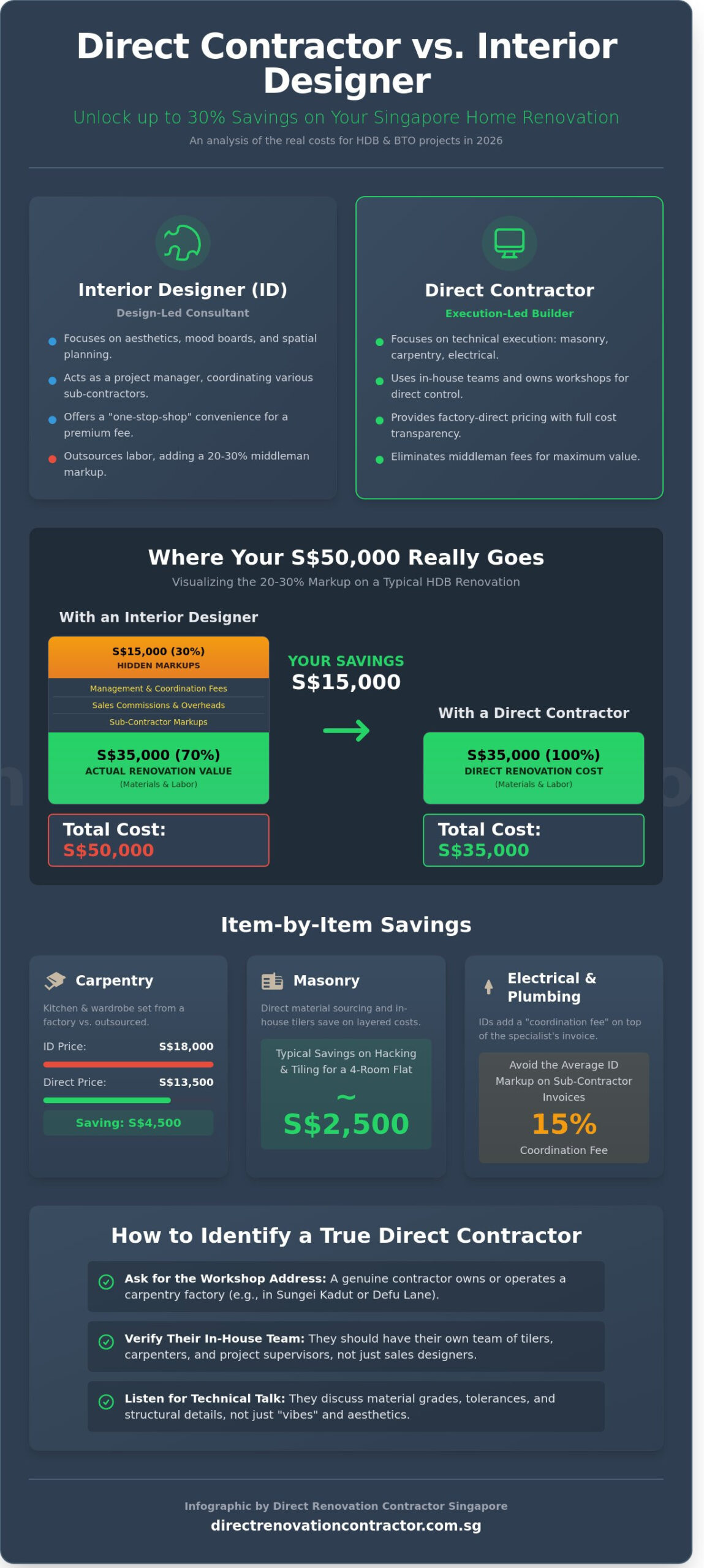
The direct contractor vs interior designer cost gap usually ranges from 15% to 30% of the total project value. This difference exists because ID firms often outsource the actual labor to sub-contractors. They add a “Middleman Markup” to cover their overheads, sales commissions, and expensive showroom rentals. In 2026, savvy BTO and resale owners are bypassing these extra costs by working directly with the source. They find that technical competence often outweighs a high-concept presentation.
Identifying a true direct contractor is simple. Ask to see their in-house carpentry workshop or their direct team of tilers. Small ID firms often masquerade as contractors but lack their own labor force. If they can’t show you a factory address in Sungei Kadut or Defu Lane, they’re likely an ID firm in disguise. True contractors talk about tolerances and material grades, not just “vibes.”
What exactly is an Interior Designer (ID)?
An ID focuses on the aesthetic “big picture.” They handle mood boards, spatial planning, and color palettes. While Wikipedia provides a broad overview of what an interior designer does, in the Singapore context, they primarily serve as project managers. They charge for convenience. You’ll often see management fees of 10% or markups on every light fixture and tile. It’s a one-stop-shop service, but you pay a premium for that hand-holding. For many, the S$10,000 to S$20,000 extra spent on an ID is simply a fee for their time and coordination skills.
The Role of a Direct Renovation Contractor
A direct contractor focuses on technical execution. We handle the heavy lifting: hacking, masonry, carpentry, and electrical works. We own the workshops and source materials directly from suppliers. This model offers total transparency. You pay for the actual labor and the cost of materials like quartz or laminate. There are no hidden commissions. For a standard 4-room BTO in 2026, choosing a direct contractor can save a homeowner upwards of S$12,000 compared to an ID firm. We prioritize functional results and structural integrity—a commitment shared by professional builders like HMJ Contracting who advocate for the direct-to-client model to ensure technical excellence. You get direct access to the people actually building your home, ensuring that what was promised is what’s delivered.
Comparing the Real Costs: Where the 20-30% Markup Goes
When you analyze a direct contractor vs interior designer cost for a standard S$50,000 HDB renovation, the price gap isn’t found in the raw materials. It’s hidden in the layers of middleman fees. An interior design firm typically adds a 20% to 30% premium to cover their office overhead, sales commissions, and 3D rendering software. On a S$50,000 project, you’re effectively paying S$10,000 to S$15,000 for management services rather than physical home improvements. A direct contractor eliminates these layers by handling the fabrication and installation in-house.
- Carpentry: An ID may quote S$18,000 for a full kitchen and wardrobe set, while a direct contractor provides the same for S$13,500.
- Masonry: Direct sourcing of tiles and labor can save up to S$2,500 on a typical 4-bedroom flat hacking and tiling job.
- Electrical & Plumbing: IDs often add a 15% “coordination fee” on top of the sub-contractor’s invoice.
The ID Management and Coordination Fee
Most ID quotes include a management fee ranging from 10% to 15% of the total project value. This covers their time spent on-site, but the costs don’t stop there. IDs rarely employ their own plumbers or electricians. Instead, they outsource these tasks and add a markup to the sub-contractor’s original quote. You’ll also see higher prices for materials like quartz countertops or vinyl flooring because the ID takes a referral commission from the supplier. Following HDB renovation regulations is mandatory for all projects, yet an ID’s coordination doesn’t always guarantee better technical compliance than a registered direct specialist who knows the structural limits of HDB blocks intimately.
Direct Factory Pricing vs. Retail Markups
Direct factory pricing is the cost of materials and labor without external commissions. Direct contractors often own their own carpentry workshops in Singapore or across the causeway. This allows them to offer kitchen cabinets at S$100 to S$120 per foot run, whereas an ID might charge S$150 or more for the same laminate finish. For masonry, sourcing tiles directly from warehouses removes the 15% retail markup IDs often bake into the price per square foot. Homeowners looking to maximize their budget often find that working with a direct specialist provides better value for every dollar spent. By cutting out the design studio’s profit margin, you’re investing directly into higher-quality materials like Blum hardware or premium internal PVC finishes that might otherwise be out of reach.
Pros and Cons: Choosing Between Design Flair and Budget Efficiency
Choosing between a direct contractor and an interior designer (ID) involves a clear trade-off. You are balancing your personal time and creative effort against your total renovation budget. When you hire an ID, you pay for a project manager and a stylist. When you go direct, you pay for the technical execution. The direct contractor vs interior designer cost gap usually ranges from 20% to 40% because you have removed the middleman markup and coordination fees.
Managing your own project requires proactive risk management. You must verify every firm’s credentials yourself to ensure they meet local standards. Use BCA’s Contractors Registration System to check if the company is licensed for the specific work you need, such as general building or specialized trades. This step reduces the risk of hiring unlicensed operators. While an ID provides oversight, a direct contractor offers deeper technical knowledge on masonry, carpentry, and electrical loads. They understand what is structurally possible in an HDB flat based on years of hands-on experience on the ground.
The “No Design” myth often scares homeowners away from the direct model. In reality, most experienced contractors have completed hundreds of BTO and resale projects. If you provide a clear reference photo or a basic sketch, they can replicate it with technical precision. You don’t need to pay a S$3,000 design fee just to decide where your kitchen sockets or cabinet handles should go.
When an Interior Designer Makes Sense
Hire an ID if your project involves complex structural changes that require a Professional Engineer (PE) or if you work 60 hours a week. If you cannot visit the site at least twice a week or feel overwhelmed by choosing between 50 shades of grey paint, the ID’s service fee is a justified expense. They ensure a cohesive aesthetic across a 5-room flat where every room must match a specific, high-concept theme without your constant input.
Why Savvy Homeowners Choose Direct Contractors
Pragmatic homeowners choose the direct route to maximize their S$50,000 budget. By cutting out the ID, you often save S$10,000 to S$15,000. These funds can be reinvested into higher-grade materials like quartz countertops or premium Italian tiles. You get direct communication with the tiler or carpenter, which prevents instructions from getting lost in translation. You also maintain full control over material selection, visiting suppliers personally to ensure the vinyl flooring or cabinetry laminates you’re paying for are exactly what arrive at your doorstep.
How to Successfully Manage a Direct Contractor Renovation in Singapore
Managing your own renovation requires a disciplined, five-step framework to ensure the project stays on track. First, establish a precise work scope. For a standard 4-room BTO, this means listing every power point and tile area. Second, source 3D architectural drawings. Expect to pay around S$200 to S$400 for professional renderings to visualize the end result. Third, coordinate the sequence of works. You must schedule hacking before masonry, and masonry before carpentry to avoid rework. Fourth, manage HDB permits or MCST approvals yourself. Finally, conduct a 50-point quality check before the final handover.
Understanding the direct contractor vs interior designer cost gap helps you realize that while you save 20% to 30% on markups, you’re trading your time for these savings. You become the project manager. This involves being on-site at least twice a week to verify that the tiling alignment and cabinet heights match your original plan. If you’re prepared for this hands-on involvement, the financial rewards are significant.
Essential Planning Tools for the DIY Homeowner
You need a detailed 2D floor plan with exact measurements. Don’t rely on guesstimates. Use a curated list of specialized sub-contractors for electrical and plumbing work to ensure technical compliance; for instance, Your Home Electrical and Handyman Services LLC represents the standard of professional expertise needed for safe residential electrical and repair work. A realistic timeline for a full flat renovation is usually 8 to 12 weeks. Setting this schedule early prevents overlapping trades and costly idle time. This structured approach ensures you maintain the direct contractor vs interior designer cost advantage without sacrificing quality.
Navigating Singaporean Regulations (HDB & MCST)
Structural safety is the priority. You must engage an HDB registered contractor; it’s a legal requirement for any hacking or structural work. HDB hacking permits usually take 7 to 14 days for approval. Remember that noisy works are restricted to 9:00 AM to 5:00 PM on weekdays. For condos, MCSTs often require a renovation deposit ranging from S$1,000 to S$3,000 to cover potential damage to common areas during debris removal. Failure to protect common corridors with proper floor protection can lead to immediate forfeiture of these deposits.
Ready to start your project with transparent, factory-direct pricing? Get a direct quote from our expert builders today.
Maximizing Your Renovation Budget with Direct Renovation Contractor Singapore
Choosing a direct contractor is the most effective way to keep your bank balance intact. When you analyze the direct contractor vs interior designer cost, the most glaring difference is the absence of a 20% to 30% management markup. We don’t hide our profits in “coordination fees” or inflated material costs. Our pricing model is strictly transparent. You pay for the labor and the materials used in your home, nothing more. Every quote we provide for 2026 reflects current market rates without the middleman fluff. Understanding the direct contractor vs interior designer cost gap allows you to allocate more funds to high-quality materials rather than service fees.
Our Paya Ubi workshop is the heart of our operations. We invite clients to visit and see their custom carpentry being fabricated. It’s a level of transparency you won’t find with firms that outsource their woodworks. By manufacturing in-house, we slash lead times and ensure quality control that external factories can’t match. Whether you’re moving into a new 4-room BTO or refreshing a 30-year-old resale flat, our 2026 renovation packages are structured to provide maximum value. We’ve optimized these packages to include essential hacking, masonry, and plumbing works at factory rates.
The DIY Support Package: The Best of Both Worlds
Homeowners often worry that skipping an ID means losing out on design clarity. We’ve solved this. Our DIY support package provides the technical documentation you need to lead your own project with confidence. We include professional 3D drawings to ensure your vision is executed perfectly before we even start hacking. You’ll also get direct access to our network of vetted material suppliers. This means you buy your tiles, vinyl, and quartz at wholesale rates, typically saving you another 10% to 15% on your total spend.
Direct Carpentry and Masonry Excellence
We specialize in the “heavy lifting” of renovation. Our in-house carpenters craft custom kitchen cabinets and wardrobes that fit your floor plan exactly. Our masonry team handles everything from complex toilet renovations to precision floor tiling with a focus on structural integrity. We don’t just make things look good; we build them to last. By cutting out the design firm, you’re investing directly in the craftsmanship of your home. It’s a pragmatic approach for the savvy Singaporean homeowner.
Take Control of Your 2026 Renovation Budget
Choosing your renovation partner depends on whether you value design hand-holding or financial efficiency. The direct contractor vs interior designer cost difference often sits between 20% and 30%, a margin that can save you upwards of S$15,000 on a standard 4-room BTO flat renovation. By working directly with the builders, you eliminate the middleman markups that typically inflate ID invoices. You’re paying for the technical skill of the workers and the raw quality of the materials rather than a coordinator’s overhead.
We provide a straightforward path to a completed home through our HDB Registered Contractor status and our dedicated carpentry workshop in Paya Ubi. This allows us to offer transparent, factory-direct pricing that keeps your costs predictable from the first quote to the final handover. You don’t need to pay for a lifestyle brand when you’re looking for solid masonry and precise carpentry. Focus on the structural integrity and functional results that matter most for your Singapore property.
Skip the ID markup and get a direct factory quote for your renovation
It’s time to build a home that fits your budget perfectly without compromising on the quality of workmanship.
Frequently Asked Questions
Is it really 30% cheaper to hire a direct contractor vs an interior designer?
You can typically save between 20% and 40% on your total renovation bill by hiring a contractor directly. When comparing the direct contractor vs interior designer cost, the savings come from removing the 15% management fee and the markups on sub-contractors. We own our carpentry factory and employ our own tilers, so you pay for the actual work rather than a design firm’s overhead and sales commission.
How do I get a 3D design if I don’t hire an interior designer?
You can hire a freelance 3D visualizer for a flat fee of S$150 to S$300 per room. Many homeowners also use free software like SketchUp or HomeByMe to create their own layouts based on their floor plans. If you have a clear vision, our team provides technical drawings for carpentry and masonry as part of the quotation process to ensure the final build matches your requirements.
Do direct contractors handle HDB renovation permits and MCST applications?
Professional HDB-registered contractors handle all necessary HDB renovation permits and MCST applications for your project. We submit the technical drawings and structural reports required for hacking or plumbing works directly to the authorities. This ensures your renovation complies with the 2024 HDB guidelines, avoiding heavy fines that can reach S$5,000 for unauthorized works or improper debris disposal.
What happens if there is a mistake in the renovation work without an ID to check?
You take on the role of project manager, but a reputable contractor provides a 12-month workmanship warranty to cover defects. If a tiling alignment is off or a cabinet hinge fails, we rectify it at no extra cost. We conduct site inspections every 3 days during the construction phase to catch errors early, preventing the need for expensive rework later in the timeline.
Can I hire a direct contractor for just specific parts of my renovation like carpentry?
You can definitely hire us for specific trades like carpentry, masonry, or electrical work on an “ala carte” basis. This approach is common for BTO owners who only need kitchen cabinets or wardrobe installation. By dealing directly with our carpentry factory, you avoid the 30% markup that design firms usually add to custom furniture quotes, keeping your budget focused on material quality.
How do I know if a direct contractor in Singapore is reliable?
Verify that the company is listed in the HDB Directory of Renovation Contractors and check their CaseTrust accreditation status. A reliable contractor should have a physical office or factory you can visit in person. Look for a track record of at least 5 years in the local industry and ask for 3 recent client references to confirm their reliability and communication style before signing.
Is the workmanship of a direct contractor as good as an ID’s sub-contractors?
Workmanship is often identical because many IDs actually hire the same sub-contractors you can engage directly. When you analyze the direct contractor vs interior designer cost, you’ll find that the quality comes from the craftsman’s skill, not the brand name. We use our own in-house teams for 90% of our projects, ensuring consistent quality across every HDB and condo unit we renovate.
What is the typical payment schedule for a direct contractor in Singapore?
A standard schedule involves a 10% deposit, followed by progressive payments of 30% after hacking, 30% after tiling, 25% after carpentry installation, and a final 5% retention sum. You should never pay more than 20% upfront for any renovation project in Singapore. This structure protects your cash flow and ensures we meet specific milestones before you release the next tranche of funds.