

The most expensive kitchen renovation quote on your desk isn’t necessarily the one with the best workmanship. In fact, many Singapore homeowners pay a 30% markup just for a middleman to manage the same tilers and carpenters they could have engaged themselves. It’s a common trap in the local market where flashy 3D renderings often mask a lack of technical knowledge regarding HDB hacking permits or actual material durability. You want a kitchen that handles heavy daily cooking, not just one that looks good in a sales brochure for six months.
We understand the frustration of dealing with opaque pricing and the fear of poor carpentry that fails within two years of installation. This 2026 guide provides a transparent comparison of materials, contractor models, and real site costs to help you build a high-performance kitchen without hidden middleman fees. We’ll break down the specific costs of masonry, plumbing, and custom cabinetry so you can secure a durable result at direct factory prices.
Key Takeaways
- Understand the 20–30% cost difference between the interior design model and the direct contractor approach to maximize your renovation budget.
- Navigate the technical stages of a kitchen renovation in Singapore, from securing HDB hacking permits to executing structural masonry and carpentry.
- Compare the durability of plywood versus chipboard and explore 2026 laminate technologies, including anti-fingerprint and thermal-healing surfaces.
- Access updated 2026 pricing benchmarks for HDB BTO and resale kitchens to identify why resale projects typically cost 40% more.
- Discover how a direct-to-factory carpentry model eliminates middleman markups while providing professional 3D drawings and technical support.
Kitchen Renovation in Singapore: ID vs. Direct Contractor Model
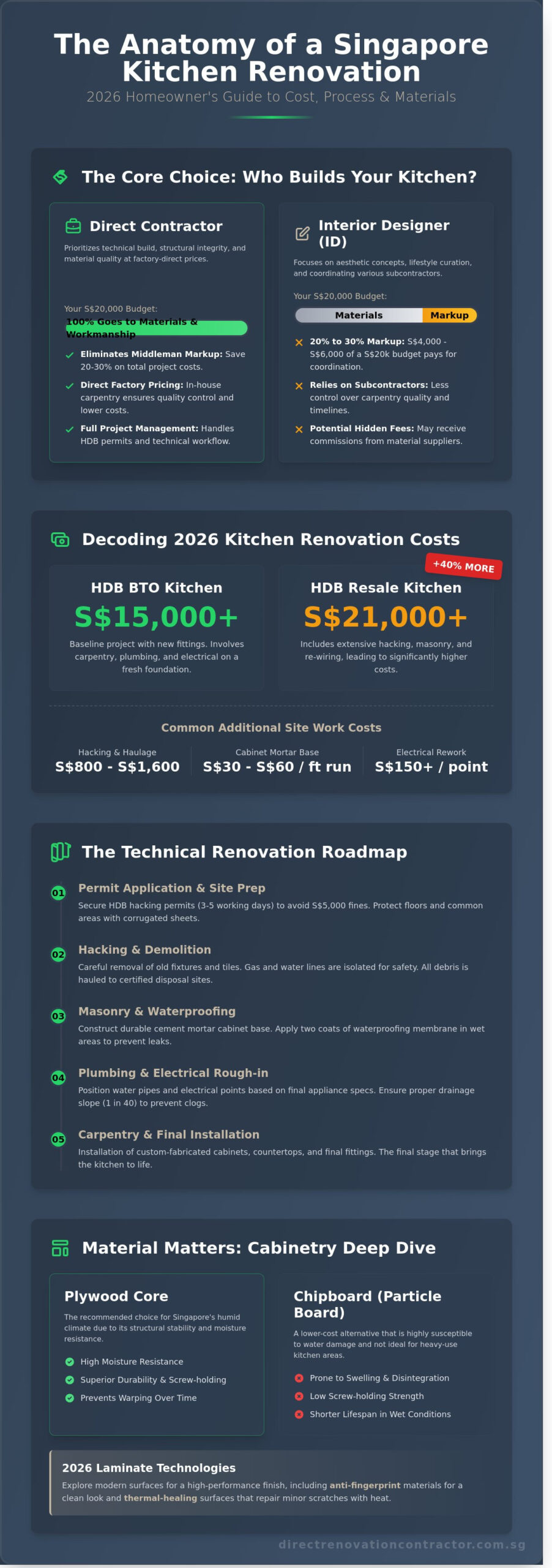
Choosing between an Interior Designer (ID) and a direct contractor is the first major decision for any Singaporean homeowner. An ID focuses on the aesthetic concept and “lifestyle” curation, while a direct contractor prioritizes the technical build and structural integrity. IDs typically add a 20% to 30% markup on top of sub-contractor rates to cover their management overhead and design time. For a standard S$20,000 Renovation project, you’re often paying S$4,000 to S$6,000 just for this coordination layer.
The Cost Efficiency of the Direct Model
Direct contractors eliminate the middleman markup because they often own their own fabrication facilities. When you receive a quote for carpentry, a direct firm provides factory-direct pricing since they employ the carpenters directly. In 2026, 3D drawings are no longer exclusive to high-end design firms. Most direct contractors now offer these visualizations for a flat fee of S$300 to S$500, or include them in kitchen renovation packages. This model also removes hidden referral fees. While some IDs take a 10% commission from tile or stone suppliers, a direct contractor passes those trade discounts straight to you.
Project Management Realities
A common myth suggests that contractors don’t handle the administrative side of a kitchen renovation. This isn’t true. A professional main contractor manages HDB renovation permits and MCST applications as a standard part of their workflow. They oversee the technical sequence of hacking, plumbing, electrical wiring, and masonry. You don’t need a designer to tell a plumber where a sink goes if you have a functional floor plan and clear technical requirements.
Deciding which path to take depends on your project’s complexity and your own schedule. If you have a clear vision and can spare 3 to 5 hours a week for site visits, the direct model is the most logical choice. It ensures your budget goes into high-quality materials rather than administrative markups. For 85% of standard HDB kitchen upgrades, the direct contractor model provides the best balance of technical skill and financial transparency. When searching for reliable renovation contractors near me, understanding these cost differences becomes crucial to avoid paying unnecessary middleman fees. For comprehensive guidance on managing your entire home renovation project in Singapore, including kitchen upgrades as part of a larger renovation plan, understanding the direct contractor approach becomes even more crucial.
Technical Stages of a Kitchen Reno: From Hacking to Masonry
A successful kitchen renovation starts with site preparation. We begin by covering the floor and common walkways with corrugated plastic sheets to prevent damage during the heavy work. In 2026, HDB regulations require specific hacking permits that typically take 3 to 5 working days for approval. We manage this paperwork for you to avoid potential fines of up to S$5,000. Once the permit is secured, the physical work moves in a strict sequence to ensure structural integrity and safety.
Hacking and Demolition Rules
Demolition is more than just swinging a hammer. We carefully remove existing cabinets, floor tiles, and wall finishes without damaging the underlying structure. For a standard 4-room HDB flat, hacking costs usually range from S$800 to S$1,600 depending on the extent of the work. This price includes professional haulage. Dumping debris in common estate bins is illegal; we use certified disposal sites to keep your project compliant. We also isolate gas pipes and water lines before the first strike. Damaging a main gas line can delay your project by 14 days while waiting for City Energy technicians to perform repairs.
Masonry Work and Base Construction
Once the space is cleared, masonry begins. We strongly recommend a cement mortar base for your cabinets. It’s far more durable than plastic carpentry legs and prevents water from ponding under your units. This base typically costs between S$30 and S$60 per foot run. Waterproofing is a non-negotiable step in the wet area. We apply two coats of waterproofing membrane to the floor and extend it 300mm up the wall. This prevents future leaks to the unit below, which can be a costly legal headache. The same waterproofing principles that protect your kitchen apply equally to your bathroom — if you’re planning a toilet renovation in Singapore, understanding HDB’s strict 3-year waterproofing warranty requirements is equally critical to avoid leaks into the unit below. For tiling, we use a 1mm to 2mm grout joint for a clean, modern look. We check every tile for “hollowness” to ensure the mortar bed is 100% solid, preventing tiles from cracking under the weight of heavy appliances.
Plumbing and electrical rough-ins must happen before the walls are closed. You’ll need your appliance dimensions ready at this stage. If your induction hob requires a 20A or 32A isolator and we only pull a standard 13A point, you’ll face rework costs of S$150 or more. We coordinate the plumbing lines with your sink position to ensure a 1 in 40 fall for drainage, which stops grease from clogging your pipes. As a direct contractor, we handle these technical stages without sub-agent markups. You can view our direct factory pricing to see how much you save by removing the middleman from your kitchen renovation.
2026 Material Comparison: Kitchen Cabinets and Countertops
Choosing materials for your kitchen renovation in 2026 requires a balance between upfront costs and long-term durability. In Singapore’s humid climate, the internal structure of your cabinets is more important than the external finish. We always recommend solid plywood cores over chipboard. Chipboard often swells and disintegrates when exposed to moisture, which is a common issue under kitchen sinks. Plywood provides the structural integrity needed to support heavy stone countertops without sagging over time.
Surface technology has advanced significantly. For 2026, anti-fingerprint laminates are the standard for high-traffic homes. These surfaces use electron-beam curing to create a matte finish that resists oil and smudges. If you choose premium thermal-healing laminates, you can actually repair micro-scratches yourself using a damp cloth and a standard iron. This technology extends the lifespan of your cabinetry by 5 to 8 years compared to traditional high-gloss finishes.
Hardware is another area where cutting corners costs you more later. We install Blum or similar high-grade European hinges because they’re rated for 200,000 opening cycles. A standard kitchen cabinet door opens roughly 20 times a day. Cheaper hinges often fail within 3 years, leading to misaligned doors and damaged carcasses. Investing an extra S$300 to S$500 in quality hardware during the initial build prevents expensive repairs down the road.
Custom Carpentry Fabrication
In 2026, expect to pay between S$75 and S$120 per linear foot for custom kitchen carpentry. This price fluctuates based on your choice of internal carcass material. While white PVC is the standard budget-friendly option, 40% of homeowners now opt for color-matched wood grain carcasses. This creates a seamless look when doors are open. Always ensure your quote includes heavy-duty drawer runners rated for at least 30kg, especially for deep drawers meant to store heavy le creuset pots or stacks of ceramic plates.
While focusing on local fabrication in Singapore, homeowners can look to the standards of bespoke kitchen designers Birmingham as a benchmark for luxury aesthetics and smart storage integration in their own custom projects.
Selecting the Right Countertop
- Quartz: The most popular all-rounder in Singapore. It’s non-porous and costs between S$80 and S$150 per foot run. It doesn’t require sealing, making it ideal for busy families.
- Sintered Stone: This is the 2026 upgrade for serious cooks. It’s made by compacting minerals under extreme pressure and heat. It’s nearly impossible to scratch and can withstand a hot wok placed directly on the surface without a trivet.
- Solid Surface: This is your most budget-conscious choice at S$60 to S$75 per foot run. Its main advantage is the ability to create a completely seamless joint between the counter and the backsplash, though it’s prone to scratches and heat damage.
Budgeting for Your Kitchen Renovation: 2026 Price Guide
Planning a kitchen renovation in 2026 requires a clear understanding of current market rates to avoid overpaying. For a standard HDB kitchen, you should expect to invest between S$12,000 and S$22,000 depending on your flat size. A 3-room HDB usually costs around S$13,500; a 4-room averages S$16,500; and 5-room units often reach S$20,000 or more. Resale kitchens are 40% more expensive than BTO units because they require intensive hacking and disposal of old structures before any new installation starts. This labor-intensive phase adds roughly S$3,500 to your initial bill.
Your budget should follow a strict 50-30-20 rule for the best results. Allocate 50% to carpentry for custom cabinets and worktops, as these are the most used elements. Set aside 30% for masonry work like tiling and waterproofing. The final 20% covers plumbing, electrical, and miscellaneous fees. Don’t forget to keep a S$1,500 buffer for hidden costs. Gas pipe relocation by a licensed technician typically costs about S$200, while adding new electrical points for ovens or dishwashers averages S$95 per point. These principles apply whether you’re tackling a standalone kitchen project or integrating it into a comprehensive home renovation strategy that covers multiple rooms and systems.
HDB Kitchen Renovation Packages
Standard packages usually include 20 feet of top and bottom cabinets, a quartz worktop, and basic plumbing installation. While these bundles offer convenience, our “Ala-carte” model allows you to pay only for the specific work your kitchen needs. Always examine quotes for “haulage and debris disposal” line items. If these aren’t listed, you’ll likely face an unexpected S$600 charge mid-project. Transparent pricing means knowing every cent’s destination before the first tile is cracked. Before committing to any package, it’s worth reading a comprehensive homeowner’s guide to renovation companies in Singapore to understand how different firm structures affect your final bill and workmanship quality.
Cost-Saving Strategies
- Overlaying tiles: This saves roughly S$2,500 by skipping the hacking and re-screeding process, provided your existing tiles are not hollow or damaged.
- Standardize cabinet heights: Keeping to a standard 900mm height prevents custom fabrication surcharges that can add 15% to your carpentry bill.
- Direct sourcing: Buy your own sinks, taps, and appliances from wholesalers. Purchasing these items yourself eliminates the middleman markups often found in interior design firm quotes.
Executing Your Kitchen Reno with Direct Renovation Contractor
Our direct-to-factory carpentry model is built on a simple premise: you shouldn’t pay for what you don’t need. Most renovation firms act as intermediaries, adding a 20% to 30% markup on top of the actual builder’s cost. We cut these middleman fees by manufacturing our cabinets in-house. This ensures you receive premium materials, like internal carcass PVC and soft-close hinges, at actual factory prices. Every kitchen renovation we undertake is backed by a fixed-price contract. We’ve eliminated hidden “consultancy” fees and administrative charges that often surprise homeowners during the final billing phase.
For the savvy owner who wants more control, we offer a unique DIY Support Package. This includes professional 3D drawings and a curated list of reliable sub-contractors for plumbing and electrical work. You get the technical expertise of a seasoned contractor while maintaining the flexibility to manage your own budget. We specialize in the strict requirements of HDB, BTO, and Condo properties across Singapore, ensuring all hacking and masonry work adheres to 2026 BCA guidelines. Understanding how to hire a renovation contractor in Singapore becomes crucial when you want to ensure your project is handled by professionals who prioritize structural integrity over aesthetic markups. When evaluating your options, comparing the service models of renovation companies in Singapore helps you identify which firms offer genuine technical competence versus those that rely on marketing budgets and hidden sub-contractor commissions.
Why Homeowners Trust Our Direct Model
Reliability comes from direct communication. When you work with us, you’re talking to the people responsible for the actual hacking, tiling, and carpentry. This eliminates the “broken telephone” effect common with sales-heavy interior design firms—a standard of direct accountability also practiced by reputable family-run firms like Moreton Bay City Building Services in the home renovation and extension industry. Our team focuses on functional longevity rather than fleeting aesthetics. We prioritize durable masonry bases and moisture-resistant cabinets that are built to last 15 years or more in Singapore’s humid climate. Our track record includes over 500 successful HDB-compliant projects where we’ve balanced technical safety with practical storage solutions.
Get Started on Your Kitchen Transformation
Preparing for your kitchen renovation starts with a precise site measurement. Before our team arrives, ensure you have the dimensions of your intended appliances, such as the fridge, hob, and oven. This prevents layout errors that are costly to fix later. A typical timeline involves:
- Week 1: Site measurement and finalization of 3D drawings.
- Week 2: Hacking of existing tiles and cabinets (typically 2 to 3 days).
- Week 3-4: Masonry work, plumbing, and electrical rewiring.
- Week 5: Carpentry installation and final handover.
Don’t settle for opaque pricing or unnecessary markups. Get a Transparent Kitchen Renovation Quote Today and work directly with the experts who build your home.
Secure Your 2026 Kitchen Project Today
Planning a successful kitchen renovation in 2026 comes down to understanding the technical sequence of hacking, masonry, and carpentry. By opting for a direct contractor model, you effectively bypass the 20% to 35% markup fees often hidden within interior design packages. This guide has outlined how to balance your S$15,000 to S$30,000 budget against high-performance materials like sintered stone or anti-fingerprint laminates. You now have the data needed to make an informed decision for your HDB or BTO flat.
Direct Renovation Contractor provides the technical expertise required for a seamless build. Our HDB-registered masonry teams ensure every tile is laid with precision; meanwhile, our own local factory delivers direct-to-consumer carpentry pricing without middleman commissions. We don’t believe in flashy sales pitches or hidden charges. We focus on delivering durable, functional kitchens through honest labor and transparent S$ pricing. You deserve a renovation partner who prioritizes structural integrity over aesthetic fluff.
Take the first step toward a functional, high-quality home. Request a Direct Contractor Quote for Your Kitchen Renovation. We’re ready to get to work on your site.
Frequently Asked Questions
How much does a basic kitchen renovation cost in Singapore for 2026?
A basic kitchen renovation in 2026 typically starts from S$8,500 and can reach S$13,000 for standard HDB layouts. This price range covers approximately 20 feet of top and bottom cabinets, a quartz worktop, and basic plumbing works. Prices have stabilized since the 15% material hike seen in 2024. Choosing a direct contractor saves you the 20% markup usually charged by design firms.
Do I need HDB permit for kitchen renovation if I am not hacking walls?
You don’t need an HDB permit for simple carpentry replacement or changing your kitchen worktop. However, you must apply for a permit if your project involves hacking floor tiles or altering gas and water pipes. 90% of kitchen overhauls require some form of permit. We handle the submission process to ensure your renovation complies with HDB’s latest 2026 safety regulations.
How long does a typical kitchen renovation take from start to finish?
A standard kitchen renovation takes between 21 and 35 working days from the first day of hacking to final handover. The first week involves demolition and masonry; the second week focuses on plumbing and electrical wiring. Custom carpentry installation usually happens in the third week. We provide a 4-week timeline for most HDB projects to account for the 3-day curing period required for cement bases.
Which is better for a Singapore kitchen: Quartz or Sintered Stone?
Quartz remains the practical choice for 70% of Singaporean homeowners due to its non-porous nature and price point of S$100 to S$150 per foot run. Sintered stone is superior for heat resistance but costs 40% more and is prone to chipping if hit at the edges. For a heavy-duty kitchen renovation, quartz offers the best long-term value without the premium price tag of ultra-compact surfaces.
Can I renovate my kitchen without hiring an Interior Designer?
You can definitely renovate your kitchen without an Interior Designer by working directly with a renovation contractor. This approach eliminates middleman fees and gives you direct access to the factory team building your cabinets. You’ll need to provide your own design references, but our site supervisors manage the technical measurements and coordination. This method typically saves homeowners between S$3,000 and S$5,000 in coordination fees.
What is the standard warranty for custom kitchen carpentry in Singapore?
The industry standard for custom kitchen carpentry is a 12-month warranty on workmanship and a 5-year warranty on internal hardware like hinges and drawer runners. We use Blum or Excel hardware which comes with specific manufacturer guarantees. Always check your contract for these details. 95% of carpentry issues, such as door misalignment, appear within the first 6 months of heavy daily use.
Should I choose a cement base or cabinet legs for my kitchen cabinets?
A 50mm cement base is the superior choice for Singapore kitchens because it prevents water from seeping under your cabinets during floor washing. Cabinet legs often trap dust and pests in the 100mm gap behind the kickplate. While a cement base requires an extra 3 days for masonry work, it extends the lifespan of your carpentry by preventing wood rot at the base.
Is it possible to renovate a kitchen while living in the same house?
It’s possible to stay in your home, but we don’t recommend it due to the 85-decibel noise levels and heavy construction dust. If you must stay, we use plastic floor-to-ceiling zip-walls to seal off the kitchen area. You’ll lose access to your stove and sink for at least 14 days. 80% of our clients choose to stay with relatives during the hacking and tiling phases. If you’re renovating multiple wet areas simultaneously, our complete toilet renovation checklist for Singapore homeowners can help you plan the sequencing of your bathroom works alongside your kitchen project to minimize total disruption time.