

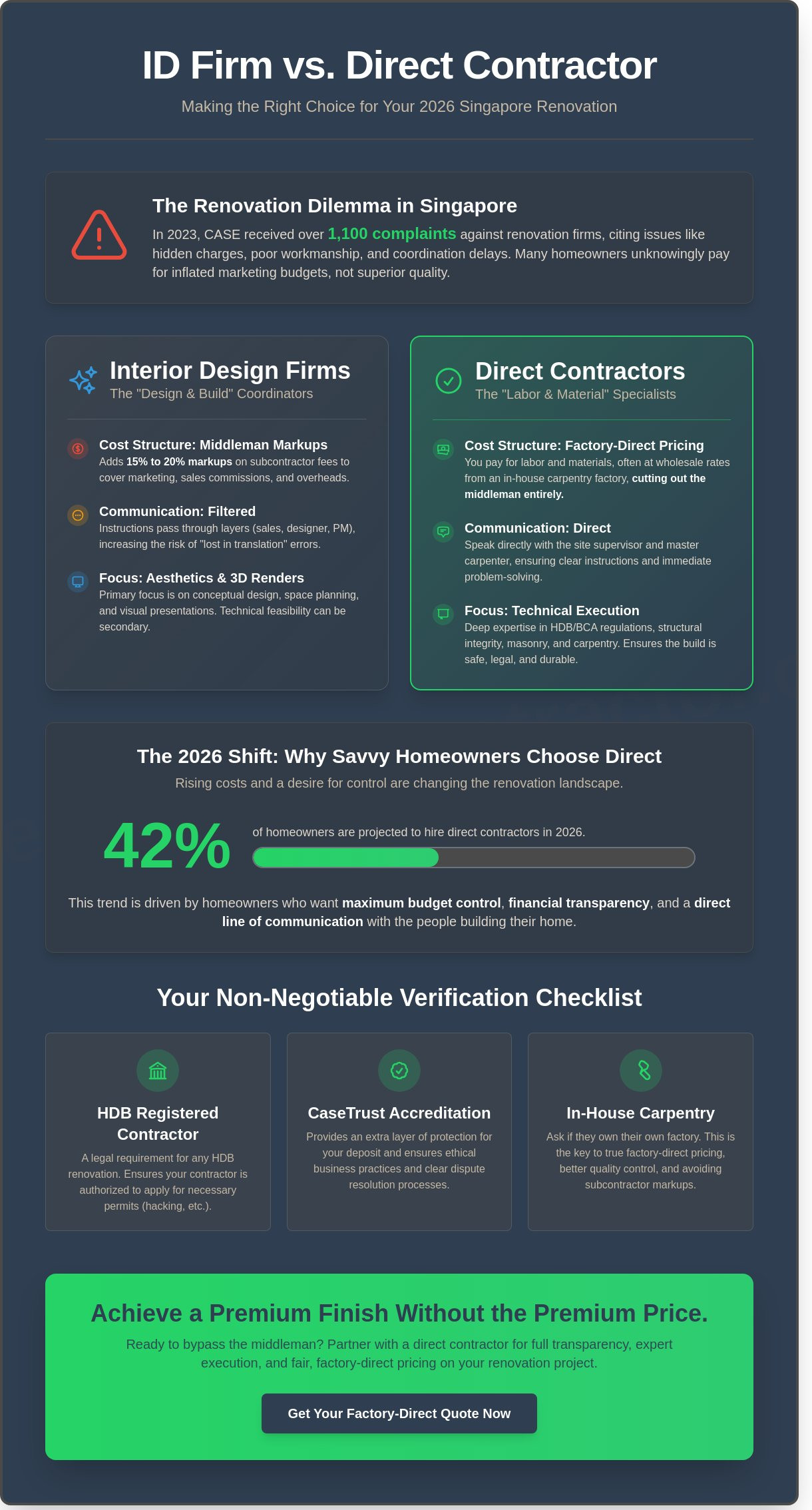
The most expensive quote you receive from Singapore renovation companies often has more to do with a firm’s marketing budget than the actual quality of your carpentry or hacking work. In 2023, the Consumers Association of Singapore (CASE) received over 1,100 complaints regarding the renovation industry, with many citing poor workmanship and hidden charges. You likely want a home that looks great and functions perfectly, but you don’t want to deal with the opaque markups that middleman firms often tack onto sub-contractor fees. It’s exhausting to manage coordination delays and permit hurdles when you just want the keys to your new HDB or condo.
This guide helps you identify the right partner for your 2026 project by focusing on technical competence and financial clarity. You’ll discover how to bypass hidden commissions, streamline HDB permit approvals, and ensure direct communication with the people actually doing the work. We’ll examine how to evaluate technical skills in masonry and tiling while avoiding the coordination headaches that plague most commercial and residential projects. By the end of this article, you’ll have a clear roadmap to achieving a premium finish at a fair, factory-direct price.
Key Takeaways
- Identify the critical differences between ID firms and direct contractors to avoid unnecessary middleman markups and hidden project costs.
- Master the non-negotiable verification checklist for renovation companies, focusing on HDB licenses and CaseTrust accreditation to protect your investment.
- Learn why technical expertise in hacking, masonry, and carpentry is more vital for structural integrity than flashy design presentations.
- Follow a practical framework for sourcing your own materials and managing project phases directly to maximize your renovation budget.
- Discover how to leverage 3D drawings and direct supplier access to achieve professional results without the typical industry price hikes.
Understanding the Landscape of Renovation Companies in Singapore
The term renovation companies serves as a broad umbrella for various service providers in the local market. For homeowners in 2026, filtering these options is the first step toward a successful project. Before you sign any contract, you must understand what is renovation from a technical and legal standpoint. In Singapore, this process involves more than just aesthetics; it requires navigating strict HDB regulations and BCA structural standards. The industry has moved toward a model of technical accountability. Homeowners now prioritize builders who can explain the specifics of masonry and hacking over those who only provide glossy 3D renders.
The landscape is currently divided into three main players. Interior Design (ID) firms handle the conceptual side. Direct contractors execute the physical work. Freelance renovators often manage small, ad-hoc tasks without a centralized office. Choosing between them depends on your budget and how much time you can spend on-site. It’s vital to verify that your chosen partner is an HDB-registered contractor. This registration isn’t just a badge. It’s a legal requirement for anyone performing works in public housing flats. Without it, you cannot obtain the necessary permits for structural changes, which could lead to heavy fines or safety risks.
The ID Model vs. The Direct Contractor Model
Interior Design firms typically follow a “Design and Build” approach. They act as project managers who coordinate various sub-contractors for electrical, plumbing, and tiling work. You pay a premium for their creative input and coordination services. In contrast, the Direct Contractor model focuses on “Labor and Material” supply. This is a hands-on partnership. When you work with a firm that owns its own carpentry factory, you cut out the middleman. This setup ensures that the person taking measurements on-site is the same person supervising the fabrication of your cabinets. You get factory-direct pricing and avoid the 15% to 20% markups often added by external design consultants.
Why 2026 Homeowners are Choosing Direct
Rising material costs throughout 2025 have changed how Singaporeans approach home improvements. By 2026, approximately 42% of savvy homeowners are opting for direct contractors to maintain control over their budgets. There’s a growing DIY renovation culture where owners prefer to handle the design themselves using digital tools. These homeowners want direct communication with the site supervisor and the master carpenter. They value functional results and financial transparency over high-concept artistic visions. By using digital project management apps, they can track hacking and tiling progress in real-time. This direct line of communication eliminates the “lost in translation” errors that occur when instructions pass through multiple layers of management.
Interior Designers vs. Direct Contractors: A Cost and Scope Comparison
Choosing between an interior design firm and direct renovation companies often comes down to budget versus hand-holding. Interior designers (IDs) act as creative consultants and project managers, while direct contractors are the actual builders. If you’re a homeowner who knows what they want, hiring the builder directly eliminates the layer of sales staff that usually inflates the final bill.
A middleman markup is the percentage added to sub-contractor quotes by design firms. This fee covers their office rent, marketing, and sales commissions. When you work with a direct contractor, you skip these overheads. You get factory prices for carpentry because the contractor often owns the workshop or works directly with the fabricator.
Contractors usually have a deeper understanding of what’s physically possible in a HDB or condo unit. While an ID might suggest a layout that looks great on screen, a contractor checks the load-bearing walls and plumbing stacks first. All work must strictly follow the Renovation Control Rules set by the Housing and Development Board. This legal framework ensures that hacking and structural changes don’t compromise building safety. Contractors handle the permit applications and technical submissions that keep your project legal.
Don’t fall for the 3D drawing trap. A pretty picture isn’t a buildable plan. Many IDs focus on lighting and colors but neglect the “how” of the build. A direct contractor focuses on the technical drawings, ensuring that the cabinets fit the actual dimensions of your walls after tiling.
Where the Hidden Costs Hide
Most ID quotes include a 10% to 25% management fee. They also add markups on materials like tiles, vinyl flooring, and light fixtures. Direct contractors provide transparent pricing by listing the labor and material costs separately. This clarity helps you see exactly where every dollar is spent. There’s no fluff; you pay for the actual masonry, electrical, and plumbing work performed.
Design Support for Practical Homeowners
You don’t need a high-end design firm to get a functional home. Modern direct contractors now offer 3D visualization to help you see the layout before work starts. This is especially useful for kitchen renovation planning, where plumbing and gas lines dictate the cabinet placement. You get the visual aid without the premium price tag. It’s about balancing aesthetics with practical masonry and electrical layouts that work for your daily life. If you’re ready to start your journey without the extra fees, consider talking to a direct renovation specialist
How to Evaluate and Verify Renovation Companies
Choosing between different renovation companies requires looking past high-quality 3D renders and glossy social media feeds. You need to verify the technical and legal foundation of the business to ensure your deposit is safe and your walls stay straight. Start with a non-negotiable checklist. Every legitimate contractor handling HDB flats must be listed on the HDB Registered Renovators Directory. This isn’t just a badge; it’s a legal requirement. Verify their CaseTrust accreditation to ensure your down payment is protected by a performance bond. Check for a BizSafe Level 3 certification or higher, which proves the company follows Ministry of Manpower safety standards during hacking and structural works.
Don’t trust every five-star review you see online. Many companies use “staged” portfolios featuring showroom units or 3D models instead of actual completed homes. Look for photos that show imperfections, such as power points, DB boxes, or tight corners. These are signs of a real project. Request to visit an ongoing site. A professional contractor won’t hide their work process. When you’re there, observe the communication style. If the person in charge uses vague design jargon instead of explaining construction solutions for your plumbing or electrical layout, they’re likely a sales designer rather than a technical expert.
Verification of Legal and Professional Credentials
To check the HDB Registered Renovators Directory, visit the HDB e-Services portal and enter the company’s UEN. If they aren’t there, they cannot legally pull permits for your flat. Beyond digital checks, finding reliable renovation contractors near me involves visiting their physical commercial office. Avoid “firms” that operate solely out of co-working spaces or home offices; a dedicated office and workshop suggest long-term stability. Always ask for proof of Public Liability Insurance and Work Injury Compensation (WICA). This protects you from being held liable if a worker is injured or if a neighbor’s property is damaged during the renovation process.
Assessing Technical Workmanship
Examine the carpentry quality in their current projects. Open the cabinets to check if they use 18mm solid plywood for the internal carcass. 15mm boards are common cost-cutting measures that lead to sagging. Inspect the hinge brands; reputable contractors use Blum or equivalent hardware with soft-close functions. Check the laminate finishing for “black lines” at the edges, which indicate poor trimming. For masonry, bring a spirit level to check if floor tiles are flat. Grout lines should be consistent, typically 2mm for homogenous tiles, and perfectly straight. A “technical contractor” focuses on these structural details, while a “sales designer” often prioritizes the aesthetic look over the long-term durability of the hacking and tiling work.
Managing Your Project: The Direct Renovation Framework
Taking control of your own home transformation requires a systematic approach that eliminates guesswork. By bypassing the middleman, you assume the role of the project lead. This framework ensures your vision translates into a functional reality without the typical 20% to 30% markup charged by design firms. Success depends on a four-step execution plan.
- Step 1: Finalising Scope. You must define every technical requirement. This includes identifying which walls are non-structural for hacking, mapping out masonry for cabinet bases, and specifying every electrical point.
- Step 2: Direct Sourcing. Visit tile boutiques and sanitary ware showrooms yourself. Purchasing materials directly ensures you get the exact quality you pay for, rather than accepting whatever “contractor’s grade” materials are bundled into a package.
- Step 3: Coordination. You are responsible for the schedule. You’ll need to ensure the plumber finishes before the tiler starts, and the electrician completes wiring before the walls are closed up.
- Step 4: Quality Control. Conduct site walks every 48 hours. Inspect the levelness of floor screed and the alignment of carpentry hinges before the final handover and rectification phase.
The Importance of a Detailed Quotation
Don’t sign a contract that uses “lump sum” pricing or vague “kitchen packages.” These often hide inferior materials or omit essential labor costs. Demand an itemised breakdown. You should compare renovation companies based on their linear footage rates for cabinetry and per-square-foot costs for tiling. Use a comprehensive toilet renovation checklist to confirm that waterproofing, floor gradients, and plumbing points are all accounted for in the initial quote. This transparency prevents “variation orders” that can inflate your budget by 15% mid-project.
Sequence of Works for HDB and Condo
Timing is everything in a Singaporean renovation. The logical flow starts with hacking and debris removal, followed by heavy “wet works” like masonry. You’ll need to apply for HDB or MCST permits at least 14 days before work begins. Install your l box false ceiling after air-con trunking is laid but before the final coat of paint. This specific timing prevents dust from settling on fresh surfaces and ensures your lighting fixtures fit perfectly within the recesses. Once the ceiling and walls are ready, carpentry installation can begin, followed by the final electrical and plumbing fittings.
Why Direct Renovation Contractor is the Pragmatic Choice for 2026
Choosing from the many renovation companies in Singapore shouldn’t feel like a gamble. At Direct Renovation Contractor, we operate on a “Straight-Talk” philosophy. We don’t hide costs behind artistic jargon or inflated design fees. Our focus remains on honest workmanship and technical competence. By 2026, the demand for transparency has only grown, and our business model meets this head-on by providing clear breakdowns for hacking, masonry, and electrical works.
We empower homeowners through our DIY support package. This service provides professional 3D drawings and direct access to our network of trusted suppliers. You get the technical blueprints needed for a successful build without paying for the overhead of a traditional interior design firm. Whether you’re managing a residential project or a commercial fit-out, our team handles the heavy lifting. We provide specialized packages for BTO, Resale, and Landed properties, alongside professional office reinstatement services that comply with strict building management regulations.
A Local Expert for Every Property Type
Different homes require different technical approaches. We provide specific expertise for hdb renovation in singapore, ensuring all works align with HDB’s latest 2026 structural guidelines. For private homeowners, we solve the unique space constraints of singapore small condo interior design through smart, custom carpentry. Our in-house factory located at Paya Ubi ensures absolute quality control over every cabinet produced, eliminating the risk of third-party delays or substandard materials. This local presence allows us to monitor production from raw wood to finished installation.
The Direct Advantage: Transparency and Savings
- No Hidden Markups: Every dollar spent is visible in the material and labor costs.
- Fixed-Price Assurance: Once the contract is signed, the price for the agreed scope stays the same.
- Technical Authority: We speak the language of HDB permits, load-bearing walls, and plumbing grades.
Don’t settle for vague estimates or “all-in” packages that lack detail. Contact us today for a contractor quote that reflects real labor and material costs. We’ll help you build a home that is structurally sound, functionally efficient, and financially sensible.
Build Your 2026 Home with Technical Precision
Choosing between different renovation companies shouldn’t be a gamble. You’ve seen how the direct contractor model prioritizes technical skill and cost transparency over abstract design concepts. By verifying HDB registration and looking for in-house capabilities, you protect your investment from the common pitfalls of sub-contracted projects. Our approach focuses on what matters: functional results and clear communication throughout the hacking, tiling, and carpentry phases.
Direct Renovation Contractor operates as an HDB Registered Contractor with our own in-house carpentry factory. This setup allows us to offer factory prices with no middleman markups or hidden fees. We take full responsibility for every site measurement and installation, ensuring your HDB or landed property is handled with professional care. It’s time to move past the stress of vague quotes and unreliable timelines. You can achieve a high-quality home transformation by working directly with the people doing the actual work.
Get a transparent, direct contractor quote from Direct Renovation Contractor Singapore today.
Your ideal home is within reach when you choose a partner who values honesty as much as craftsmanship.
Frequently Asked Questions
What is the main difference between an interior designer and a renovation contractor?
An interior designer handles the creative concept and project management, while a renovation contractor focuses on the technical execution of the build. You usually pay a premium for an ID’s design fees and coordination services. Choosing direct renovation companies allows you to work with the builders themselves, which often saves you 15% to 20% by cutting out the middleman markups found in design firms.
Are all renovation companies in Singapore required to be HDB registered?
Yes, any company performing works in an HDB flat must be registered under the Directory of Renovation Contractors (DRC). This is a legal requirement to ensure that the builders understand the structural integrity of public housing. You can verify a firm’s status on the HDB e-Service portal, which currently lists over 2,500 active renovation companies that have undergone the mandatory training for HDB’s specific rules.
How can I tell if a renovation quote has hidden markups?
You can spot hidden markups by looking for vague “lump sum” items or generic descriptions like “general works” instead of detailed line items. A transparent quote should list exact measurements in square feet or running feet for masonry and carpentry. If a company’s material cost is 30% higher than the market average without a specific brand name attached, they’re likely padding their profit margins.
Can a direct contractor help with 3D design drawings?
Most direct contractors provide 3D design drawings to help you visualize the layout and confirm the placement of carpentry before fabrication begins. We don’t charge the high creative fees of a boutique firm because we use these drawings as technical blueprints for our site supervisors. This ensures that electrical points and cabinet dimensions are 100% accurate before our team starts the 4 to 6 week installation process.
What should I do if a renovation company is not CaseTrust accredited?
If a firm isn’t CaseTrust accredited, you must protect yourself by using a progressive payment schedule that limits the initial deposit to 10% or 20%. You should also check the company’s ACRA records to ensure they’ve been operating for at least 5 years. Always insist on a written contract that includes a penalty clause for late completion, which provides a concrete way to hold the builder accountable for delays.
How long does a typical HDB flat renovation take in 2026?
A standard HDB renovation in 2026 takes between 8 and 12 weeks depending on the volume of hacking and custom carpentry required. BTO units are typically faster, often finishing within 6 to 8 weeks since they require less structural preparation. Resale flats take longer because they involve stripping old tiles and rewiring, all while adhering to HDB’s restricted noisy work hours from 9:00 AM to 5:00 PM.
Is it cheaper to buy my own tiles and bathroom fixtures?
It’s rarely cheaper to buy your own materials because contractors receive trade discounts of 10% to 15% from major suppliers like Hafary or Soon Bee Huat. If you buy your own, you’re responsible for coordinating deliveries and managing the 5% to 10% buffer needed for wastage. Letting the contractor handle procurement ensures the materials meet the specific slip resistance and durability standards required for local building codes.
What is a reinstatement service, and do I need it for my office?
A reinstatement service involves returning a leased commercial space to its original “bare shell” condition as specified in your tenancy agreement. You’ll need this for your office to avoid legal disputes with your landlord and to get your full security deposit back. This process includes removing all partitions, hacking floor finishes, and restoring the original fire safety and electrical systems to the Building and Construction Authority (BCA) standards.