
Why are you still paying a 29.72 cents per kWh electricity tariff for outdated fixtures that waste 80% of their energy as heat? It’s frustrating to watch your monthly utility bills climb while you struggle to decode technical jargon like Lumens, Kelvins, and the new mandatory MELS ratings effective July 2026. Most homeowners want a bright, modern living space but fear overpaying through middleman markups and confusing technical specs. You need a solution that prioritizes functional results over artistic fluff.
This guide shows you how to implement energy efficient lighting for homes to slash your overheads and boost your property value through strategic design and direct electrical installation. We’ll break down the latest mandatory energy standards, explain how to maximize your $400 Climate Vouchers, and provide a clear roadmap for a professional, contractor-led setup. You’ll learn how to achieve a high-end look using a transparent, direct-to-contractor model that eliminates unnecessary fees and ensures your renovation meets all local regulatory requirements.
Key Takeaways
- Learn how the 2026 electricity tariff hikes and new MELS regulations impact your long-term household renovation budget.
- Master the technical shift from Watts to Lumens to ensure you’re paying for actual light output rather than wasted energy.
- Identify the specific placements for ambient, task, and accent lighting that optimize visibility while lowering overall power consumption.
- See how smart sensors and professional electrical wiring for energy efficient lighting for homes can reduce waste by up to 30%.
- Discover the financial advantage of the direct contractor model, which removes interior designer markups and ensures transparent pricing.
Why Energy Efficient Lighting is Essential for Singapore Homes in 2026
With the regulated electricity tariff currently at 29.72 cents per kWh as of June 2026, homeowners can’t ignore the cost of illumination. Lighting typically accounts for 15% to 20% of a typical Singaporean home’s energy consumption. Modern energy efficient lighting for homes isn’t just about picking a random bulb from a shelf. It’s an integrated system that combines high-efficacy hardware with smart management to reduce waste. This approach is no longer a luxury; it’s a technical requirement for any pragmatic renovation project.
The shift toward sustainable living is now a standard factor in residential property valuations. Buyers in 2026 look for homes with lower operational costs and sustainable infrastructure already in place. Integrating these systems during your home renovation is a practical investment that yields long-term financial returns. It’s about building a home that’s cheaper to run and easier to maintain over a ten-year horizon.
The Financial Impact of High-Efficiency Lighting
Switching from legacy CFLs to high-efficacy LEDs offers a clear return on investment. While unrated bulbs might seem cheaper at the hardware store, they fail more frequently and generate significant heat. This heat load forces your air-conditioning to work harder, compounding your utility costs. Modern LED lamp technology converts almost all energy into light rather than heat, which is essential in Singapore’s tropical climate. You aren’t just saving on the light itself; you’re reducing the strain on your entire cooling system. We focus on the technical execution of these systems through professional electrical wiring and installation to ensure maximum performance without middleman markups.
Understanding NEA Energy Labels in Singapore
Since July 1, 2026, all lighting products sold in Singapore must be registered under the Mandatory Energy Labelling Scheme (MELS). This means you must look for the NEA “ticks” on every lamp you purchase. The system is straightforward: the more ticks, the more efficient the product. Minimum Energy Performance Standards (MEPS) now require all local retailers to remove non-compliant, low-efficiency products from their shelves. Choosing a 3-tick or higher rating is a prerequisite for a green home. It guarantees that the hardware meets strict local regulatory standards, ensuring you don’t end up with sub-par equipment that inflates your bills. We help clients navigate these specs to ensure every fixture installed is both compliant and cost-effective.
Comparing Modern Lighting Technologies: LED vs. Legacy Options
LEDs have completely replaced legacy options like CFLs and halogens in the 2026 Singapore renovation market. This isn’t just a trend; it’s a technical necessity driven by the NEA’s stricter efficiency standards. Legacy bulbs waste too much energy as heat, which is a major drawback in our humid climate. Quality LED fixtures offer a lifespan of 25,000 to 50,000 hours, meaning you won’t need to replace them for years. This reliability is a core component of energy efficient lighting for homes, as it reduces long-term maintenance costs and material waste.
Choosing the right fixture also involves looking at the Color Rendering Index (CRI). A high CRI, specifically 90 or above, ensures that colors in your home look natural and vibrant, preventing the washed-out look often associated with cheap, low-quality LEDs. According to the Energy Saver guide to LED lighting, modern LEDs are significantly more efficient than traditional incandescent bulbs, using at least 75% less energy. This efficiency doesn’t come at the cost of visual quality if you select fixtures with the correct technical specifications.
Heat dissipation is another critical factor. Unlike halogens, which can reach high temperatures and damage surrounding materials, LEDs stay relatively cool. This protects the structural integrity of your false ceiling and partition works, preventing discoloration or cracking over time. It’s a pragmatic choice for any homeowner looking for durability alongside energy savings.
Lumens per Watt: The Only Metric That Matters
Luminous efficacy is the ratio of light output to power input. To calculate a fixture’s efficiency, divide the total lumens by the wattage consumed. In 2026, the industry benchmark for high-efficiency residential fixtures is 100 lumens per watt or higher. Anything lower is likely utilizing older chip technology that will cost you more on your SP Group bill over time.
Colour Temperature and Mood (Kelvins)
Kelvin ratings determine the warmth or coolness of your light. For living rooms and bedrooms, we recommend Warm White (2700K to 3000K) to create a relaxing atmosphere. For functional areas like kitchens or study rooms, Cool White (4000K to 5000K) provides better clarity for tasks. Many 2026 models now feature Tunable White technology. This allows you to adjust the color temperature throughout the day to match your body’s natural circadian rhythm, avoiding the clinical blue light look while maintaining high efficiency.
Strategic Lighting Design: Maximising Lumens in HDB and Condo Layouts
Effective energy efficient lighting for homes starts with a three-layer design strategy: ambient, task, and accent lighting. Instead of relying on a single, high-wattage central fixture to illuminate an entire room, we distribute light where it’s actually needed. Ambient lighting provides the base level of visibility, while task lighting focuses on specific areas like kitchen counters or study desks. Accent lighting highlights architectural features or carpentry without wasting power on empty floor space. This layered approach ensures every lumen serves a purpose, preventing the over-illumination that often leads to high utility bills.
Optimising daylighting is another practical way to reduce your reliance on electric lights. In Singaporean flats, window orientations are fixed, but you can amplify natural light by using reflective surfaces and light-coloured wall finishes. Mirrors and gloss-finish custom carpentry in Singapore help bounce light deeper into the floor plan. We often integrate low-profile LED strips directly into cabinet valances and wardrobe interiors. This provides immediate visibility exactly where you need it, eliminating the need to turn on heavy ceiling lights just to find an item in a cupboard.
When selecting your fixtures, understanding lighting brightness is key to a functional layout. You should focus on the lumen output rather than the wattage. A well-positioned 5-watt LED task light can provide better work visibility than a poorly placed 15-watt ambient light. By zoning your illumination, you gain better control over your environment and your energy consumption.
False Ceilings and L-Box Lighting Strategies
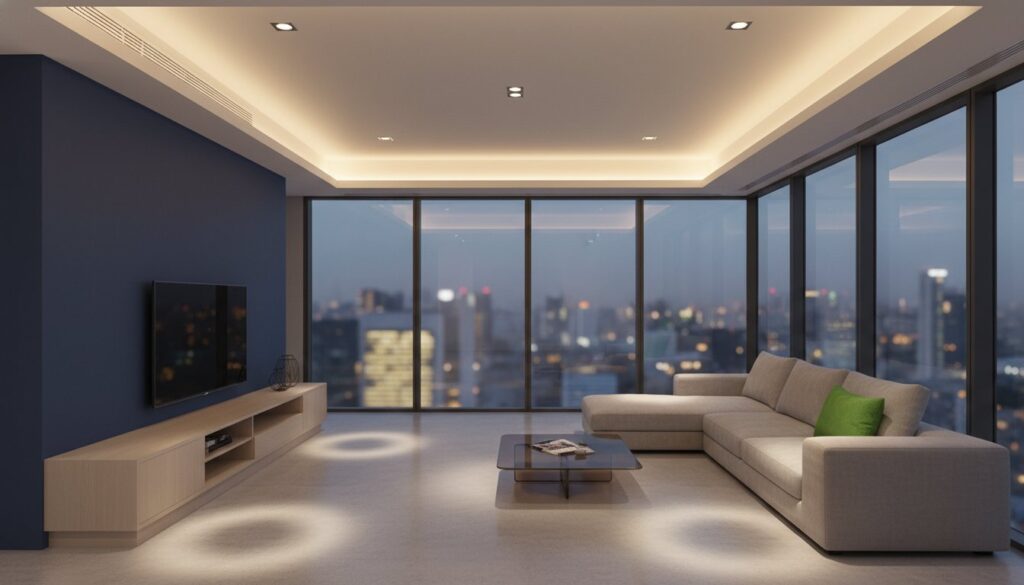
In a typical HDB renovation in Singapore, ceiling height is a major constraint. L-box designs are a pragmatic solution, providing indirect lighting that makes a space feel larger without the bulk of a full false ceiling. We install high-efficacy LED strips within these coves to create a soft, modern glow. This setup is highly efficient because it uses the ceiling as a giant reflector, distributing light evenly across the living area while keeping the hardware hidden and protected.
Zoning Your Home for Efficiency
Technical Installation: Electrical Wiring and Smart Lighting Controls
A high-end fixture is useless if the underlying technical infrastructure is faulty. Implementing energy efficient lighting for homes requires more than just swapping bulbs; it demands a robust electrical load plan. During your home renovation, you must ensure that your wiring can handle modern smart controls and high-quality LED drivers. These drivers are the heart of your system, converting high-voltage AC to low-voltage DC. Cheap transformers lead to flickering and premature failure, undoing any savings you gained from efficient lamps.
Smart Controls and Automation
Dimmers do more than just set a mood. They actively reduce the power draw of your fixtures, extending the lifespan of your LEDs. When planning your renovation, you’ll need to choose between smart bulbs and smart switches. We generally recommend smart switches for full-scale projects. They allow you to control standard high-efficacy fixtures while maintaining manual control at the wall. This provides a more reliable long-term solution than individual smart bulbs, which can be difficult to sync and expensive to replace.
Professional Electrical Installation Standards
All electrical work in Singapore must comply with Singapore Standard SS 638. This regulation ensures the safety and integrity of your home’s wiring. DIY lighting installation is a common mistake that leads to imbalanced loads and fire hazards. You should always verify the credentials of your electrical sub-contractors to ensure they’re licensed and experienced with modern LED systems. If you’re planning a full upgrade, our team provides transparent electrical wiring and installation services as part of our direct contractor model, ensuring your home meets all local safety requirements without hidden markups.
Direct Contractor vs. ID: Saving on Your Lighting Renovation
Choosing a direct renovation contractor Singapore is the most practical way to manage your budget when upgrading to energy efficient lighting for homes. Most interior design (ID) firms operate on a commission-based model, where they add a markup to the fixtures they recommend or charge a percentage for “procurement management.” By working directly with the contractor, you eliminate these middleman fees. You pay for the actual labor and materials used in your project, ensuring every dollar spent goes toward the quality of your hardware and the precision of the installation.
We advocate for a transparent pricing model where you see the breakdown of costs for electrical wiring, labor, and materials. This approach allows you to source your own high-efficacy fixtures while hiring professional installers to handle the technical execution. You avoid the “designer fee” often hidden within standard lighting packages. Direct communication with the electrical team also ensures that your technical requirements, such as driver compatibility and smart hub integration, are met without information getting lost through a third party.
Sourcing Quality Fixtures in Singapore
While online imports might look cheap, they often lack the NEA Mandatory Energy Labelling Scheme (MELS) certification required in 2026. Low-quality drivers found in unrated imports are prone to overheating and early failure. We recommend sourcing from reputable local suppliers who provide clear warranties for both the LED chips and the drivers. A solid warranty for a high-quality fixture should cover at least three to five years of operation. We provide our clients with a curated list of direct material suppliers to ensure they get trade prices without compromising on regulatory compliance.
Streamlining the Renovation Process
Coordinating electrical works with other trades is essential for a seamless finish. We schedule your lighting installation alongside carpentry and painting phases to ensure that LED strips are properly recessed into cabinets and that all wiring is hidden behind false ceilings before the final coat of paint. This process avoids the need for costly hacking or touch-ups later. Our final handover includes a checklist to verify that all dimmers, sensors, and smart controls are functioning at peak efficiency. This methodical approach guarantees that your home is not only aesthetically pleasing but also fully optimized for long-term energy savings.
Future-Proof Your Home with Smarter Lighting Solutions
Upgrading your property doesn’t have to be a confusing or overpriced experience. By focusing on technical specifications like luminous efficacy and adhering to the 2026 MELS standards, you ensure your renovation remains compliant and cost-effective. Implementing energy efficient lighting for homes is a pragmatic necessity that pays for itself through reduced utility bills and lower heat loads on your air-conditioning system. You’ve seen how strategic zoning and smart controls can cut waste, and how the direct contractor model protects your budget from unnecessary middleman markups.
We provide a straightforward, no-nonsense approach to electrical work. As HDB-registered contractors, we focus on safe, high-quality installations that integrate seamlessly with your custom carpentry. You get transparent, direct-to-owner pricing without the hidden designer commissions that inflate project costs. It’s time to take control of your home’s performance and long-term value. You can achieve a bright, modern aesthetic without compromising on functional efficiency or financial transparency.
Get a Transparent Quote for Your Energy-Efficient Lighting Installation Today and start building a more efficient, well-lit home for the future.
Frequently Asked Questions
What is the most energy-efficient light bulb for a Singapore home?
LED lamps with a 3-tick NEA rating are currently the most efficient choice for residential use. Since July 2026, all bulbs sold locally must meet strict Minimum Energy Performance Standards (MEPS) under the Mandatory Energy Labelling Scheme. High-quality LEDs convert almost all power into light rather than heat, which is essential for maintaining a cool environment in Singapore’s tropical climate.
How much can I actually save on my electricity bill by switching to LEDs?
You can reduce your lighting-related power consumption by up to 90% compared to traditional incandescent bulbs. With the June 2026 electricity tariff at 29.72 cents per kWh, these savings add up quickly for any household. Since lighting accounts for roughly 15% of a typical home energy bill, switching to energy efficient lighting for homes provides a clear financial return within the first year.
Do I need a permit for changing lighting fixtures in an HDB flat?
You don’t need a specific HDB permit to replace existing light fixtures or swap bulbs. However, any new electrical wiring, relocation of points, or installation of new false ceilings must be performed by a licensed professional. All works must comply with Singapore Standard SS 638. If your lighting project involves hacking walls, this must be included in your overall renovation permit application.
What is the difference between warm white and cool white LEDs?
The difference lies in the color temperature measured in Kelvins. Warm white (2700K to 3000K) has a yellowish glow suitable for relaxing areas like bedrooms. Cool white (4000K to 5000K) is brighter and more clinical, making it better for task-oriented zones like kitchens or study nooks. Choosing the right temperature ensures your home is functional without needing excessive, high-wattage fixtures in every room.
Are smart lights more energy-efficient than standard LED bulbs?
Smart lights use a small amount of standby power, but they save more energy through better management. Features like dimming and automated schedules prevent lights from running at full brightness or staying on in empty rooms. When integrated correctly, smart controls can cut your lighting waste by an additional 30% compared to standard manual switches, making them a very pragmatic investment.
How long do LED lights typically last in Singapore’s humid climate?
Quality LED fixtures typically last between 25,000 and 50,000 hours in local conditions. Singapore’s high humidity can sometimes affect the electronic drivers rather than the LED chips themselves. We use high-grade transformers and ensure proper ventilation within false ceilings to prevent heat buildup. This technical precaution prevents the primary cause of premature LED failure in our regional environment.
Why do my energy-efficient LED lights flicker?
Flickering is usually caused by an incompatible dimmer switch or a low-quality LED driver. LEDs require a steady DC current, and cheap transformers often struggle to provide this consistently. If you’ve recently upgraded to energy efficient lighting for homes and notice strobing, it’s likely a technical mismatch. Replacing the driver with a high-quality, regulated version usually solves the issue immediately.
Can I install energy-efficient lighting myself or do I need a contractor?
While you can swap a basic light bulb yourself, any project involving new wiring, L-box installation, or smart hubs requires a professional. A contractor ensures your electrical load is balanced and all fixtures are securely mounted according to local regulations. This is especially important for HDB and Condo renovations where fire safety is a priority. Professional installation also ensures your manufacturer warranties remain valid.