

Most homeowners in Singapore end up paying 20% to 30% more than necessary because of hidden middleman markups disguised as “management fees.” You’ve likely realized that calculating a realistic renovation cost singapore is getting harder as material prices and labor rates continue to fluctuate ahead of 2026. It’s frustrating to receive a quote filled with confusing technical jargon only to have hidden costs appear once the hacking starts. We know you want a home that’s built well without paying for someone else’s fancy showroom overheads.
This guide helps you master your 2026 renovation budget with transparent price breakdowns for essential works like masonry, carpentry, and tiling. We’ll show you how to avoid unnecessary commissions by working directly with the source. You’ll gain a clear list of component costs and professional strategies to build a reliable budget buffer. Whether you’re moving into a new HDB BTO or refreshing a resale flat, this layout gives you the confidence to manage your project without the typical financial stress. We’re cutting through the noise to give you the facts you need for a successful, cost-effective build.
Key Takeaways
- Understand how the 9% GST and global supply chain shifts have redefined the local pricing landscape for 2026.
- Get a transparent breakdown of the current renovation cost singapore homeowners can expect across HDB, condo, and landed properties.
- Learn why masonry and custom carpentry are the primary drivers of your budget and how to calculate costs based on material choice and linear footage.
- Discover how to eliminate 20-30% in middleman markups by bypassing traditional interior design fees and working directly with a contractor.
- Master strategic planning techniques, including setting a realistic contingency buffer and prioritizing high-value built-in works for long-term property value.
Understanding the 2026 Renovation Landscape in Singapore
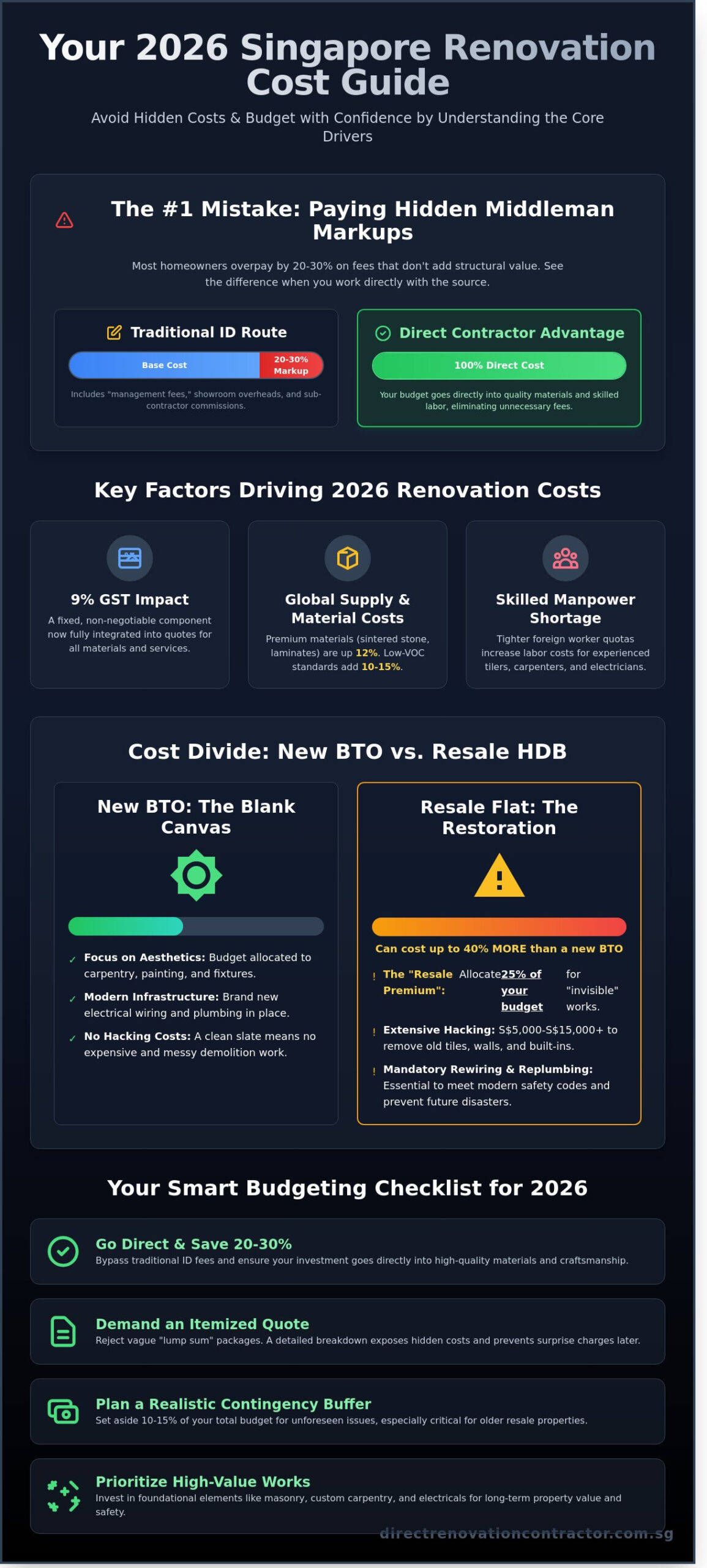
In 2026, calculating your renovation cost singapore requires more than a simple price-per-square-foot estimate. It’s the total investment needed to bring a property up to modern safety and functional standards. The 9% GST is a fixed reality now. Global supply chain shifts have also permanently raised the floor for material prices. You’ll find that labor for skilled trades like masonry and carpentry is the biggest part of your bill. This is why many homeowners now choose a direct-to-contractor model. They want to avoid the 20% to 30% markups often added by interior design firms for project management and “design fees” that don’t add structural value.
Macro Factors Influencing Your 2026 Quote
Contractor availability depends heavily on current manpower regulations. Tighter quotas for foreign workers mean firms must pay higher levies or offer better local wages to retain skilled tilers and carpenters. These costs pass directly to the consumer. Premium materials such as sintered stone and sustainable laminates have seen price increases of 12% since 2024 due to carbon taxes and shipping adjustments. If a quote looks too low, it’s a red flag. Cheap quotes in 2026 often hide the use of sub-standard glue, low-grade plywood, or multiple layers of sub-contracting that dilute accountability and quality control.
- Manpower Quotas: Higher levies for skilled workers increase the baseline price of masonry and carpentry.
- Material Standards: Sustainable, low-VOC materials are now a market standard but carry a 10% to 15% price premium.
- Transparency: Savvy owners prioritize itemized quotes over “lump sum” packages to avoid hidden sub-contractor markups.
New BTO vs. Resale: The Fundamental Cost Divide
Renovating public housing in Singapore varies wildly depending on the age of the unit. A new BTO is a blank canvas with modern wiring and plumbing already in place. A resale flat is often a liability. Resale units can cost 40% more because you can’t just build on top of old problems. You have to fix them first. This involves full rewiring and replumbing to meet current safety codes and prevent future leaks. Hacking is the most underestimated expense in older units. Removing old floor tiles and heavy built-in wardrobes can add S$5,000 to S$15,000 to your renovation cost singapore before a single new item is installed. The Resale Premium is the cost of restoring structural integrity before aesthetic upgrades.
When you buy resale, you aren’t just paying for a new look. You’re paying to strip the unit back to its raw state. This ensures that your new carpentry doesn’t sit on rotting floorboards or hide outdated electrical circuits that could pose a fire hazard. We recommend allocating at least 25% of a resale budget strictly for these “invisible” works.
Breaking Down the Core Cost Components: From Masonry to Carpentry
Understanding your renovation cost singapore starts with a clear look at the structural and functional work required for your home. Market demand stays strong, with approximately S$47 billion to S$53 billion in construction contracts expected in 2026. This high volume of activity across the island means labor and material prices remain a significant factor, making it vital to prioritize your spending on the following core components.
Masonry and Hacking: The Heavy Lifters
Masonry forms the literal foundation of your interior. If you’re renovating a resale HDB flat, hacking is your first major expense. It isn’t just about the manual labor; it includes the cost of haulage and professional disposal of debris at approved sites. For new BTOs, the focus shifts to floor leveling and screeding to ensure your tiles or vinyl lay perfectly flat without hollow spots.
- Tile Choice: Ceramic tiles are the most affordable, but homogeneous tiles are the industry standard for high-traffic areas because the color is consistent throughout the tile.
- Waterproofing: This is a non-negotiable step in bathrooms and kitchens. We apply a dedicated membrane to prevent leaks that could damage your neighbor’s ceiling below.
- Tile Sizes: Choosing tiles bigger than 600mm x 600mm increases labor costs. Larger tiles are harder to handle and require more precise leveling to avoid “lippage.”
Carpentry: Bespoke Fabrication vs. Modular Solutions
Custom carpentry is typically the largest slice of the budget, priced by the linear foot (pfr). This covers your kitchen cabinets, wardrobes, and TV consoles. The final bill depends heavily on the internal carcass material. Most homeowners opt for plywood with a PVC finish for its moisture resistance, which is superior to cheaper melamine or chipboard options. Hardware also plays a major role; switching from standard hinges to premium soft-close systems like Blum will increase the total but ensures the longevity of your doors. As a direct renovation contractor, we build these pieces in-house to maintain quality control while stripping away middleman markups.
Electrical, Plumbing, and False Ceilings
Technical work is about safety and compliance. For any property older than 25 years, a full electrical rewiring is essential to handle modern power loads and meet current EMA standards. Plumbing costs vary based on whether you’re just replacing fixtures or rerouting stainless steel pipes. Finally, false ceilings are more than just aesthetic; they hide unsightly electrical trunking and aircon pipes. An L-box design is a popular choice for cove lighting, but a simple flat false ceiling is a more cost-effective way to achieve a clean, modern look.
Comparing Property Types: HDB, Condo, and Landed Budgets
The type of property you own is the primary factor that determines your total renovation cost singapore. HDB flats offer the most predictability because of their standardized layouts. This allows contractors to provide BTO packages with transparent, fixed pricing for essential works. For a 3-room HDB in 2026, owners should budget between S$40,000 and S$55,000. A 4-room flat typically ranges from S$50,000 to S$75,000, while 5-room units often start at S$65,000 and can exceed S$95,000 depending on the complexity of the carpentry and masonry.
The HDB Renovation Roadmap
A standard 4-room BTO with minimal carpentry usually costs around S$48,000. If you decide on extensive custom kitchen cabinets and full-height wardrobes in every bedroom, that figure easily climbs toward S$70,000. You must use HDB-registered contractors for these projects. This isn’t just a suggestion; it’s a legal requirement for permit approvals. We handle the submission process to ensure all hacking and electrical works meet HDB’s technical specifications. For a deeper look at these requirements, check out our guide on HDB Renovation in Singapore.
Condominium and Landed Property Nuances
Condo renovations are generally 15% to 25% more expensive than HDBs of a similar size. This price gap exists because of strict Management Corporation Strata Title (MCST) rules. You’ll need to account for a renovation deposit, often S$2,000, and higher logistics costs. Contractors must protect common areas like lift lobbies and corridors daily. Working hours are also limited to weekdays between 9 am and 5 pm, which can extend the project timeline. If you’re working with limited square footage, our advice on Singapore Small Condo Interior Design helps maximize your spend.
The Hidden Costs: Interior Designers vs. Direct Contractors
Understanding why an Interior Designer (ID) quote differs from a contractor’s estimate is crucial for managing your renovation cost singapore. Most ID firms apply a management fee or design fee that ranges from 5% to 15% of the total contract to cover coordination and site supervision. While this offers convenience, it adds thousands of dollars to the final bill. Choosing a direct contractor model eliminates the 20% to 30% middleman markup that typically funds ID firm overheads and sales commissions. You aren’t paying for a flashy showroom or a marketing team; you’re paying for the actual materials and labor used in your home.
The DIY renovation approach involves you taking over the project management role. You’ll work with professional technical support from the contractor to ensure structural integrity while you handle the aesthetic choices. It’s a pragmatic way to save money if you have the time to visit the site and communicate your requirements clearly. Many homeowners find that by removing the ID layer, they can afford higher quality finishes like quartz countertops or custom carpentry that would otherwise be outside their budget.
Where the Markups Hide
Hidden costs often lurk in the referral fee system. When an ID brings you to a tile or lighting boutique, the shop often pays the ID a commission of 10% to 20% on whatever you buy. This cost is baked into the retail price you pay at the counter. Similarly, “free” 3D drawings are rarely free; their production cost is usually distributed across marked-up carpentry and masonry line items. Direct contractors provide factory-direct pricing by removing the sales commission layer.
Is the Direct Model Right for You?
Managing your own renovation requires you to be available for site measurements and timeline coordination. You’ll need to be decisive about electrical points and plumbing positions early in the process. In this model, 3D drawings serve as a technical blueprint rather than just a visual aid, ensuring the workers have a clear guide for execution. If you prefer a hands-on approach and want full transparency on where every dollar goes, this is the most cost-effective route. You can explore how these savings impact your bottom line in this Direct Renovation Contractor Singapore Comparison.
A common misconception is that “direct” means “no design.” Experienced contractors have handled hundreds of HDB and BTO layouts. They offer practical design advice based on what’s physically possible and durable, rather than just what looks good on a screen. This functional expertise helps keep your renovation cost singapore predictable by avoiding complex, non-standard structures that drive up labor prices. For a straightforward, honest breakdown of your project requirements, contact a direct renovation contractor today.
Strategic Budgeting: How to Plan Your 2026 Renovation
Successful budgeting for a 2026 project requires a shift from wishful thinking to technical reality. You need to account for the total renovation cost singapore by setting aside a 15% to 20% contingency buffer. This isn’t optional. Site conditions like uneven floor slabs or aging electrical conduits often appear only after hacking begins. By earmarking this cash upfront, you avoid stressful mid-project scrambles for funds. A direct contractor approach helps keep these costs predictable because you’re paying for actual labor and materials rather than inflated management fees.
Invest your capital where it counts for the long term. Prioritize built-in carpentry and essential masonry over expensive loose furniture. You can buy a designer sofa three years later, but replacing a poorly built kitchen cabinet or fixing leaking pipes behind a wall is a major upheaval. Built-in works increase the functional value of your HDB or condo, making them a smarter financial move. Direct Renovation Contractor Singapore facilitates this by providing factory-direct pricing on essential carpentry, ensuring your money goes into the structural integrity of your home.
Creating Your Renovation Checklist
- Step 1: Define “Must-haves” vs. “Nice-to-haves.” Essential rewiring, plumbing, and waterproofing are non-negotiable for safety and HDB compliance. A fluted feature wall or a marble backsplash is a luxury that can be scaled back if the renovation cost singapore exceeds your initial limit.
- Step 2: Request itemized quotes. Never accept a lump-sum figure. A transparent quote lists every square foot of tiling and every running foot of cabinetry based on actual site measurements. This prevents “hidden costs” from surfacing during the final billing.
- Step 3: Verify credentials. Check for HDB registration and CaseTrust accreditation. Look at actual workmanship in recent 2025 or 2026 projects to ensure the technical skill matches your expectations.
Finalizing Your Choice
Our 3D support packages bridge the gap between technical drawings and your vision. You see exactly how the masonry and carpentry will look before a single tile is laid. This prevents costly rectifications later. For a deeper look at the process, read our Home Renovation in Singapore guide to ensure your project stays on track and within your 2026 budget.
Secure Your Home Investment for 2026
Navigating the renovation cost singapore homeowners face in 2026 requires a focus on technical details rather than abstract design concepts. You now understand how property type and material choices like masonry or carpentry dictate your final spending. By moving away from the middleman model, you can avoid the 20% to 30% markups often added by interior design firms. Focus on HDB-registered standards and practical budgeting to ensure your project stays on track without compromising structural integrity.
Direct Renovation Contractor Singapore provides a straightforward path to your ideal home. We operate as HDB-registered contractors with our own in-house carpentry workshop. This means you benefit from factory-direct pricing and transparent, itemized billing with no hidden fees. We handle the hacking, tiling, and electrical work ourselves to maintain quality control at every stage. You get the technical expertise of a seasoned builder without paying for unnecessary overhead.
Get a Transparent, Direct-to-Contractor Quote for Your 2026 Renovation
Your renovation journey doesn’t have to be a source of financial stress. With the right data and a direct partner, you’ll build a space that’s both functional and cost-effective.
Frequently Asked Questions
How much does a 4-room HDB renovation cost in Singapore in 2026?
In 2026, a standard 4-room BTO renovation cost in Singapore typically ranges from S$45,000 to S$65,000, while resale units often exceed S$85,000 due to extensive hacking. These figures vary based on your choice of carpentry and masonry. By working with a direct contractor, you eliminate the 20% to 30% markup typically charged by design firms for project management.
Is it really cheaper to hire a direct contractor instead of an interior designer?
Hiring a direct contractor is generally 15% to 25% cheaper than engaging an interior designer because you remove middleman commissions. You’re paying for the actual labor and materials rather than 3D renders or design consultations. This approach suits homeowners who have a clear vision and want to manage their own timeline to ensure every dollar goes into the build quality.
What are the biggest hidden costs in a Singapore renovation quote?
The biggest hidden costs often include electrical rewiring, plumbing rectification, and haulage fees for debris removal. For example, a basic quote might omit the S$500 to S$1,500 required for professional cleaning or the costs for protecting your flooring during works. We provide a transparent breakdown of every hacking and masonry item to ensure your final bill matches your initial estimate.
Do I need a renovation loan, and what are the current interest rates in 2026?
Most Singaporean banks offer renovation loans capped at S$30,000 or six times your monthly salary to cover the renovation cost in Singapore. In 2026, interest rates for these loans typically hover between 4.2% and 5.5% per annum. You should compare monthly rest rates and processing fees, which usually cost about 1% of the total loan amount, to find the most cost-effective financing option.
How much should I budget for hacking and masonry in a resale flat?
You should budget between S$15,000 and S$25,000 for hacking and masonry in a standard resale flat. This includes removing old tiles, hacking down non-structural walls, and the subsequent cement screeding or tiling works. Since resale units require more preparation than BTOs, these structural works often consume 30% of your total renovation budget to ensure a level and durable foundation.
Can I renovate my HDB flat without a permit?
You cannot perform any structural changes or major works like floor replacement and wall hacking without a valid HDB permit. Minor tasks like painting or installing window grilles don’t require permits, but anything involving electricity or water usually does. We handle all HDB permit applications for our clients to ensure every modification complies with the latest 2026 building regulations and safety standards.
What is the average duration of a full home renovation in Singapore?
A full home renovation in Singapore takes approximately 8 to 12 weeks to complete from the start of hacking to final handover. BTO units are usually faster, often finishing within 8 weeks, while resale flats take longer because of the demolition phase. We follow a strict process-oriented schedule to minimize delays, ensuring your carpentry and tiling are synchronized for maximum efficiency.
How do I verify if a renovation contractor is HDB-registered?
You can verify a contractor’s status by checking the HDB Directory of Renovation Contractors (DRC) on the official HDB website. This ensures the company is trained in HDB’s specific renovation rules and won’t damage the building’s structural integrity. Every registered firm has a unique license number; ours is readily available for your verification to guarantee we meet all government safety requirements.