

Why should you pay an interior design firm a 20% to 30% markup just to manage phone calls you can handle yourself? Most homeowners in Singapore feel forced into high-priced packages because they fear the complexity of coordinating hacking, masonry, and carpentry on their own. It’s a common anxiety, especially when a single mistake in HDB permit compliance can lead to costly delays or legal fines. You want a high-quality home without the middleman tax, but you need a reliable roadmap to get there.
This diy home renovation guide singapore is designed to give you that exact roadmap for your 2026 project. You’ll learn how to manage your renovation with the authority of a seasoned builder, allowing you to save thousands of dollars by working directly with contractors. We’ll break down a clear step-by-step management framework, from securing MCST approvals to avoiding hidden variation orders during the final handover. By the end of this guide, you’ll have the technical confidence to oversee a renovation that meets strict HDB standards while keeping your budget firmly under control.
Key Takeaways
- Master the project management model using this diy home renovation guide singapore to successfully bypass high-cost ID firms and work directly with skilled tradespeople.
- Identify which structural changes require HDB or MCST permits and learn to read floor plans accurately to avoid costly compliance errors and legal delays.
- Follow a logical, step-by-step workflow that prioritizes the correct sequence of hacking, M&E coordination, and masonry to ensure a smooth project timeline.
- Eliminate hidden middleman markups and learn the technical strategies needed to manage Variation Orders (VOs) and keep your renovation budget strictly on track.
- Bridge the gap between DIY and professional design by utilizing 3D support packages that provide technical clarity without the premium price tag of a traditional firm.
Understanding the DIY Home Renovation Model in Singapore (2026)
In 2026, a diy home renovation guide singapore focuses on the homeowner acting as the principal coordinator rather than a manual laborer. You won’t usually find Singaporean homeowners swinging sledgehammers for hacking works due to strict HDB regulations and safety standards. Instead, DIY now refers to Project Management (PM). You take over the role traditionally held by an Interior Design (ID) firm. This involves scheduling sub-contractors, sourcing materials, and ensuring the technical sequence of the build stays on track. By 2025, data indicated a 15% rise in homeowners choosing this route to combat the rising costs of labor and materials in the local market.
Homeowners are moving away from traditional ID firms because the value proposition has shifted. In the past, IDs were essential for sourcing. Today, digital platforms and direct factory access allow you to find the same suppliers yourself. Managing home improvement projects independently requires a time commitment of roughly 10 to 15 hours per week. You’ll be responsible for site measurements, permit applications, and quality control. It’s a demanding role that rewards those who value financial transparency over convenience.
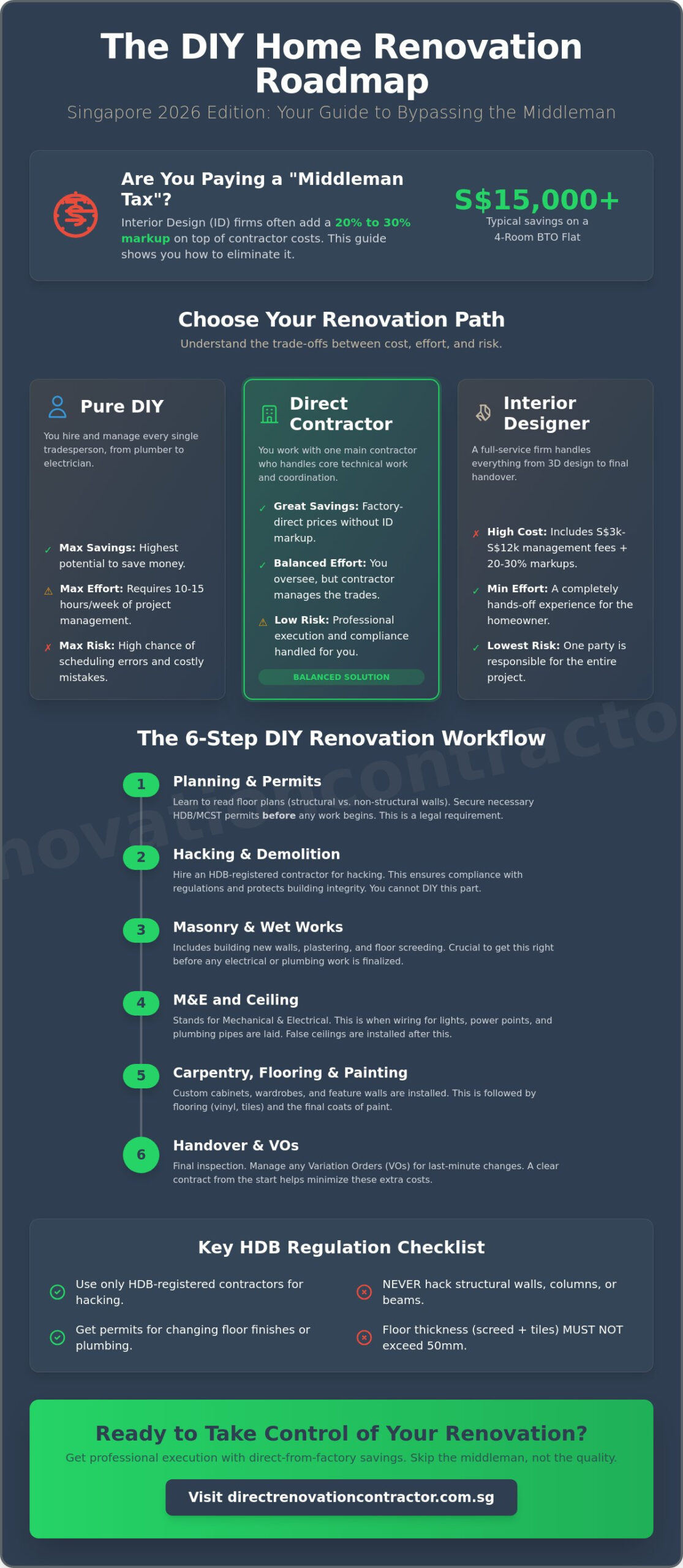
The “Middleman Markup” is the primary reason for this shift. Most ID firms don’t employ their own workers. They hire the same sub-contractors you can find yourself, then add a management fee ranging from S$3,000 to S$12,000. They also frequently apply a 20% to 30% markup on carpentry, masonry, and electrical quotes. By removing this layer, you ensure that your budget goes directly into the materials and workmanship of your flat.
DIY vs. Direct Contractor vs. Interior Designer
An Interior Designer offers a hands-off experience with 3D visualizations and full supervision, but you’ll pay a premium for the service. Pure DIY involves hiring individual tradesmen for every specific task, which offers the most savings but carries the highest risk of scheduling errors. The direct contractor model serves as a middle ground for homeowners who want professional execution without the high-concept design fees. A direct contractor provides a balanced solution by handling the core technical works and basic coordination while passing factory-direct savings to the homeowner.
The Financial Benefits of Managing Your Own Reno
The most immediate benefit is the elimination of hidden coordination fees. When you manage the project, you gain total transparency in material costs. You buy your tiles, vinyl flooring, and bathroom fixtures directly from the suppliers at retail or trade prices. This prevents the common industry practice where intermediaries take commissions from showrooms. On a standard 4-room BTO renovation, these savings often exceed S$15,000. You also avoid inflated costs on carpentry and masonry, as you’re paying the actual factory rate for the fabrication and installation of your cabinets and wardrobes.
Essential Planning: Floor Plans, Permits, and HDB/MCST Regulations
Your floor plan is the blueprint for your entire project. If you’re following a diy home renovation guide singapore, you must learn to read the symbols correctly before buying any materials. Thick, bold black lines indicate structural walls or columns that you cannot touch. Dotted lines or thinner lines usually represent non-structural walls that are eligible for hacking. Getting this wrong can lead to structural damage and heavy fines from the authorities. You should verify every measurement on-site rather than relying solely on the digital copy provided by the developer or HDB.
Before you pick up a sledgehammer, you need a permit. Under the HDB renovation regulations, certain works like hacking walls, changing floor finishes, or relocating plumbing require official approval. In 2026, the HDB e-application process remains the standard, and you must hire an HDB-registered contractor to carry out these works. This isn’t just a suggestion; it’s a legal requirement to ensure the building’s integrity. These professionals understand the exact weight limits for floor slabs and the proper methods for masonry that won’t compromise your neighbors’ ceilings.
Navigating HDB Renovation Guidelines
Hacking load-bearing walls is strictly prohibited. For floor slabs, you can’t exceed a total thickness of 50mm, including the screed and tiles. Approval timelines in 2026 typically take 7 to 14 working days, though complex requests involving structural changes might take longer. For a deeper dive into specific flat types and the latest rules, check out our HDB Renovation in Singapore: The Ultimate 2026 Owner’s Guide. You’ll find that following a diy home renovation guide singapore requires staying updated on these shifting technical requirements to avoid costly stop-work orders.
Condo Renovation: MCST and Insurance Requirements
Private property owners deal with the Management Corporation Strata Title (MCST). You’ll likely need to place a renovation deposit, often ranging from S$1,000 to S$3,000, which is refundable if no damage occurs to common areas like lifts or corridors. Contractors must provide Public Liability Insurance to cover potential mishaps during the project. Most MCSTs restrict work to weekdays between 9:00 AM and 5:00 PM and require lift protection padding to be installed before any materials arrive. You’re also barred from changing the external facade, which includes the color of your balcony railings or window frames. Working with a direct renovation contractor ensures these administrative hurdles are handled professionally, allowing you to focus on the creative aspects of your home transformation.
The DIY Renovation Workflow: A Step-by-Step Sequence for 2026
Managing a renovation project without a main contractor requires a strict adherence to a logical sequence. If you get the order wrong, you’ll end up paying twice for the same job. This diy home renovation guide singapore breaks down the 2026 workflow into four distinct phases that every homeowner must follow to maintain structural integrity and budget control.
- Phase 1: Hacking and Demolition – This is the messiest stage. It involves stripping the unit to its bare bones, removing old flooring, and knocking down non-load-bearing walls. In Singapore, you must ensure all HDB hacking permits are approved before the first sledgehammer swings.
- Phase 2: M&E Works – Mechanical and Electrical works include all the “behind-the-scenes” infrastructure. You’ll coordinate electricians and plumbers to lay cables and pipes while the walls are still bare.
- Phase 3: Masonry and Tiling – This phase sets the “skin” of the home. It involves floor screeding, waterproofing for bathrooms, and laying tiles or vinyl. This stage is labor-intensive and requires high precision to avoid hollow tiles.
- Phase 4: Carpentry and Finishing – The final fit-out includes installing custom cabinets, wardrobes, and painting. This is when the house finally starts looking like a home.
Many handy Singaporeans DIY-ed renovation projects by acting as their own project managers, specifically focusing on the transition between these phases to avoid downtime. In 2026, labor costs are expected to stay high, so keeping a tight schedule is your best defense against budget creep.
Coordinating Wet Works and Electrical
You must finalize every electrical point before tiling begins. Once the masonry team finishes the walls, adding a new socket becomes an expensive nightmare involving hacking and patch-up work. Plumbing essentials for kitchen and bathroom repositioning must also be locked in early. If you’re moving a sink, the floor trap and inlet positions must be set during the hacking phase. The “first-fix” stage involves running all concealed cables through conduits, while the “second-fix” stage occurs after painting when the final switches and sockets are mounted.
Carpentry Fabrication and Installation
The timeline for carpentry is often the biggest bottleneck in a diy home renovation guide singapore. Site measurements can only happen after masonry is complete because even a 5mm difference in wall thickness affects the fit. After measurement, factory fabrication usually takes 14 to 21 days. It’s vital to have your appliance dimensions ready during the design stage. If your fridge or oven doesn’t fit the carcass, modifications on-site will be messy and costly. For a breakdown of linear footage pricing and how to save by going direct, check out our Carpenter Singapore: The 2026 Guide to Custom Carpentry and Direct Savings.
Budgeting for Your DIY Reno: Eliminating Middleman Markups
Eliminating middleman markups is the primary reason homeowners follow a diy home renovation guide singapore. When you work without an Interior Designer (ID), you remove the 20% to 35% management fee often hidden within individual line items. To build a realistic budget, you must separate labor from material costs. For example, a direct contractor might quote S$3.50 per square foot for labor to lay vinyl, while the material itself costs S$4.00 per square foot. Identifying these costs separately prevents contractors from adding a “buffer” to the material price.
Creating a Detailed Scope of Work
Accuracy starts with an itemized list. You need to account for hacking, masonry, carpentry, and electrical works as distinct categories. Don’t accept lump-sum quotes such as “Kitchen Renovation: S$15,000.” This lack of detail leads to Variation Orders (VOs), which are additional charges for work not specified in the original contract. To avoid budget blowouts, get at least three direct contractor quotes to compare unit rates for specific tasks. You can find comprehensive templates in this Home Renovation in Singapore: A Practical Guide to Planning and Execution in 2026.
Managing Payments and Milestones
In Singapore, a standard payment schedule protects your cash flow. Never pay 100% upfront. A common structure involves a 10% deposit, followed by progressive payments of 30% to 40% as milestones like hacking, tiling, or carpentry installation are completed. It’s a pragmatic way to ensure work stays on schedule. Always retain the final 5% of the total contract value until the “defect rectification” period is over. This ensures the contractor returns to fix minor issues like paint chips or misaligned cabinet hinges before they receive the final check.
Ready to skip the ID markups and work with the builders directly? View our direct renovation packages for transparent, factory-direct pricing on your HDB or condo project.
Navigating DIY Challenges with Direct Renovation Support
Managing a project solo is a massive undertaking. The biggest hurdle for most homeowners following a diy home renovation guide singapore is the lack of technical plans. Without 3D drawings, you’re playing a game of telephone with your contractors. Misunderstandings lead to wasted materials and expensive hacking. Professional 3D support packages bridge this gap between a traditional interior designer and a pure DIY approach. They allow you to visualize the final result and provide a clear roadmap for every sub-contractor on site.
The Power of 3D Drawings in DIY Projects
3D visuals prevent communication errors. They show exactly where a socket goes or how a cabinet door opens. You need these drawings for accurate carpentry and electrical placement. For instance, a 5mm error in a floor plan can ruin a custom kitchen layout. Direct Renovation Contractor Singapore provides technical support for DIYers, ensuring your vision translates into buildable plans. This service gives you access to a curated list of reliable sub-contractors, removing the guesswork from hiring. Using a vetted list ensures that every plumber and tiler has a proven track record in local HDB and condo projects.
Final Defect Checking and Rectification
The project isn’t over until the final handover. Conduct a joint inspection with your contractor before making the final payment. Look for common defects in tiling, such as “hollow” sounds or uneven grout lines. In carpentry, verify that hinges are aligned and drawers slide smoothly without resistance. For electrical works, use a socket tester to confirm all points are live and properly grounded. Document every issue. Don’t sign off until rectifications are complete. This step is vital for getting your renovation deposit back from the MCST or HDB. Most HDB renovation permits require a clean site and adherence to structural rules before they release your S$1,000 to S$3,000 deposit. A structured diy home renovation guide singapore approach ensures you don’t leave money on the table.
- Tiling: Use a tapping rod to check for hollow tiles that may crack later.
- Carpentry: Check all laminate edges for peeling or sharp, unfinished corners.
- Electrical: Ensure the DB box is clearly labeled for future maintenance.
- Plumbing: Run all taps for 10 minutes to check for leaks in the waste pipes.
By focusing on these technical details and utilizing professional support for drawings, you eliminate the risks that usually sink DIY projects. Quality workmanship isn’t just about aesthetics; it’s about ensuring your home remains functional and safe for years to come.
Take Control of Your 2026 Home Transformation
Managing a renovation yourself requires a clear roadmap and a commitment to technical accuracy. By 2026, the local market demands even greater transparency in pricing and strict adherence to HDB renovation guidelines. You’ve learned how to navigate floor plans, secure necessary permits, and manage the sequence of work from masonry to electrical installations. This diy home renovation guide singapore highlights that the biggest savings come from eliminating middleman markups and working directly with the source.
We provide the technical backbone you need to succeed. Our team offers direct factory pricing for carpentry and connects you with HDB-registered contractors who provide transparent quotes without hidden fees. With professional 3D documentation, your project management stays on track from the first day of hacking to the final handover. You don’t need to pay for high-concept design fluff when you have the right technical expertise at your fingertips.
Get our DIY Renovation Support Package with 3D Drawings and Direct Contractor Lists Today!
Your vision is achievable when you have the right technical partners by your side. Let’s get to work on building your home the right way.
Frequently Asked Questions
Can I renovate my HDB flat without hiring an interior designer?
Yes, you can manage your own renovation by hiring direct contractors for specific tasks like masonry or carpentry. This approach eliminates the 20% to 30% markup typically charged by interior design firms for project management. You’ll need to coordinate the timeline and handle material procurement yourself. This diy home renovation guide singapore approach works best for homeowners who have a clear vision and the time to oversee site progress daily.
Do I need an HDB permit for all DIY renovation works?
How much can I save by managing my own renovation in Singapore?
Homeowners typically save between 15% and 40% on total project costs by working directly with contractors. These savings come from removing middleman fees and accessing factory pricing for carpentry and masonry materials. For a standard 4-room BTO flat, this can equate to savings of S$10,000 to S$25,000 depending on the scope of work. You retain full control over the budget without paying for design concepts you don’t need.
How do I find reliable direct contractors for tiling and carpentry?
Look for contractors with a physical workshop or factory in Singapore and a valid HDB Registered Renovation Contractor (RRC) license. Check local forums and Google Reviews for feedback from the last 12 months to ensure their current workmanship is consistent. Ask to see photos of their actual completed projects rather than stock images. A reliable contractor provides a detailed quotation with no hidden costs and explains the technical steps of hacking or tiling clearly.
What happens if a DIY renovation project goes over budget?
You must immediately prioritize essential works like electrical and plumbing over aesthetic upgrades if your funds run low. Set aside a 10% contingency fund at the start to cover unforeseen issues like structural repairs or material price hikes. If the budget breaks, pause non-essential carpentry or feature walls until more funds are available. Managing your own project allows you to make these hard choices directly without paying a coordinator’s commission on the extra spend.
Are 3D drawings necessary if I am managing the project myself?
3D drawings aren’t strictly necessary, but you do need detailed 2D technical site plans for your contractors to follow. These plans should specify exact measurements for carpentry and the placement of electrical points. Most direct contractors can work from hand-drawn sketches or reference photos if the dimensions are accurate. Using a diy home renovation guide singapore helps you understand that clear communication of technical specs is more important than expensive artistic renders.
How do I handle dispute resolution with direct contractors?
Always use a written contract that outlines the scope of work, payment milestones, and completion dates to prevent disputes. If a conflict arises, refer to the signed agreement and discuss the technical issue directly on-site. For unresolved matters, Singapore homeowners can seek mediation through the Consumers Association of Singapore (CASE) or the Singapore Mediation Centre. Keep all records of WhatsApp conversations and invoices as evidence of your agreed terms.
What is the typical timeline for a DIY HDB renovation in 2026?
A DIY renovation for a standard BTO flat usually takes 8 to 12 weeks to complete. This timeline includes 2 weeks for hacking and masonry, 3 weeks for carpentry fabrication, and 2 weeks for final installations and painting. Resale flats may take an additional 4 weeks due to extensive demolition and surface preparation. You must factor in a 14-day buffer for potential delivery delays or permit approvals to keep the project on track.