
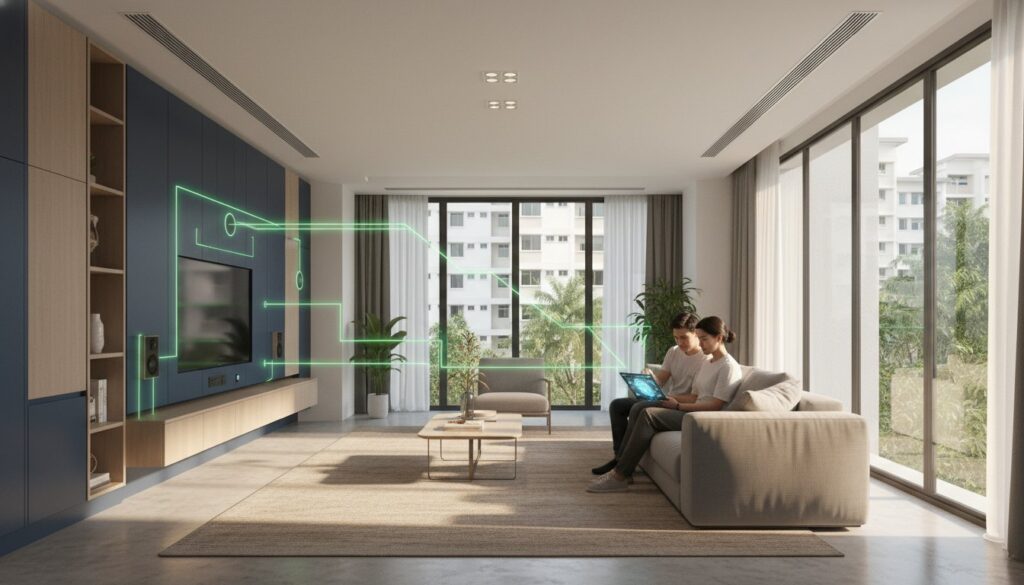
Buying expensive gadgets won’t give you a smart home if your basic infrastructure is flawed. Most homeowners focus on the latest devices while ignoring the electrical foundation required for stability. You’re likely worried about whether Zigbee or Matter is the right choice, or if your Wi-Fi will struggle with those thick HDB concrete walls. It’s a common concern, especially when you see interior designers charging high markups for simple tech setups. We understand that you want a reliable system without the unnecessary middleman fees. This guide simplifies the process of smart home installation for bto flats by focusing on technical competence and direct coordination.
You’ll learn how to plan a future-proof setup that integrates seamlessly into your renovation timeline. We explain why hiring a Licensed Electrical Worker (LEW) is mandatory for compliance with Singapore Standard SS 638 and how to position hardware to overcome signal interference from reinforced concrete. This article provides a clear roadmap for a cost-effective, stable system that gives you total control over your lights, air-con, and security.
Key Takeaways
- Learn why Zigbee and Thread protocols offer superior stability over Wi-Fi when navigating the thick reinforced concrete walls typical of HDB construction.
- Master the technical requirements for smart home installation for bto flats, specifically the importance of neutral wires for consistent smart switch performance.
- Discover how to coordinate with carpentry and false ceiling works to conceal hubs, drivers, and power bricks for a clean, professional finish.
- Identify the strategic placement of LAN data points during the wiring phase to ensure lag-free 4K streaming and gaming in every room.
- Save 20-30% on your total setup cost by working directly with a contractor to eliminate interior designer markups and ensure technical accountability.
Understanding Smart Home Ecosystems for HDB BTO Flats
Successful smart home installation for bto flats starts with choosing a central “brain” that won’t become obsolete in three years. By 2026, the industry has shifted toward ecosystem-agnostic setups. This means you aren’t locked into a single brand’s hardware. Whether you prefer the simplicity of Apple Home, the voice integration of Google Home, or the deep customisation of Home Assistant, your infrastructure must support cross-platform communication. Understanding smart home ecosystems is the first step in avoiding a fragmented system where your lights don’t talk to your air-con. A professional setup relies on a dedicated gateway or hub to manage these connections locally rather than through the cloud.
Zigbee vs. Wi-Fi: Why it Matters in a BTO
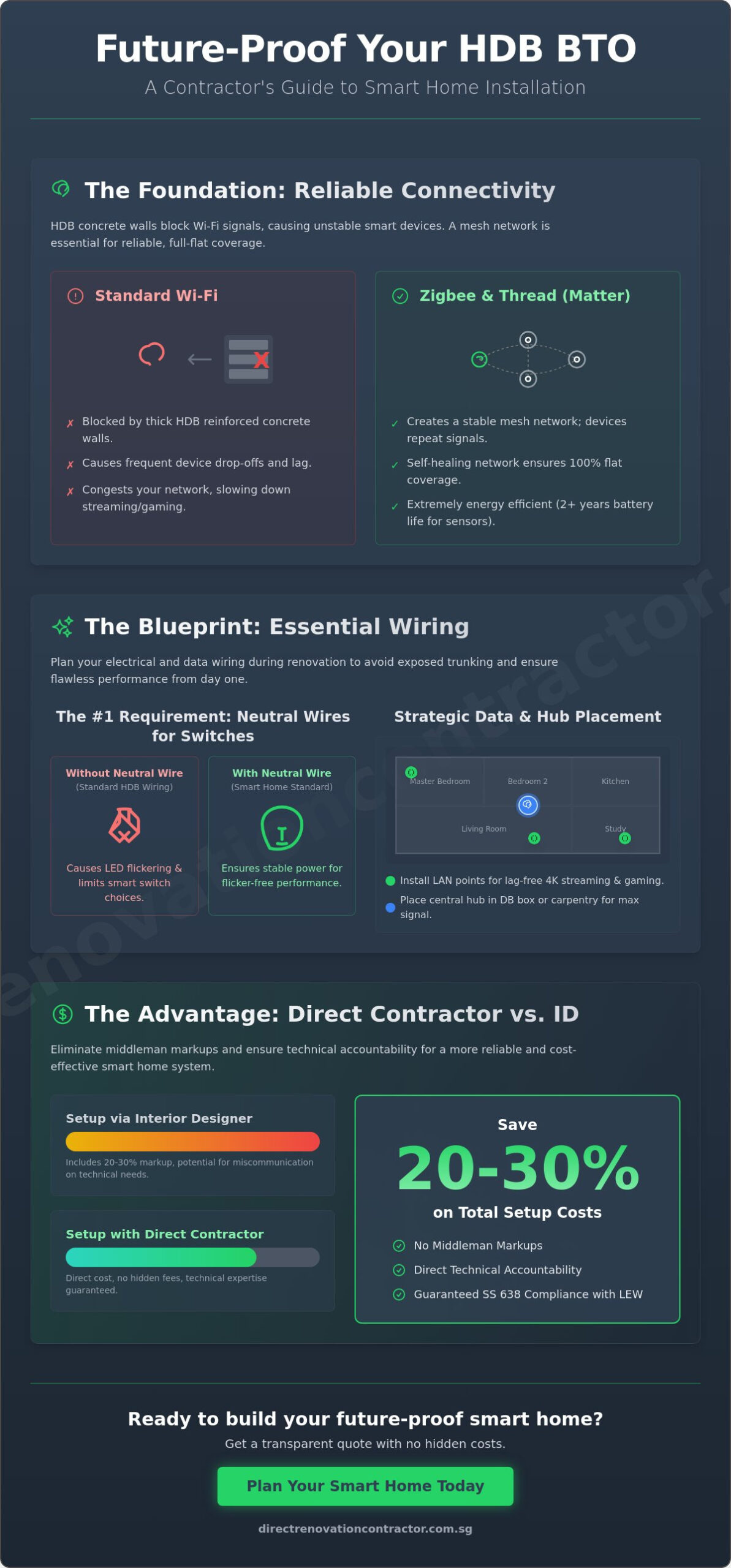
HDB flats present a specific technical hurdle: reinforced concrete. These thick structural walls are notorious for blocking Wi-Fi signals. If you rely solely on Wi-Fi for your smart switches and sensors, you’ll experience frequent device drop-offs as your router struggles to penetrate the kitchen or bedrooms. We recommend Zigbee for a stable smart home installation for bto flats. Unlike Wi-Fi, where every device competes for router bandwidth, Zigbee creates a mesh network. Each powered device acts as a signal repeater. This ensures full-flat coverage without congesting your internet. Zigbee sensors are also incredibly energy efficient; many door sensors or buttons can run for over two years on a single coin battery.
The 2026 Standard: Matter and Thread
The introduction of Matter has effectively ended the compatibility war between tech giants. If a device is Matter-certified, it will work with your chosen ecosystem regardless of the manufacturer. This simplifies the procurement process for your renovation. Thread is the modern networking protocol that carries Matter data. It creates a self-healing network within your home. If one smart bulb fails, the system automatically reroutes the signal through another device to maintain connectivity. This is the gold standard for future-proofing. When you invest in Thread-enabled hardware today, you ensure your devices remain functional and secure well into 2030. It’s a pragmatic choice for homeowners who value technical longevity over flashy, short-lived gadgets.
The physical hub remains the most critical component. It’s the hardware that bridges your Thread or Zigbee devices to your home network. We typically plan for this hub to be centrally located, often concealed within custom carpentry or the DB box area. This placement ensures the strongest possible signal reach across the entire floor plan. Local processing through a hub also means your automation schedules, like evening lighting scenes, will trigger even if your internet service provider has an outage. Reliability is the hallmark of a contractor-led installation.
Essential Wiring and Infrastructure for a Reliable Smart Home
A smart home is only as reliable as the electrical and data infrastructure hidden behind your walls. While wireless protocols like Zigbee handle low-bandwidth sensors well, your heavy-duty smart home installation for bto flats requires a robust wired foundation. Skipping the planning of your physical wiring during the early stages of your electrical work is a mistake that leads to connectivity drops and unsightly exposed trunking later on. You need to think about power and data delivery before the first coat of paint hits the walls. This proactive approach ensures your tech works as intended from day one.
The Critical Role of Neutral Wiring
The most common technical hurdle in HDB units is the absence of a neutral wire at light switch points. Standard HDB wiring typically only includes a live wire. However, most high-quality smart switches require a neutral wire to stay powered even when the lights are off. Requesting your contractor to pull neutral wires during your home renovation is significantly cheaper than trying to retrofit them once the house is finished. While “no-neutral” switches exist, they often cause LED flickering or require bulky capacitors. For a flicker-free experience and better hardware choices, like those seen in PCMag’s Best Smart Home Products, a neutral wire setup is the pragmatic choice.
Network Infrastructure: Beyond the Router
Relying solely on a single router in the living room is a recipe for dead zones in the master bedroom. HDB concrete walls are dense; they kill Wi-Fi signals efficiently. We recommend pulling LAN cables to the study and living room to support 4K streaming and lag-free gaming. Concealing these data cables within your hdb renovation in singapore ensures a clean look without compromising on speed. Planning for ceiling-mounted Access Points (APs) provides uniform coverage across the entire flat without cluttering your tabletops with mesh nodes. This creates a seamless roaming experience as you move between rooms.
Don’t forget the niche power requirements that often get overlooked. Smart motorized curtains and blinds need a power point near the window head. Similarly, modern robot vacuum docks with auto-empty stations require more space and a dedicated socket in a low-traffic area. Executing a successful smart home installation for bto flats depends on these small details. If you’re unsure about the placement of these points, consulting a specialist for electrical wiring and installation early in the design phase will save you from using messy extension cords later. Proper placement of these points ensures your smart home remains functional and aesthetically pleasing.
Top Smart Home Features to Prioritise for BTO Units
Selecting the right features for your smart home installation for bto flats shouldn’t be about buying every gadget on the shelf. It’s about selecting systems that solve specific HDB living challenges, such as rising electricity costs or the inconvenience of manual routines. We prioritize functionality and long-term reliability over novelty. A well-planned setup focuses on lighting, climate control, and security to create a home that works for you without constant troubleshooting. Focusing on these core areas ensures you get the best return on your investment.
Smart Lighting and Switches
Smart switches are the pragmatic choice for most homeowners. Unlike smart bulbs, which lose their connectivity if the physical wall switch is turned off, smart switches keep your lighting system connected at all times. This allows you to create useful “Scenes.” You can set a “Leaving Home” scene that kills every light in the flat with one tap or a voice command. For corridors and bathrooms, we recommend integrating motion sensors. These enable “walk-through” lighting, ensuring your path is lit at night without you fumbling for a switch. It’s a simple, effective way to improve safety and convenience while reducing unnecessary power usage.
Climate and Energy Management
Cooling is the biggest energy drain in Singapore. You don’t need to buy expensive, native smart air-conditioners to get intelligent control. IR blasters are a cost-effective alternative. These small devices mimic your remote control’s signal, allowing you to automate your existing air-con units via your smart hub. You can program your system to turn off the air-con automatically when the last person leaves the flat. Integrating automated blinds is another smart move for any smart home installation for bto flats. By scheduling blinds to close during the peak afternoon sun, you prevent heat soak in your living room. This reduces the load on your air-con and slashes your monthly utility bills. Most modern systems allow you to monitor this real-time energy usage through a single dashboard.
Integrating Smart Tech with Your BTO Renovation Works
The biggest mistake homeowners make is treating technology as an afterthought. Many online forums suggest a DIY approach after you move in, but this often results in unsightly plastic trunking and visible wires. A professional smart home installation for bto flats requires deep integration with your renovation timeline. By coordinating tech requirements during the hacking and carpentry phases, you ensure that every hub, sensor, and power brick remains completely hidden. This level of planning creates a clean, minimalist aesthetic that is impossible to achieve once the painting is finished.
Smart Tech and Custom Carpentry
Custom furniture provides the perfect opportunity to conceal the “brains” of your home. When working with a carpenter singapore, you should design TV consoles with ventilated compartments. Smart hubs and network switches generate heat; they need airflow to prevent hardware failure. We also recommend building concealed charging stations inside wardrobes or kitchen cabinets to keep surfaces clutter-free. For a premium look, integrate LED strips directly into your cabinetry. By installing smart drivers behind removable panels, you get automated cabinet lighting that triggers when doors open, without any visible wiring.
Ceiling and Masonry Integration
False ceilings are your best friend for a stable wireless network. While we previously discussed the strength of Zigbee, placing repeaters inside the false ceiling further improves signal distribution across the flat. You can also use these voids to install recessed motion sensors. These “invisible” sensors are far more aesthetic than bulky battery-operated units stuck to walls with adhesive tape. Additionally, you must factor smart curtain tracks into your window pelmet designs early. Motorized tracks are wider than standard ones and require a dedicated power point. Failing to plan for this space during the masonry or partition stage will leave you with curtains that don’t fit or wires dangling near your windows.
Kitchen safety is another area where early integration pays off. We recommend installing smart gas detectors and water leak sensors near the sink and stove. These devices can be wired into your main power during the kitchen renovation to avoid battery changes. If a leak is detected, the system can automatically shut off the water valve or alert your phone immediately. This pragmatic approach to safety is a core part of a modern smart home installation for bto flats.
Success depends on a unified timeline. You need a team that understands how electrical wiring, carpentry, and tech setup overlap. Coordinating these moving parts is much simpler when you work with a direct renovation contractor singapore who handles the entire execution. This ensures that the person drilling the holes knows exactly where the data cables and smart drivers need to go. If you want a home that is both smart and structurally sound, contact us for a direct carpentry and electrical quote today.
Why Use a Direct Contractor for Smart Home Installation?
Choosing the right partner for smart home installation for bto flats often comes down to who actually does the work. Many homeowners default to their interior designer (ID) for tech integration, but this often adds a layer of management fees without adding technical value. A direct contractor model prioritizes functional results and financial clarity. You deal directly with the electricians and carpenters who execute the physical installation. This ensures your smart home is built on a foundation of technical competence rather than high-concept artistic visions that might lack structural feasibility. It’s a straightforward approach that values quality workmanship over flashy presentations.
Cost Savings and Transparency
Working with a direct contractor allows you to eliminate the typical 20-30% markup that IDs apply to hardware and labor. We provide unmarked-up pricing on smart switches, sensors, and hubs. Instead of offering vague “smart home bundles” that hide the individual cost of components, we provide itemized electrical quotes. This transparency helps you see exactly where your money goes. You avoid the “tech tax” often added by design firms who simply outsource the technical work to a third party. You get the same high-quality hardware at a price that reflects the actual labor and material costs, ensuring your budget is spent on better equipment.
Seamless Execution and Support
A successful smart home installation for bto flats requires an electrician who understands the nuances of modern protocols. Since our team handles both the structural electrical wiring and the tech setup, there is no finger-pointing if a switch fails to connect. We ensure all work complies with the Singapore Standard SS 638. This is the Code of Practice for Electrical Installations. Having one point of contact for structural, electrical, and tech issues simplifies the renovation process. If you need to adjust the position of a sensor or a concealed hub in your custom cabinetry, the communication is direct and immediate. There are no middlemen to relay messages or inflate costs.
Our approach is based on your specific needs, not a fixed package designed for a generic showroom. We provide direct access to technical expertise, helping you build a system that is reliable and future-proof. This straightforward communication rhythm creates a sense of order. It ensures your BTO makeover is completed on time and within budget. By cutting out the middleman, you invest your budget into better hardware and more skilled labor. This is the most pragmatic way to achieve a seamless, reliable smart home in 2026. We take technical accountability for every wire and hub we install.
Build Your Future-Ready BTO with Technical Confidence
We bring over 20 years of experience as HDB-registered contractors to every project. Our specialized electrical team understands the nuances of smart home wiring, ensuring your setup complies with all local safety standards without undisclosed fees. You don’t have to navigate complex tech protocols alone or overpay for simple installations. We focus on functional results and fair pricing to help you achieve a seamless living experience from day one. Build a home that works for you, supported by a team that values technical competence over flashy presentations.
Get a Transparent Quote for Your Smart BTO Renovation and start planning your setup today. Your future home is just a few practical decisions away.
Frequently Asked Questions
Do I need a neutral wire for smart switches in my BTO flat?
You should request neutral wiring during your electrical installation for the best results. Most high-performance smart switches require a neutral wire to maintain a constant power supply for their internal radios. While no-neutral switches are available, they often cause LED flickering or require the installation of bulky capacitors. Pulling neutral wires during the initial renovation is a pragmatic step that ensures long-term stability and a wider choice of hardware.
Can I install a smart home system in an HDB flat without a major renovation?
You can certainly implement a smart system using wireless protocols without hacking your walls. Modern devices using Zigbee or Matter-over-Thread are designed for modular, non-invasive setups. You can start with smart bulbs, plug-in gateways, and battery-operated sensors. However, a renovation provides the only opportunity to conceal wiring for motorized curtains and integrated wall switches, which results in a much cleaner and more professional finish.
Which is better for HDB flats: Zigbee, Wi-Fi, or Matter?
Zigbee and Thread are superior to Wi-Fi for HDB layouts because they create a mesh network that penetrates reinforced concrete walls more effectively. Matter is the 2026 industry standard that ensures these devices work across different ecosystems like Apple Home and Google Home. For a reliable smart home installation for bto flats, we recommend choosing Matter-certified devices that utilize Thread to ensure your system is both stable and future-proof.
How much does a basic smart home installation for a BTO cost?
Industry data shows that basic smart home packages for lighting typically start at approximately S$899. For a more comprehensive entry-level setup covering a few rooms with lighting and air-conditioning control, homeowners usually spend between S$1,500 and S$4,000. A full-home installation for a 3 or 4-room flat, including security and automated curtains, generally ranges from S$3,000 to S$5,000 depending on the device count.
Do smart home devices use a lot of electricity?
Smart devices use a negligible amount of electricity as they are designed for low-power operation. Most sensors run for over two years on a single coin battery because they only transmit data when triggered. In practice, a smart home installation for bto flats often reduces overall energy consumption. Features like automated air-con shut-off and motion-sensing lights prevent electricity wastage, leading to lower monthly utility bills over time.
Will my smart home still work if the internet goes down?
Your local automations will still function if your setup includes a local hub or gateway. While you’ll lose the ability to control devices remotely via your smartphone, scheduled events and sensor-based triggers continue to work within the flat. This local processing is a critical safety feature of professional systems. It ensures your lights and security features remain operational even during a service provider outage.
Is it safe to use smart locks for HDB gates and doors?
It is safe and fully permitted by HDB regulations. Homeowners don’t need prior approval for smart door locks or viewers. These devices use advanced encryption standards to protect against unauthorized access. If you install an associated CCTV camera, you must ensure it doesn’t face your neighbor’s door or windows. For installations in common corridors, it’s a good practice to consult your Town Council first.
Can I integrate my existing air-con into a smart home system?
You can integrate almost any existing air-con unit using infrared (IR) blasters. These devices mimic your remote control’s signals, allowing your smart hub to manage cooling schedules and temperature settings. This is a highly cost-effective alternative to buying native smart air-conditioners. It allows you to include climate management in your smart home installation for bto flats without the expense of replacing perfectly functional cooling hardware.