
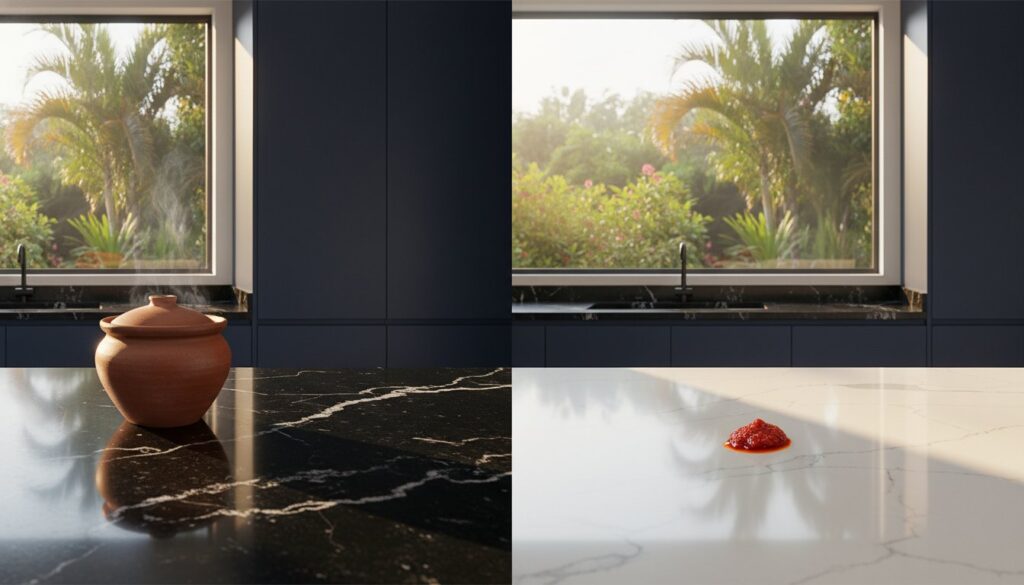
Your choice of kitchen surface shouldn’t be based on a glossy brochure or an interior designer’s recommendation that includes a hidden commission. In a typical Singaporean home, the real test of a material happens when you spill turmeric or place a hot claypot directly on the counter. Understanding the quartz vs granite countertop pros and cons is essential because the wrong decision can lead to permanent stains or expensive heat cracks within the first year of your renovation.
We know you want a kitchen that looks high-end but remains practical for heavy daily use. It’s frustrating to pay premium prices only to worry every time you cook a family meal or deal with the anxiety of sambal stains. This guide provides a transparent comparison of these two popular materials, focusing on technical durability and actual maintenance requirements in our local climate. We’ll show you how to achieve a luxury finish while sticking to a pragmatic budget.
By the end of this article, you’ll know exactly which material fits your cooking style and how to secure direct contractor pricing without middleman markups. We will look at stain resistance, heat tolerance, and the latest 2026 market trends for HDB and condo owners to ensure your countertop lasts as long as your home.
Key Takeaways
- Learn the technical quartz vs granite countertop pros and cons to decide if you need the heat resistance of natural stone or the stain-proof nature of engineered quartz.
- Match your countertop material to your specific cooking habits, identifying whether you need a surface for heavy “wok hei” frying or one for low-maintenance daily cleanup.
- Understand why the “Turmeric Test” is a dealbreaker for many Singaporean kitchens and which material prevents permanent sambal stains without the need for annual sealing.
- Save on your kitchen renovation by learning how to bypass the 20-40% markups typically added by interior designers to stone quotes.
- Access a practical checklist for your final selection, including the best local industrial yards to visit to inspect full slabs before you commit to a purchase.
Understanding Quartz and Granite in the 2026 Singapore Kitchen
Choosing a countertop is a 15-year decision for most HDB and condo owners. You shouldn’t make this choice based on a fancy 3D render or a recommendation from an interior designer who might be collecting a commission on the material. In 2026, savvy homeowners are increasingly bypassing the middleman. They go straight to the stone yards in Ubi or Sungei Kadut to inspect raw slabs. Understanding the quartz vs granite countertop pros and cons starts with a clear-eyed look at the materials themselves. Granite is a 100% natural igneous rock, while quartz is a manufactured product designed to solve specific household problems.
These two materials dominate the local market because they balance aesthetics with the technical requirements of a high-heat, high-humidity environment. While newer materials like sintered stone are rising in popularity, quartz and granite remain the practical benchmarks for durability and resale value. By sourcing these directly from a masonry specialist, you ensure that your budget goes toward the quality of the stone rather than undisclosed administrative fees.
The Anatomy of a Natural Granite Slab
Granite is formed deep within the earth over millions of years. This process creates a density that few other materials can match. Because it’s a natural product, no two slabs are identical. If you choose a variety like Black Galaxy or Steel Grey from a local yard, your kitchen will have a unique pattern that cannot be replicated in a factory. This individuality is a major draw for homeowners who want a “one-of-a-kind” luxury feel.
However, granite’s natural origin means it has microscopic pores. These pores can trap liquids if the surface isn’t maintained properly. You’ll need to apply a high-quality sealer periodically to prevent moisture and bacteria from penetrating the stone. In a Singaporean kitchen where oily splatters are common, this maintenance step is a critical factor in the quartz vs granite countertop pros and cons debate. If you neglect the sealing, even a hard stone like granite can suffer from deep-set stains.
The Engineering Behind Modern Quartz
Quartz is often called “engineered stone” because it’s a composite material. It’s typically made of roughly 90% crushed natural quartz crystals held together by a 10% mix of polyester resins and pigments. For a deep dive into the manufacturing process, Understanding Engineered Quartz provides a technical overview of how these components are vibrated and compressed under vacuum to create a dense slab. This engineering process makes quartz completely non-porous.
The resin binder creates a waterproof, bacteria-resistant surface that never requires sealing. This is a massive advantage for busy families who don’t want to worry about a spill sitting on the counter overnight. In 2026, manufacturing advancements have allowed quartz to move beyond basic solid colors. You can now find slabs with realistic marble veining or gritty, industrial concrete textures that offer the look of natural stone without the maintenance baggage. It’s the go-to choice for a minimalist, uniform aesthetic in modern HDB renovations.
The Technical Showdown: Durability, Heat, and Staining
Both materials are exceptionally hard, but they react differently to the daily stresses of a busy kitchen. Understanding the quartz vs granite countertop pros and cons requires looking at their physical limits under pressure. On the Mohs scale, which measures mineral hardness, granite typically ranks between 6 and 7. Quartz usually sits at a solid 7. This means both surfaces are highly resistant to scratches from standard kitchen knives. However, impact resistance is a different story. If you drop a heavy cast-iron skillet on the edge of a granite slab, it’s more likely to chip than quartz. Quartz has a slight advantage here because the resin binder gives it a touch of flexibility that natural stone lacks. For a deeper look at the science behind these materials, this Geologist’s Perspective on Durability explains how their molecular structures differ.
Heat Resistance: The Achilles Heel of Quartz
This is where quartz often loses its edge. The polyester resins used to bind quartz crystals together cannot handle extreme heat. If you place a pot straight from the stove onto a quartz surface, the temperature can exceed 150°C. This can cause the resin to discolor, leaving a permanent burn ring, or even cause the slab to crack from thermal shock. Granite is a volcanic rock born from intense heat, so it handles hot pots with ease. Even so, we always tell our clients to use trivets. It’s a simple habit that protects your investment regardless of the material’s properties.
Stain Protection and Porosity
In a Singaporean kitchen, the “Turmeric Test” is the ultimate benchmark. Turmeric, sambal, and red wine are notorious for leaving permanent marks. Quartz is the clear winner for stain protection because it’s completely non-porous. You can leave a spill and wipe it away later with no trace. Granite requires more vigilance. Because it’s a natural stone, it has tiny pores that can absorb liquids. You’ll need to seal it at least once a year to maintain its resistance. You can tell it’s time for a new seal if water stops beading on the surface and starts soaking into the stone. If you’re looking for a hassle-free experience, quartz is the wipe-and-go champion.
Durability isn’t just about the stone; it’s about the structural support underneath. If your kitchen cabinets aren’t perfectly level, the weight of a heavy slab can cause structural cracks over time. This is why we emphasize the importance of professional masonry and carpentry. If you are planning a full kitchen overhaul, choosing an experienced direct renovation contractor ensures your countertops are installed on a reinforced, level base that prevents these avoidable issues.
Lifestyle Compatibility: Matching Stone to Your Cooking Habits
Your property type and cooking frequency determine the winner in the quartz vs granite countertop pros and cons debate. If you live in an HDB, you must consider structural weight limits before installing thick natural stone slabs. While most modern units handle standard stone thickness easily, older resale flats require careful assessment to ensure the floor loading remains within safety limits. You can find more details on these specific regulations in our HDB Renovation in Singapore: The Ultimate 2026 Owner’s Guide. Beyond structural rules, your daily kitchen workflow is the most important factor in your choice.
The Best Countertop for Asian Culinary Styles
Aesthetics vs. Functionality in Small Spaces
In a compact BTO or condo kitchen, visual clutter makes the space feel cramped. Granite often features “busy” or “speckled” patterns that can overwhelm a tight galley layout. Light-colored, minimalist quartz makes a small area feel brighter and more expansive. If you’re struggling with a tight floor plan, check out our guide on Singapore Small Condo Interior Design for practical space-saving ideas. For social cooks who host dinner parties, the uniform look of quartz provides a sleek, modern backdrop. It requires much less effort to clean after guests leave compared to granite, which might need a specialized stone cleaner to maintain its shine. Balancing these quartz vs granite countertop pros and cons ensures your kitchen remains functional and durable for your specific lifestyle.
Cost Comparison and the Direct Contractor Advantage
Pricing for stone surfaces in Singapore is typically quoted per foot run (pfr) for standard depths or per square foot (psf) for custom islands. When weighing the quartz vs granite countertop pros and cons, homeowners often find that the initial quote is just the starting point. In the 2026 market, entry-level quartz typically ranges from S$100 to S$140 psf, while premium slabs with complex veining can exceed S$200 psf. Granite follows a similar path, starting around S$90 psf for common varieties like Steel Grey, but rare slabs from Brazil or Italy can climb well beyond S$250 psf. These figures represent the material and basic installation, but the final bill often depends on who is managing the project.
Many interior design (ID) firms add a 20% to 40% commission on top of the stone supplier’s price for “coordination fees.” This is an unnecessary expense for the savvy homeowner. Working with a Direct Renovation Contractor Singapore removes this middleman tax. We provide transparent pricing where you pay for the actual material and labor. You should also budget for fabrication details that aren’t always in the base quote, such as mitered edge profiling, backsplash matching, and the specific labor required for under-mount sink cut-outs.
Why Direct Sourcing Saves You Thousands
Direct sourcing isn’t just about lower numbers on a quote; it’s about control. When you bypass an ID, you can visit the stone yards in Ubi or Sungei Kadut yourself to pick the exact slab that will be installed in your home. This is vital for granite, where patterns vary wildly from one block to the next. Our carpenter singapore team coordinates directly with the masonry fabricators. This ensures your kitchen cabinet carcasses are built with the necessary reinforcements to support a 60kg granite slab without sagging or structural failure over time.
Long-term Value: Resale Impact of Stone Choice
Both materials hold their value well in the HDB resale market, but they appeal to different buyers. Quartz is currently the more popular choice for its “like-new” appearance and low-maintenance reputation. However, granite offers better long-term repairability. If a granite counter chips, a skilled mason can often patch it with color-matched epoxy that’s nearly invisible. Quartz is much harder to repair if it suffers a deep burn from a hot pot. From a pragmatic standpoint, granite’s durability often outlasts design trends, whereas specific quartz patterns may look dated after a decade. If you’re ready to upgrade your kitchen with honest, contractor-direct pricing, contact us for a transparent quote today.
Final Verdict: Which Countertop Should You Install?
Choosing between stone surfaces comes down to a trade-off between heat tolerance and maintenance effort. The quartz vs granite countertop pros and cons we’ve discussed show that neither material is universally superior. Your decision should rest on the technical realities of your daily routine. If you prioritize a kitchen that stays pristine with minimal effort, quartz is your best bet. If you’re a high-heat cook who wants a surface that can handle a piping hot claypot without a second thought, granite remains the gold standard. Don’t rely on small 10cm samples provided by an ID. You must visit local stone yards in Ubi or Sungei Kadut to see the full slabs. Natural granite patterns vary wildly across a single piece, and the “veining” in quartz looks different when scaled up to a three-meter counter.
Technical performance also depends on the quality of the supporting structure. A premium granite slab is useless if it’s installed on poorly constructed cabinets that sag under the weight. We ensure that our masonry and carpentry teams work in sync. This hands-on coordination prevents structural cracks and ensures that your sink cut-outs and edge profiles are executed with precision. Choosing a direct contractor means your budget goes into this technical workmanship rather than administrative markups.
The 5-Point Selection Framework
To make your final choice, evaluate these five factors: your total renovation budget, how often you cook with high heat, your willingness to perform annual sealing, your preference for uniform vs. natural patterns, and your property’s weight restrictions. Here is our final assessment for the perfect candidate:
- The Perfect Quartz Owner: You want a minimalist, modern aesthetic and zero maintenance chores after a long workday.
- The Perfect Granite Owner: You’re a culinary enthusiast who values heat tolerance and the raw, unique character of natural earth.
For the typical 2026 HDB BTO owner, quartz is usually the most pragmatic choice. It handles the humidity of Singapore perfectly, makes small kitchens feel brighter, and survives the occasional sambal spill without permanent damage. It’s the most cost-effective way to achieve a premium look while maintaining a low-maintenance lifestyle.
Start Your Direct Renovation Journey
We simplify the renovation process by removing the middleman. When you work with us, you get direct access to technical experts who understand the nuances of local masonry and carpentry. This transparent model allows you to maximize your material quality without exceeding your budget. We don’t hide fees in “coordination” charges. Instead, we focus on delivering high-quality HDB and condo renovation packages that stand the test of time. Contact us today for a straightforward, unmarked-up quote and a professional assessment of your kitchen needs.
Secure the Best Surface for Your 2026 Renovation
Choosing the right material is only half the battle. While the quartz vs granite countertop pros and cons guide your selection between stain resistance and heat tolerance, the quality of your installation determines the final result. You shouldn’t have to settle for thinner slabs or lower-grade stone just to cover an interior designer’s commission. We believe in technical competence and financial transparency, ensuring your kitchen is built to last without unnecessary markups.
Our team specializes in HDB carpentry and masonry, providing the structural support needed for heavy stone surfaces. By working directly with us, you benefit from direct-to-owner pricing and a straightforward project timeline. We handle everything from the initial site assessment to the final installation with a focus on functional quality rather than flashy presentations. It’s time to build a kitchen that works as hard as you do.
Get a Direct Quote for Your Kitchen Renovation today and experience a renovation process free from undisclosed fees. Your ideal kitchen is within reach when you partner with a contractor who values honesty and workmanship above all else.
Frequently Asked Questions
Is quartz better than granite for a heavy-use HDB kitchen?
Quartz is generally better for busy HDB kitchens because it’s completely non-porous and requires zero maintenance. It withstands the daily spills of a family home without needing annual sealing. However, if your heavy use involves daily pounding with a heavy pestle and mortar or placing hot woks directly on the surface, granite’s natural density and heat resistance make it a more durable choice for those specific tasks.
Do quartz countertops stain easily with curry or turmeric?
Quartz countertops are highly resistant to staining from curry, turmeric, or sambal because the resin binder creates a waterproof surface. Unlike natural stone, liquids cannot penetrate the material. If you spill turmeric, you can simply wipe it away with a damp cloth and mild detergent. This stain resistance is a major factor when weighing the quartz vs granite countertop pros and cons for local cooking styles.
How often do I really need to seal a granite countertop?
You should seal your granite countertop at least once every 12 months to maintain its protective barrier. A simple way to check is the water bead test. Pour a few drops of water on the stone; if it doesn’t bead up but instead soaks in and leaves a dark spot, the seal has worn off. Neglecting this maintenance can lead to permanent discoloration from oils and spices.
Can I put hot pots directly on a quartz countertop?
No, you should never place hot pots directly on quartz because the heat can permanently damage the resin binder. Temperatures above 150°C can cause the surface to discolor, yellow, or even develop structural cracks from thermal shock. While granite can handle direct heat better, we always recommend using trivets or heat pads for both materials to ensure your countertop stays in top condition for years.
Why is quartz often more expensive than granite in Singapore?
Quartz is often more expensive because of the complex manufacturing process and the cost of high-quality resins. While common granite varieties like Steel Grey are quite affordable, premium engineered quartz brands carry a higher price tag due to their consistent patterns and specialized textures. When evaluating the quartz vs granite countertop pros and cons, remember that granite prices fluctuate based on the rarity and origin of the natural stone.
Which countertop material is easiest to repair if it chips?
Granite is significantly easier to repair if a chip occurs on the edge or corner. A professional mason can use color-matched epoxy resin to fill the chip and buff it down until it’s nearly invisible. Quartz is much more difficult to patch because its uniform, engineered appearance makes it hard to hide the repair site. For quartz, a major crack or burn often requires replacing an entire section of the counter.
What is the most popular countertop color for Singapore homes in 2026?
Light grey and off-white slabs with subtle, marble-like veining are the most popular choices in 2026. These colors fit the “Japandi” and modern minimalist trends that dominate current BTO and condo renovations. These lighter shades make compact Singaporean kitchens feel more spacious and bright. While dark granite remains a classic for heavy-duty kitchens, the trend has shifted toward the clean, airy look of light-colored engineered stone.
How do I avoid paying extra for my countertop through an Interior Designer?
You can avoid hidden markups by working directly with a renovation contractor instead of an interior design firm. Most IDs don’t own their own workshops; they outsource the masonry and carpentry to specialists and add a commission for the referral. By engaging a direct contractor, you pay the actual trade price for the material and labor. This transparent model ensures your budget goes toward a higher grade of stone rather than middleman fees.